


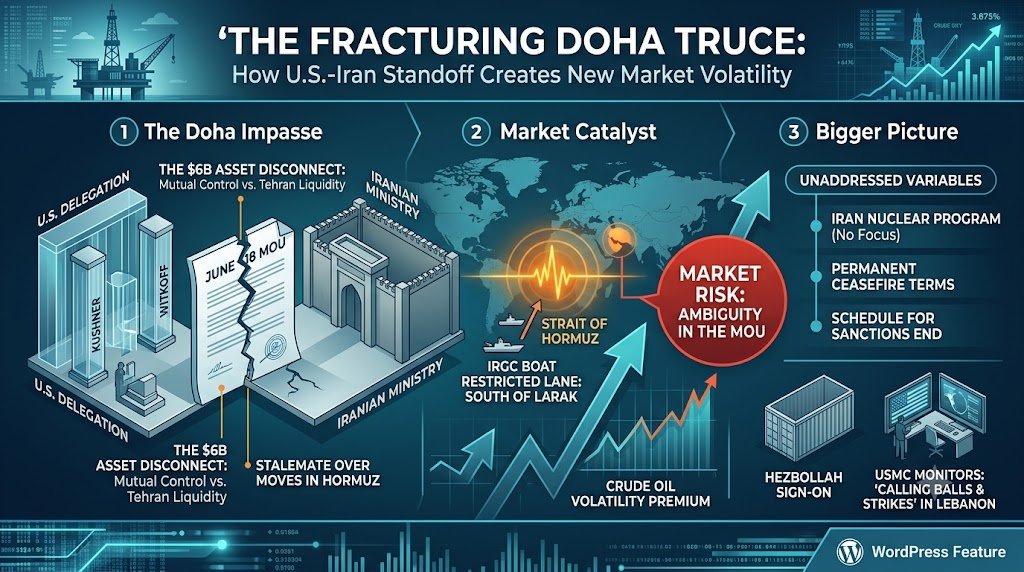
- The sudden friction surrounding the U.S.-Iran Doha talks has triggered an immediate 17% drop in standard maritime volume through the Strait of Hormuz.
- Diplomatic gridlock centers heavily on conflicting interpretations of the June 18 MOU regarding the exact liquidity status of $6 billion in frozen assets.
- Tehran’s aggressive posture during joint maritime committee meetings has escalated into direct territorial threats toward neighboring Oman.
- Market strategists warn that because the framework completely bypasses Iran’s nuclear program, the structural instability of the truce will continue to rattle international energy sectors.
The diplomatic architecture of the Middle East is facing its most volatile test since the initiation of the recent conflict. A high-stakes diplomatic standoff has emerged over the second round of the U.S.-Iran technical talks in Doha, threatening to implode the fragile ceasefire brokered under the June 18 Memorandum of Understanding (MOU).
While President Donald Trump announced that high-level envoys Steve Witkoff and Jared Kushner have been dispatched to Qatar, Tehran flatly denied any plans for direct engagement. This narrative friction, compounded by critical disputes over maritime sovereignty and billions in frozen assets, is exerting acute pressure on international energy markets and corporate supply lines.
Advanced Israeli Systems Sold to Qatar and Saudi Arabia, Documents and Photographs Reveal
Key Data Insights: The Strait of Hormuz Chokepoint
The immediate fallout of the diplomatic impasse is concentrated in the Strait of Hormuz, the world’s most critical maritime oil transit artery. Following intense exchanges of fire last week triggered by unauthorized Iranian targeting of merchant vessels, the underlying economics of the transit chokepoint remain severely strained.
| Metric | Pre-War Status | Current Evaluation | Economic Impact |
| Daily Vessel Transits | $130+$ commercial crossings | 108 verified crossings (June 26–28) | ~17% drop in standard maritime volume |
| Asset Liquidity Status | $6 Billion frozen in Doha | Contested ($12 Billion total claimed by Iran) | Stalling point of broader technical talks |
| Sanctions Regime | Active energy embargoes | Explicitly lifted via MOU last week | Volatility premium embedded in crude futures |
The Weaponization of Strategic Narratives
The primary headwind to a permanent peace is the staggering divergence in how the vaguely worded MOU is being interpreted. For elite investors and corporate strategists, this ambiguity presents a severe risk vector.
- The $6 Billion Disconnect: The Trump administration asserts that the $6 billion in released Iranian assets held in Doha must remain under strict U.S. oversight to purchase American agricultural goods. Conversely, Iranian President Masoud Pezeshkian publicly declared the funds must be made entirely liquid under Iranian Central Bank direction, viewing the release alongside last week’s lifting of oil sanctions as non-negotiable components of the truce.
- The Maritime Sovereign Toll: In a destabilizing regional twist, Iranian Deputy Foreign Minister Kazem Gharibabadi held a “joint Hormuz committee” meeting with Oman that rapidly deteriorated into coercive diplomacy. While Washington and Congress insist on an entirely open strait, Tehran claims absolute administrative dominance over the waterway. The Islamic Revolutionary Guard Corps (IRGC) has explicitly cornered maritime operators, warning that passage is restricted to a narrow lane south of Larak Island. Tehran further threatened external actors after French President Emmanuel Macron and the Sultan of Oman agreed to collaborate on removing Iranian-placed naval mines, stating demining remains “exclusively” an Iranian prerogative.
The Bigger Picture: Structural Risks Ahead
With merely 48 days remaining in the extendable 60-day negotiating window, the underlying mechanics of these talks are deeply concerning to global markets.
READ MORE: Trump says U.S. and Iran will meet to negotiate after days of strikes
The immediate danger is that the process has entirely bypassed Iran’s nuclear program—the original catalyst for the conflict. By kicking the nuclear can down the road, the current framework leaves the most explosive regional variable unaddressed. Furthermore, while a “trilateral framework” between the U.S., Israel, and Lebanon was initiated to halt fighting with Hezbollah, the militant group has not formally signed on, meaning the risk of a multi-front relapse remains potent.
For international markets, the era of neutral capital in the Persian Gulf is effectively paused. The ongoing volatility premium built into energy futures will not dissipate through temporary handshakes. Until the technical blanks of the MOU are explicitly filled, global logistics and commodity markets must price in a persistent reality: an architecture built on weaponized narratives and weekend spikes of armed escalation.