


-
U.S. Iran Naval Blockade 2026 Beyond the Strait: Why the U.S. Navy is now seizing “Dark Fleet” tankers as far as Indonesia and Sri Lanka.
- The Munir-Trump Factor: Inside the diplomatic ceasefire extension and the high-stakes “brainstorming” for a new nuclear deal.
- A Nation Divided: Why the Iranian regime is reportedly “fractured” and ready to negotiate under the weight of three U.S. aircraft carriers.
- Global Market Shockwaves: How the Arabian Sea naval standoff is redrawing energy trade routes from Singapore to Rotterdam.
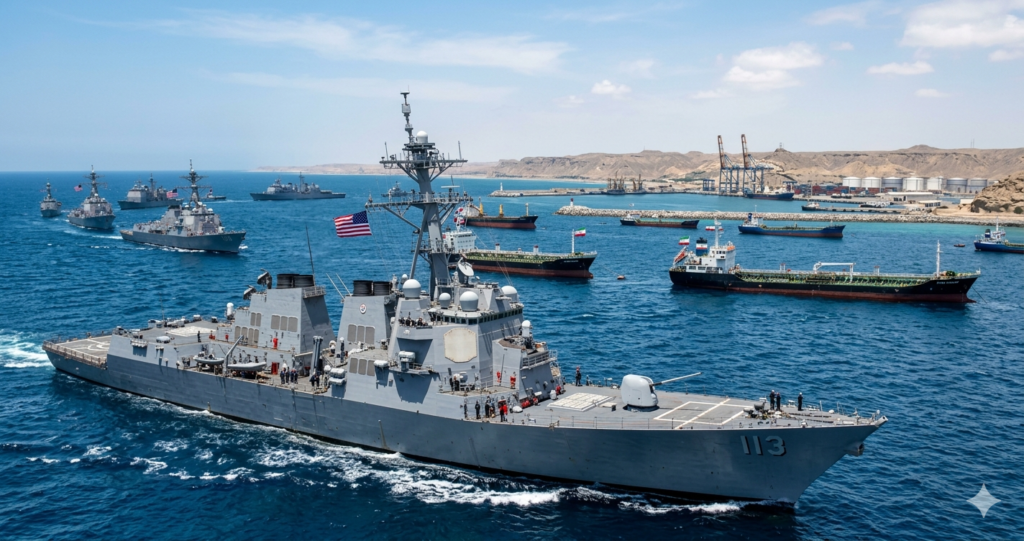
WASHINGTON D.C. — In a dramatic escalation of the “Maximum Pressure 2.0” campaign, the United States has expanded its naval blockade far beyond the traditional confines of the Persian Gulf, transforming the Indian Ocean and the Arabian Sea into a high-stakes arena of maritime interdiction.
The recent seizure of the supertanker Tifani between Sri Lanka and Indonesia signals a pivotal shift in strategy: Washington is no longer just guarding the gate; it is hunting the “dark fleet” across the global commons.
US Iran Ceasefire Extended as High-Stakes Islamabad Talks Signal Possible Breakthrough
The Strategy of Total Interdiction
The capture of the Tifani, capable of carrying 2 million barrels of Iranian crude, underscores a directive from the Trump administration to pursue material support for Tehran wherever it floats. By utilizing satellite imagery and the superior speed of U.S. Navy destroyers, the Pentagon is systematically dismantling Iran’s economic lifelines.
Global Shock: Iran Re-Closes Strait of Hormuz, Threatening to Scuttle Pakistan-Led Peace Talks
The message from the Chairman of the Joint Chiefs of Staff, Gen. Dan Caine, was clear: any vessel attempting to bypass sanctions—regardless of its distance from the Strait of Hormuz—is a target. With the imminent arrival of the USS George H.W. Bush, joining the USS Gerald R. Ford and USS Abraham Lincoln, the U.S. will soon command a level of regional firepower not seen in decades.
Calculated Leverage: The “Munir-Trump” Window
While the iron fist of the Navy tightens the blockade, a diplomatic velvet glove remains visible. President Trump’s decision to extend a two-week ceasefire—reportedly facilitated by high-level coordination with key regional figures including Pakistan’s Field Marshal Asim Munir—suggests that the military maneuvers are a means to a specific end.
U.S. operations against Iran expand to Indian Ocean with tanker capture
Insiders indicate that the objective is not necessarily a full-scale kinetic war, but rather the creation of an “unbearable status quo” that forces a fractured Iranian leadership to the negotiating table. The extension of the ceasefire provides both Washington and Tehran a critical window for “strategic brainstorming.” By agreeing to this pause, Trump is signaling to the international community—and to the Iranian regime—that a deal is possible, provided it meets Washington’s core demands:
-
A total cessation of the nuclear program.
-
The surrender of highly enriched uranium.
-
The permanent reopening of the Strait of Hormuz.
U.S. Iran Naval Blockade 2026 A Domestic Mandate and Regional Solidarity
Despite international jitters over rising energy prices and the “convulsing” global economy, President Trump finds himself in a rare position of domestic and regional strength. In the United States, a majority of Americans support a firm stance against Iran, viewing the restoration of maritime security as a national priority.
U.S. operations against Iran expand to Indian Ocean with tanker capture
More importantly, traditional U.S. allies in the Middle East have rallied behind the blockade. For these nations, the closure of the Strait of Hormuz was an existential threat to their own export-reliant economies. They see the U.S. naval presence as the only credible deterrent against Iranian regional hegemony.
The View from Tehran: High Pressure, High Stakes
For Iran, the stakes could not be higher. The seizure of vessels like the Dorena, Sevin, and the cargo ship Touskarepresents more than just lost revenue; it represents a loss of sovereignty over its own trade routes. Sources close to the situation suggest that “Maximum Pressure” is having its intended effect, with segments of the Iranian government reportedly ready to strike a deal to alleviate the crippling economic siege.
However, the regime remains publicly defiant, demanding an end to the “maritime piracy” of the blockade as a precondition for formal talks.
Global Implications: From Beijing to Brussels
The global community is watching with bated breath. For energy-hungry economies in China, Japan, and Singapore, the stability of the Indian Ocean is paramount. While the blockade targets Iranian oil, the broader disruption to shipping routes has sent ripples through the markets in London and New York.
Washington’s gamble is that the short-term economic pain will lead to a long-term “Grand Bargain” that stabilizes the Middle East for a generation. As U.S. Marines board tankers and aircraft carriers take their stations, the world waits to see if Tehran will fold under the weight of the blockade or if the Arabian Sea will become the flashpoint for a conflict that no one can afford.