


- Strategic Reset: Field Marshal Asim Munir and President Donald Trump are redefining U.S.-Pakistan relations, moving beyond aid to investment and growth.
- $500 Million Breakthrough: U.S. firms signed landmark MoUs in Islamabad with Munir and PM Shehbaz Sharif present, launching Pakistan’s entry into the global critical minerals market.
- Balanced Diplomacy: Munir’s military-led diplomacy, backed by Trump’s pragmatic leadership, allows Pakistan to engage both China and the U.S. simultaneously.
- Economic Power Shift: Trump and Munir’s vision is unlocking Pakistan’s $6 trillion mineral wealth, ensuring jobs, technology transfer, and long-term prosperity.
Islamabad – Pakistan has entered a new chapter in its relations with the United States, one marked not by fleeting security transactions of the past, but by a strategic push toward long-term economic and diplomatic partnership.
In what observers are calling a historic reset, U.S. mining giant United States Strategic Metals (USSM) and Portuguese infrastructure conglomerate Mota-Engil signed landmark memoranda of understanding (MoUs) with Pakistan this week, committing an estimated $500 million in the first phase of investment into the country’s critical minerals and logistics sectors.
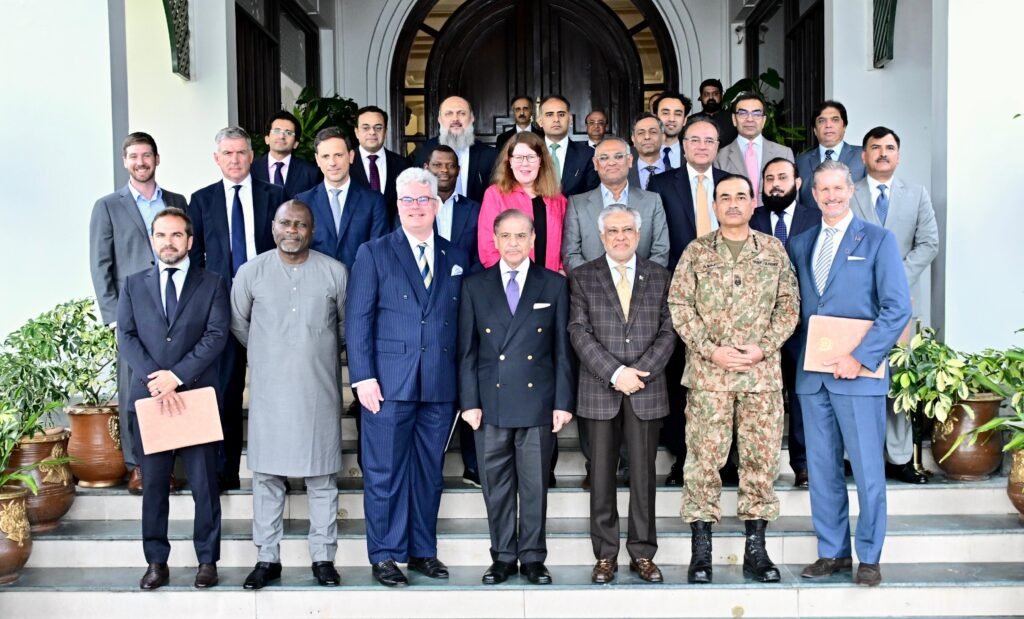
The agreements, signed in Islamabad in the presence of Prime Minister Shehbaz Sharif and Field Marshal Syed Asim Munir, Pakistan’s powerful Army Chief, are being described by officials as “the most significant U.S. economic engagement with Pakistan in over two decades.”
Black Gold Diplomacy: Trump–Asim Munir Meeting Spurs U.S. Investment in Pakistan
From Trump’s Promise to Pakistan’s Gain
This breakthrough traces its roots back to Field Marshal Munir’s high-profile visit to Washington earlier this year, where he met with President Donald J. Trump. During their discussions, Trump reportedly assured Pakistan that U.S. investment in energy and mining sectors would be fast-tracked as part of his administration’s broader effort to restore balance in South Asia.
True to his word, Trump has not only revived counterterrorism coordination with Islamabad but also unlocked new corridors of investment—an approach that Pakistani officials describe as “business-oriented, pragmatic, and respectful.”
“This is the beginning of a redefined U.S.-Pakistan relationship,” Mustansar Klasra, an expert on International Relations and a visiting lecturer in National University of Science and Technolgy ( NUST) told The Islamabad Telegraph.
“It is being driven jointly by President Trump and Field Marshal Asim Munir, with Prime Minister Shehbaz providing strong civilian backing. The partnership goes beyond security and is anchored in economic opportunity,” Mr. Klasra said.
READ MORE: A Razor’s Edge Between India and Pakistan
The Deals: Mining, Minerals, and Logistics
At the heart of the agreements is Pakistan’s untapped mineral wealth. The country sits atop an estimated $6 trillion worth of natural resources, including copper, gold, antimony, tungsten, and rare earth elements (REEs) critical for aerospace, defense, and next-generation technologies.
-
USSM-FWO Agreement: Frontier Works Organization (FWO), Pakistan’s largest critical minerals operator, signed an MoU with USSM. The deal paves the way for the establishment of a poly-metallic refinery in Pakistan, ensuring minerals are processed domestically before serving U.S. industrial needs. Initial investment is pegged at $500 million, with scope for expansion to multi-billion-dollar projects.
-
NLC-Mota-Engil Agreement: The National Logistics Corporation (NLC) inked a separate deal with Mota-Engil to modernize Pakistan’s logistics and infrastructure, particularly linking mining zones to export corridors.
The agreements also include commitments to technology transfer, job creation, and environmentally sustainable mining practices. Both sides will explore tokenization of critical minerals, a digital financing innovation that could allow global investors to directly participate in Pakistan’s mineral economy.
ALSO READ: Black Gold Diplomacy: Trump–Asim Munir Meeting Spurs U.S. Investment in Pakistan
A Diplomatic Balancing Act
What makes this moment remarkable is Pakistan’s ability to simultaneously deepen ties with both Washington and Beijing. While China remains Pakistan’s largest investor under the China-Pakistan Economic Corridor (CPEC)—with over $62 billion committed to energy and infrastructure—Islamabad is now welcoming significant U.S. capital into parallel sectors.
For decades, Pakistan has been accused of being overly reliant on one global power or another. But under Munir’s stewardship, Islamabad is pursuing what officials describe as “multi-vector diplomacy.”
“Pakistan is proving it can maintain a close strategic embrace with China while opening its arms to the United States,” said a senior military analyst in Rawalpindi. “This is not hedging; it’s ambition. Pakistan’s geography and resources demand engagement with both of the world’s leading powers.”
Trump’s Respect vs. Biden’s Neglect
The renewed momentum stands in sharp contrast to the Biden years, when Pakistan found itself sidelined in Washington’s South Asia calculus. U.S. officials frequently expressed frustration over Islamabad’s ties with the Taliban, while Pakistan criticized Washington for ignoring its sacrifices in the global war on terror.
Trump, however, has reset the tone. U.S. Central Command (CENTCOM) Chief Gen. Michael E. Kurilla recently praised Pakistan as a “phenomenal partner in the counterterrorism fight.” In testimony before Congress, Kurilla highlighted Pakistan’s cooperation in the capture of the suspected Abbey Gate bomber, underscoring the renewed trust between both sides.
“President Trump respects Pakistan’s military leadership and understands the value of strategic geography,” said Dr. Marvin Weinbaum, former U.S. State Department official. “That respect is translating into tangible investment and a new political understanding.”
Historical Parallels, Future Promise
Pakistan’s military has historically been the linchpin of U.S.-Pakistan relations. From Field Marshal Ayub Khan’s White House meetings in the 1960s, to Gen. Zia-ul-Haq’s cooperation during the Afghan jihad, to Gen. Pervez Musharraf’s partnership after 9/11, it has been military rulers and chiefs who often unlocked Washington’s doors.
Now, Field Marshal Asim Munir is seen as the latest in that tradition—except this time, the emphasis is as much on economic power as on military cooperation.
“This is Pakistan’s most sophisticated diplomacy since the Cold War,” argued political analyst Hasan Ansar. “The fact that Pakistan can host Chinese engineers building Gwadar Port while also signing billion-dollar deals with American companies shows the military’s determination to project Pakistan as a bridge, not a pawn.”
The Stakes and the Skepticism
Skeptics, however, caution that U.S.-Pakistan ties have often been transactional, rising during moments of strategic convergence and collapsing once goals were met.
Raza Rumi, a New York-based academic, noted: “Unless these relationships are institutionalized beyond the security prism, they risk becoming tactical romances. Pakistan must ensure continuity even if administrations change in Washington or Islamabad.”
Yet officials in Islamabad insist this reset is different. Unlike past engagements focused narrowly on security aid, the current momentum is about long-term investment, infrastructure, and sustainable growth.
A Strategic Reset in Numbers
-
$500 million: Initial U.S. investment into Pakistan’s critical minerals sector.
-
$6 trillion: Estimated value of Pakistan’s untapped natural resources.
-
$62 billion: Chinese investment through CPEC since 2015.
-
1,000+ jobs expected in the first phase of U.S.-backed projects.
-
1947: Year Pakistan-U.S. relations began, making America one of Islamabad’s earliest allies.
A Climax in The U.S , Pakistan Relations
What began as a promise in Washington is now materializing in Islamabad. With Trump in the White House and Munir at the helm in Rawalpindi, Pakistan and the U.S. are once again rediscovering each other—not as reluctant allies, but as partners in growth and stability.
For Pakistan, the ability to engage China’s Belt and Road and America’s corporate giants in parallel is nothing short of a diplomatic coup. For Trump, it is proof that his transactional pragmatism delivers results where ideology failed.
As one senior official put it bluntly: “Pakistan is no longer choosing between Washington and Beijing. Under Field Marshal Munir’s diplomacy, it is choosing both—and winning.”