


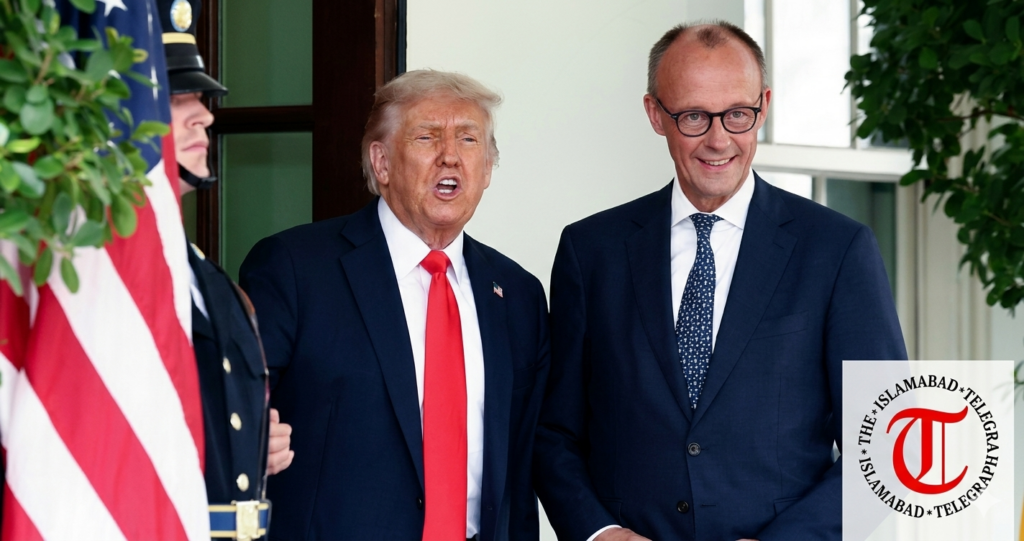
- U.S. troop withdrawal from Germany marks a major shift in transatlantic security posture
- Pentagon plans to remove 5,000 troops amid tensions over Iran war strategy
- Germany responds cautiously as fears grow over weakening NATO unity
- New poll shows American public support for Iran war at historic lows
The announcement came with the quiet force of a door closing in a long-familiar hallway. On Friday, the Pentagon confirmed that roughly 5,000 U.S. troops would be withdrawn from Germany, a country that, for decades, has served as both staging ground and symbol of American commitment to Europe.
The drawdown, officials said, would unfold over six to twelve months—methodical, deliberate, and, to many observers, deeply unsettling.
Behind the bureaucratic phrasing lay a rupture that had been building for weeks. Donald Trump, increasingly embattled over his administration’s war in Iran, had grown impatient with European allies he accused of offering rhetorical support but little else. At the center of the tension stood Friedrich Merz, whose attempt to balance alliance diplomacy with domestic skepticism finally tipped into open criticism.
Speaking to students earlier in the week, Merz departed from the careful language of transatlantic solidarity. The United States, he said, had entered the Iran war “without any strategy whatsoever”—a remark that traveled quickly across diplomatic channels and landed heavily in Washington.
A senior Defense Department official, speaking anonymously, described the comments as “inappropriate and unhelpful,” but the response was not merely rhetorical. Days later came the withdrawal announcement.
In Berlin, the reaction was restrained but unmistakably anxious. German officials, who had only recently been reassured by American praise for Berlin’s new military strategy—an ambitious plan to transform Germany into Europe’s leading conventional force by 2039—now found themselves recalibrating.
The presence of U.S. troops on German soil has never been merely logistical; it has been psychological, a guarantee embedded in bases, barracks, and command centers like U.S. European Command and U.S. Africa Command.
Global Markets Shudder as U.S.-Iran Conflict Escalates; Crude Prices Hit Record Highs
To remove even a portion of that presence is to introduce uncertainty into a relationship long defined by its predictability.
Publicly, German leaders have avoided escalation. Privately, European officials worry that the decision signals something larger: not a tactical adjustment, but a strategic pivot away from Europe altogether. The Pentagon has framed the move as part of a broader reorientation toward the Indo-Pacific and the Western Hemisphere—a shift consistent with Trump’s long-standing skepticism of NATO and his insistence that European allies shoulder more of their own defense.
Yet timing, as ever, is everything. The withdrawal comes as Russia’s war in Ukraine grinds on, and as Europe confronts its most volatile security environment in decades. For critics in Washington, the optics are troubling. Senator Jack Reed warned that reducing America’s military footprint in Europe risks emboldening Vladimir Putin, describing the move as a “gift” to Moscow.
Trump to downsize U.S. military presence in Germany
Whether this moment represents a genuine fracture in U.S.-German relations—or merely another episode in a turbulent alliance—remains an open question. The Trump administration insists that it is pushing Europe toward self-reliance, not abandonment. But in Berlin, the distinction may feel academic.
Complicating the picture further is the mood back home. The war in Iran, once framed as a decisive move to prevent nuclear escalation, has become increasingly unpopular with the American public. A recent poll conducted by The Washington Post and ABC News found that 61 percent of Americans believe the use of military force against Iran was a mistake. Fewer than two in ten consider the war successful.
The numbers are striking not only for their scale but for their سرعة—how quickly public opinion has turned. Comparisons to the Vietnam War and the Iraq War, once invoked cautiously, are now appearing with greater frequency. In both cases, it took years of mounting casualties and uncertainty to reach similar levels of disapproval. In Iran, that threshold has been crossed in a matter of months.
Israel, Lebanon Talks Set for Washington as Iran–U.S. Dialogue in Islamabad Faces Uncertainty Amid Escalating Maritime Tensions
Economic anxiety is amplifying the discontent. Rising fuel prices, disrupted shipping routes, and fears of recession have begun to alter everyday behavior, with many Americans cutting travel and household spending. A majority now believes the war has increased the risk of terrorism and weakened relationships with allies—an assessment that, in light of the German withdrawal decision, may feel less abstract than it once did.
And so the story folds back on itself: a war abroad reshaping alliances, and a restless electorate reshaping the politics of that war. In the corridors of power, decisions are explained in terms of strategy and posture. But on both sides of the Atlantic, they are increasingly felt as something more immediate—a loosening of ties, a recalibration of trust, and perhaps, the early signs of a transatlantic relationship entering a more uncertain age.