


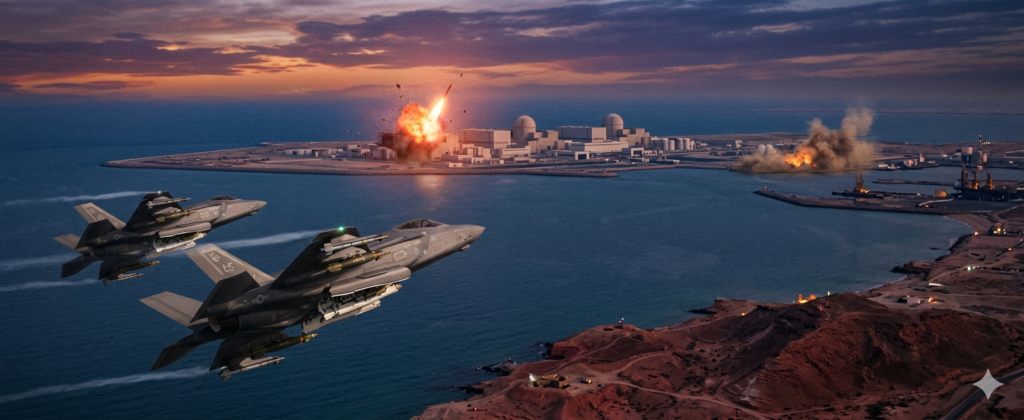
- UAE drone attack Barakah nuclear plant exposes critical infrastructure vulnerability in the Gulf
- Two UAVs intercepted, third hits power generator near sensitive nuclear facility
- Rising U.S.-Iran tensions fuel fears of wider regional conflict and proxy warfare
- Energy markets and Strait of Hormuz security face renewed uncertainty after escalation
A rare and deeply unsettling security breach at the United Arab Emirates’ most sensitive energy installation has exposed the widening arc of instability across the Gulf, raising fears that critical civilian infrastructure is increasingly becoming a target in a volatile regional standoff.
On May 17, 2026, UAE air defence systems intercepted three unmanned aerial vehicles (UAVs) that entered the country from the western border. According to the Ministry of Defence, two drones were neutralized mid-air, but a third managed to strike an electrical generator located outside the inner perimeter of the Barakah Nuclear Power Plant in Abu Dhabi’s Al Dhafra region.
While authorities confirmed that there was no radiological leak and no casualties, the symbolic and strategic implications of the incident are far more significant than the limited physical damage suggests.
This marks the first known instance of a hostile aerial object successfully reaching the vicinity of the Barakah facility—an installation that supplies nearly a quarter of the UAE’s electricity and represents a cornerstone of its long-term energy diversification strategy. Emirati officials were quick to describe the strike as a “terrorist attack,” emphasizing that investigations are ongoing to determine responsibility. However, early indicators point toward a broader pattern of asymmetric warfare increasingly defining the region’s security environment.
Trump Xi Summit 2026 Signals Global Reset as China Draws Taiwan Red Line
The timing of the incident is critical. It comes amid a fragile and increasingly strained ceasefire following the U.S.-Israel military campaign against Iran that began earlier this year. Despite weeks of diplomatic efforts, negotiations remain deadlocked. Washington continues to demand the dismantling of Iran’s nuclear program and the reopening of the Strait of Hormuz, while Tehran insists on compensation for war damages and an end to what it describes as unlawful blockades.
Against this backdrop, the UAE—long considered one of the region’s most stable actors—has emerged as a frontline state. Its hosting of U.S. military assets and cooperation with Western security frameworks has made it a potential target for both direct and proxy retaliation. Iranian-aligned militias operating in Iraq and Yemen, particularly the Houthis, have previously demonstrated both the capability and intent to strike deep into Gulf territory using drones and missile systems.
US-Iran Deal Nears Breakthrough as Trump Eyes Historic Islamabad Visit to Seal Regional Peace
The International Atomic Energy Agency (IAEA) responded swiftly, confirming that the affected reactor unit temporarily switched to emergency diesel generators but remained fully secure. Nevertheless, the agency issued an unusually direct warning, calling for “maximum military restraint” around nuclear facilities—an indication of the growing alarm within international oversight bodies.
Meanwhile, U.S. President Donald Trump’s rhetoric has escalated sharply. In a series of statements, he warned Iran that “the clock is ticking,” signaling that Washington may be preparing to revisit military options. Reports indicate that high-level meetings are scheduled this week to assess potential responses, including renewed strikes or expanded naval operations in the Strait of Hormuz.
Drone strikes UAE nuclear plant as US and Iran signal they are prepared to resume war
Energy markets have already begun reacting. Disruptions to shipping lanes and the threat of further escalation have pushed oil prices upward, with analysts warning of a prolonged supply shock if tensions continue to spiral. The Strait of Hormuz, through which roughly a fifth of global oil supply flows, remains the critical pressure point. Any sustained conflict in its vicinity would have immediate and severe global economic consequences.
Forecast: Escalation, Deterrence, or Controlled Chaos?
Based on current military posturing and diplomatic signals, three potential trajectories are emerging.
First, a controlled escalation scenario appears most likely in the short term. In this model, proxy attacks—such as drone strikes—continue at a calibrated pace, allowing regional actors to apply pressure without triggering full-scale war. The Barakah incident fits this pattern: symbolic, disruptive, but carefully limited to avoid catastrophic fallout.
US Attack on Iran Ships Pushes War Into Dangerous Phase, Triggers Global Oil Shock
Second, there is a rising probability of direct confrontation if diplomatic channels collapse entirely. Trump’s increasingly aggressive posture, combined with Iran’s warnings of “surprise scenarios,” suggests that both sides are preparing contingency plans. A single miscalculation—particularly involving critical infrastructure—could rapidly escalate into open conflict.
Third, a fragile deterrence equilibrium may emerge if backchannel negotiations succeed in producing limited concessions. However, this would require significant compromises on both sides, which currently appear unlikely given the entrenched positions.
For the UAE, the incident underscores an urgent need to reassess its air defence architecture and critical infrastructure protection. While its systems successfully intercepted most threats, the penetration of even one drone highlights vulnerabilities that adversaries may seek to exploit further.
Ultimately, the strike near Barakah is more than an isolated security breach—it is a warning signal. The Gulf’s strategic landscape is shifting toward a new era where drones, proxies, and infrastructure targeting redefine the rules of engagement. And as the region edges closer to a tipping point, the margin for error is rapidly shrinking.