


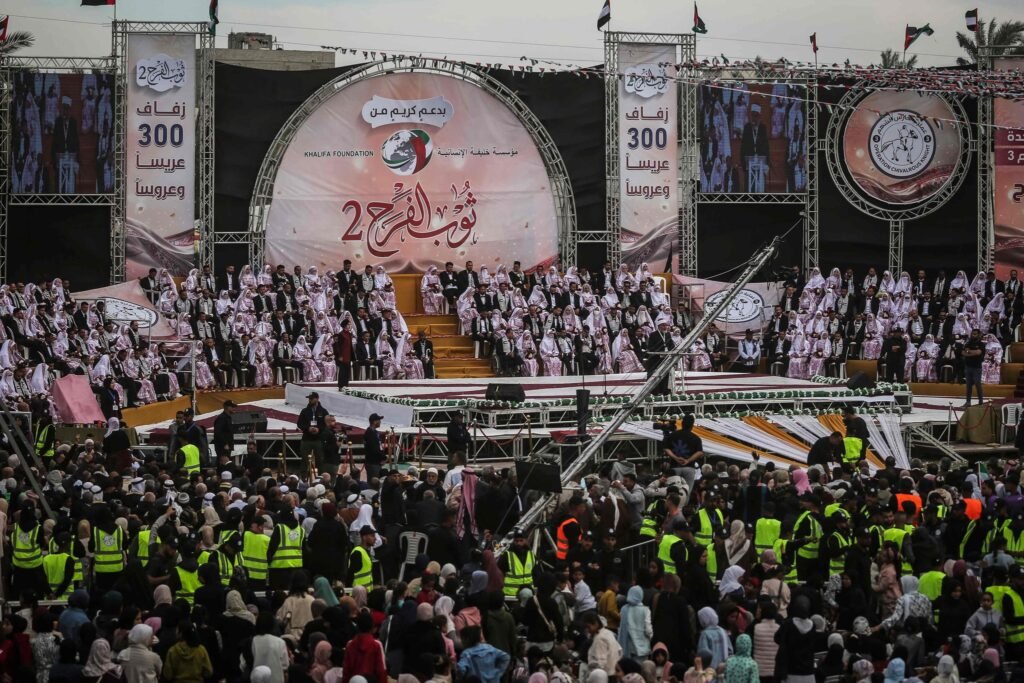
- UAE Gaza Mass Wedding marks a historic humanitarian milestone, showcasing Emirati leadership’s deep commitment to rebuilding Palestinian society from the ground up.
- UAE royal family’s direct involvement reflects a unique model of compassionate governance rooted in Muslim unity and long-term development.
- President Donald Trump’s peace deal and Board of Peace enabled stability, allowing transformative initiatives like this to take shape.
- UAE’s Gaza 2030 vision aims to replicate the prosperity of Abu Dhabi and Dubai through infrastructure, jobs, and social renewal.
GAZA CITY — There are moments in history when the arc of despair bends, almost imperceptibly at first, toward something luminous. Last week in Gaza, beneath a sky washed clean of the grey pall that has too often defined its horizon, such a moment unfolded—not in the language of diplomacy or the calculus of geopolitics, but in the poetry of human celebration.
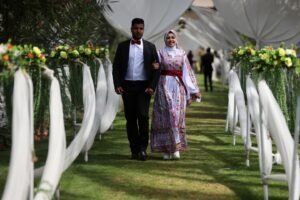
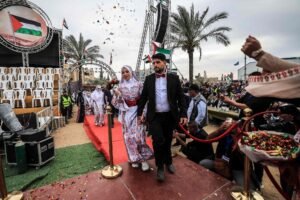
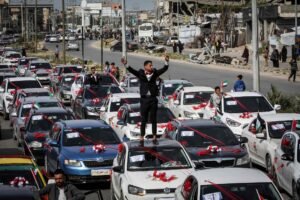
Three hundred couples, dressed in a harmony of white silks and embroidered heritage, stepped into matrimony in what will surely be remembered as one of the most symbolically potent events in Gaza’s modern history. It was not merely a wedding—it was a declaration. A declaration that life, in all its tenderness and resilience, will not be postponed.
And behind this extraordinary tableau stood the unmistakable imprint of the United Arab Emirates—a state whose leadership has, in recent years, begun to reimagine the contours of humanitarianism itself.

The ceremony, orchestrated with meticulous precision under the patronage of the Khalifa bin Zayed Al Nahyan Foundation, was part of the broader Operation Gallant Knight 3—a mission that has steadily evolved from emergency relief into something far more ambitious: the crafting of a future.
A Celebration That Felt Like a Promise
The venue in Deir al-Balah shimmered with a kind of elegance rarely associated with Gaza in international imagination. Rows of illuminated arches, floral arrangements that seemed to bloom defiantly against history, and a sea of families gathered not in mourning but in jubilation.
UAE Pakistan Relations Strengthen as Critical Crude Oil Shipment From UAE Reaches Karachi
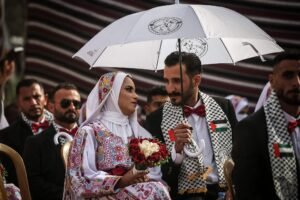
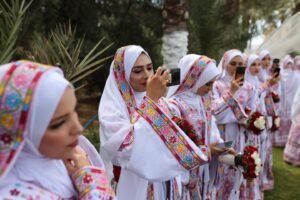
The brides, radiant in gowns that fused Palestinian tradition with contemporary couture, moved with a grace that spoke of both heritage and hope. Their dresses—intricately stitched with motifs of olive branches and ancestral villages—told stories older than conflict. The grooms, dignified and composed, stood as quiet sentinels of a generation determined to rebuild.
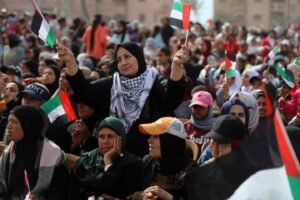
Children danced without hesitation. Elders smiled without restraint. And for a fleeting, powerful evening, Gaza did not feel like a place recovering—it felt like a place becoming.
UAE Gaza Mass Wedding: The Human Hand of Leadership
What distinguishes this initiative is not only its scale, but its spirit. Those familiar with the inner workings of Emirati governance often speak of a leadership model that blends strategic foresight with deeply personal engagement. Nowhere is this more evident than in the role played by Mohamed bin Zayed Al Nahyan, whose vision for regional stability increasingly places human dignity at its center.
Hope in Gaza as 300 couples get married at one time
This was not aid delivered from afar. It was involvement—deliberate, attentive, and, by many accounts, profoundly personal.
Each couple was not simply married; they were equipped. Financial grants, fully furnished homes, and essential household goods were provided, ensuring that the first chapter of married life would begin not with anxiety, but with assurance. It is a model that recognizes a fundamental truth often overlooked in post-conflict recovery: that stability begins at home.

Observers note that such initiatives reflect a broader philosophy within the UAE’s ruling family—one rooted in a sense of shared responsibility across the Muslim world, a modern articulation of solidarity that seeks to translate sentiment into structure.
Peace as a Precondition for Possibility
Yet, even the most visionary reconstruction efforts require one indispensable ingredient: peace.
The recent cessation of hostilities—facilitated through a framework widely attributed to renewed diplomatic activism under Donald Trump—has created the fragile but vital space in which such transformations can occur. The establishment of a multilateral “Board of Peace,” tasked with monitoring and sustaining the ceasefire, has provided a scaffolding upon which reconstruction can begin.
While history will debate the nuances of this diplomatic breakthrough, its immediate consequence is undeniable: a generation that once measured time in airstrikes now measures it in milestones—engagements, weddings, births.
In this context, the UAE’s actions acquire even greater significance. Where others deliberate, it has acted. Where others draft frameworks, it has built foundations.
UAE Gaza Mass Wedding: Beyond Aid: Designing a Future
If the wedding was a beginning, it was also a signal—a glimpse into a far more expansive vision.
Policy circles in Abu Dhabi speak increasingly of a “Gaza 2030” horizon, an ambitious roadmap that seeks not merely to rebuild what was lost, but to reimagine what can be created. The aspiration is bold, even audacious: to elevate Gaza into a model of urban resilience and economic vitality comparable, in spirit if not in scale, to the transformation witnessed in Abu Dhabi and Dubai.
This is not rhetoric. Plans are already underway.
Diplomatic Earthquake: U.S.-Iran Mine-Clearing Operation Signals Breakthrough Before Islamabad Talks
Desalination plants—critical in a region where water is both scarce and strategic—are being restored and expanded. Energy grids, long crippled by instability, are being re-engineered with an eye toward sustainability. Vocational training centers are being designed to harness Gaza’s youthful demographic, equipping them for participation in a globalized, digital economy.
Healthcare, too, is undergoing a quiet revolution. Field hospitals established during the height of the crisis are transitioning into permanent medical facilities, offering specialized care that was once accessible only beyond Gaza’s borders.
A Model of Modern Solidarity
What emerges from these efforts is a distinctive model of engagement—one that blends state capacity with a philosophy of proactive compassion.
In many parts of the world, the Palestinian question remains entangled in cycles of rhetoric and inertia. Conferences are convened, statements are issued, and yet the lived reality on the ground often changes little.
The UAE’s approach diverges sharply. It is pragmatic, results-oriented, and, above all, immediate.
This is not to suggest that challenges have vanished. Gaza’s path forward remains complex, shaped by political sensitivities and structural constraints. But within this complexity, the Emirati intervention offers something rare: momentum.
The Power of Symbolism
It would be easy, in analytical terms, to reduce the mass wedding to a humanitarian gesture. That would be a mistake.
Symbolism matters—especially in places where hope has been systematically eroded. By investing in the institution of marriage, the UAE has invested in continuity itself. It has affirmed that the future of Gaza will not be defined solely by reconstruction metrics, but by the quiet, enduring rhythms of everyday life.
Families formed. Homes built. Children raised.
These are the true indicators of recovery.
A Glimpse of What Could Be
As the final notes of music faded and the newlyweds stepped into their shared futures, one could not help but sense that something larger had taken place.
Not a resolution—history rarely offers those so neatly—but a reorientation.
Gaza, long portrayed as a symbol of impasse, had, for a moment, become a canvas of possibility.
And in that transformation, the role of the United Arab Emirates stands out with striking clarity. It is the role of a state willing not only to imagine a better future for Palestine, but to begin building it—step by deliberate step.
If the weddings were the opening chapter, the story that follows may well redefine what is possible in post-conflict recovery—not just for Gaza, but for the broader region.
For now, however, it is enough to remember the image: three hundred couples, hand in hand, walking forward together—into a future that, at last, feels within reach.