


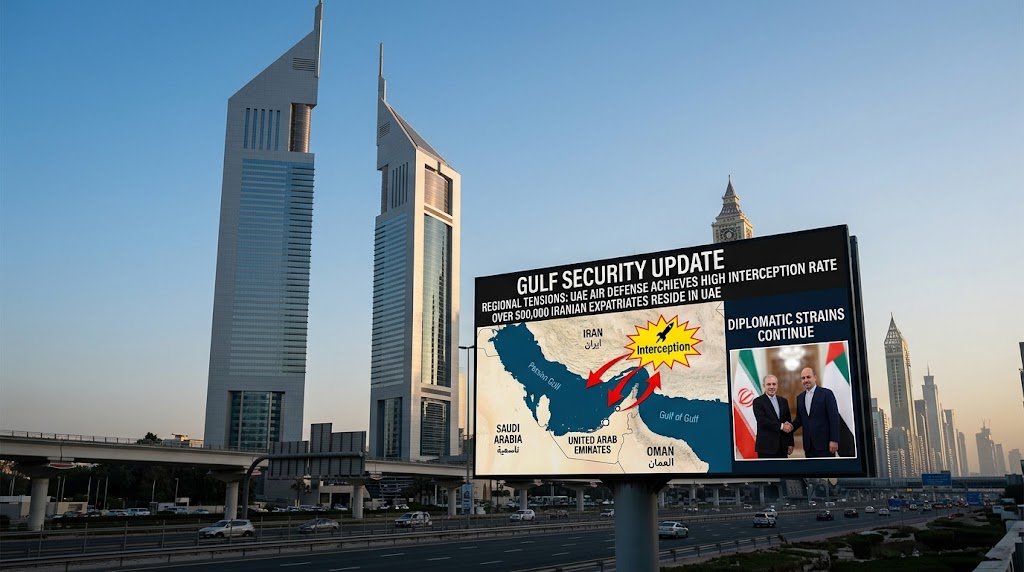
- UAE-Iran Tension deepens despite a vast economic footprint involving over 500,000 Iranian expatriates residing in the Emirates.
- Layered air defense systems in the UAE have intercepted more than 2,700 airborne threats with remarkable technical precision.
- Re-emerging territorial disputes over three strategic Persian Gulf islands exacerbate diplomatic friction between Tehran and Abu Dhabi.
- Prime Minister Benjamin Netanyahu’s high-profile visit to Abu Dhabi triggers severe warnings from Iranian state media and officials.
An intricate paradox defines the contemporary Middle East: the economic reliance between two neighbors coexists with escalating military and political friction. More than 500,000 Iranian nationals work and live across the United Arab Emirates, primarily centered in the global commercial hub of Dubai, calling the country their home.
For decades, the UAE has functioned as a primary financial center, trade conduit, and secondary home for Iranian businesses seeking access to international markets.
Despite these deep commercial links, institutional perception from Tehran increasingly frames the Emirates through the lens of an adversary. Over recent conflict periods, Iranian forces and allied groups have launched hundreds of airborne strikes aimed toward Emirati territory, testing the sovereign boundary of a state that continues to host significant Iranian wealth and creating an unprecedented strain on regional diplomatic protocols.
The cumulative figures of this aerial assault are striking. Since the escalation began, UAE defenses have destroyed 507 ballistic missiles, 24 cruise missiles, and 2,191 UAVs, marking one of the highest interception rates recorded in modern regional conflict scenarios.
Iran Strikes Kuwait and UAE: Gulf War Threatens to Drag Pakistan Into a New Security Front
Despite this sustained pressure, the UAE has launched no retaliatory strikes, maintaining a strictly defensive posture. Military analysts emphasize that this choice reflects deliberate strategic restraint rather than operational constraint.
The UAE operates a layered air defense architecture that integrates radar surveillance, rapid-response interception systems, and advanced platforms such as MIM-104 Patriot batteries designed to engage multiple threats simultaneously, from low-flying drones to high-speed ballistic missiles.
Yet, even successful interceptions carry severe human consequences across the dense Emirati landscape. Across the conflict period, authorities report 10 civilian fatalities. The fatalities include foreign nationals from Pakistan, India, Bangladesh, Egypt, and other countries. There were also two Emirati personnel and a Moroccan contractor linked to the armed forces.
Total injuries have reached 217, spanning more than two dozen nationalities and highlighting the wide human footprint of the crisis. Crucially, officials emphasize that most casualties have resulted from falling interception debris rather than direct kinetic hits.
Diplomatic relations deteriorated further following two recent developments that reignited the Islamic Republic’s diplomatic offensive against Abu Dhabi. First, on September 25, 2026, Emirati official Reem Ibrahim al Hashimi renewed sovereign claims to three Gulf islands.
Iran Sees United Arab Emirates as an Enemy Alongside the United States and Israel
The islands are Greater Tonb, Lesser Tonb, and Abu Musa, asserted during her United Nations address. Iran’s Assistant Foreign Minister Kazem Gharib-Abadi swiftly responded that the islands remain an inseparable part of Iran’s realm, advising Emirati leadership to show commitment to neighborly goodwill and accept historical realities.
Sovereignty over these landmasses, seized by Shah Mohammad Reza Pahlavi in 1971 as British forces withdrew, is a deeply sensitive topic across the Iranian political spectrum. While exiled opposition figures like Reza Pahlavi criticize the regime for risking their loss through diplomatic weakness, Tehran has consistently used island sovereignty as a rallying vehicle for domestic nationalism.
The geopolitical balance shifted even more dramatically on September 28, 2026, when Emirati President Mohamed bin Zayed confirmed that, at his explicit invitation, Israeli Prime Minister Benjamin Netanyahu had traveled to Abu Dhabi. The Iranian Ministry of Foreign Affairs promptly issued a stern warning, cautioning that regional states must remain mindful of the consequences of hosting trips that threaten collective peace.
Regime-aligned media outlets joined the diplomatic offensive with heightened intensity. Nour News, an outlet closely affiliated with Iran’s Supreme National Security Council, published multiple editorials targeting the Emirates.
Pointing to reports of Israeli Iron Dome deployments to the Gulf, the outlet argued that Abu Dhabi is no longer merely a southern neighbor, but a nation escalating cooperation with Iran’s principal adversary to an overt operational level, rendering it a military dimension of the enemy and a legitimate target.
Additional state essays condemned the UAE as hypocritical for championing stability while hosting Israeli leadership, insisting that true security requires accepting regional realities and participating in local security frameworks that exclude Western and Israeli influence.
Even prominent Iranian reformist figures, such as journalist Ahmad Zeidabadi, reacted with alarm regarding perceived secret plots from Jerusalem, while advocating for domestic unity and cautious statecraft to fend them off.
On October 3, 2026, the official Islamic Republic News Agency published an interview with University of Tehran professor Hadi Borhani, who characterized the UAE as Israel’s gateway into the Arab world, warning that military collaboration with Jerusalem leaves the Emirates increasingly vulnerable during broader regional crises.
Furthermore, former foreign minister Ali-Akbar Velayati dismissed the UAE’s territorial claims by emphasizing that historical maps predating the modern Emirati state clearly identify the islands as Iranian.
It increasingly appears that the relationship between Tehran and Abu Dhabi is reaching a point of no return, deteriorating past the friction seen during previous rocket and drone strikes.
Whereas Tehran once treated Dubai and Abu Dhabi with economic caution due to massive Iranian investments and capital flows, current diplomatic rhetoric signals that ideological hostility is superseding commercial pragmatism.
In practice, as security ties between the UAE, Israel, and Western partners continue to formalize, Abu Dhabi must prepare for greater hostility in future conflicts as Iran increasingly treats the United Arab Emirates as an operational extension of its primary military adversaries.