


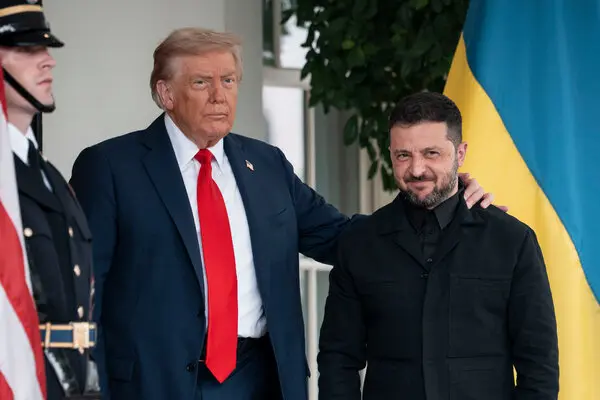
- Ukraine peace deal negotiations center on a revised 20-point framework at Mar-a-Lago.
- Zelenskiy seeks “Article 5” style security guarantees in exchange for potential frontline freezes.
- Massive Russian missile strikes on Kyiv provide a grim backdrop to the Florida summit.
- European leaders boost defense spending as the U.S. pushes for a final agreement.
In a potentially historic development, Ukrainian President Volodymyr Zelenskiy is set to meet U.S. President Donald Trump today, December 28, 2025, at the Mar-a-Lago resort in Florida. This high-stakes meeting represents the most significant diplomatic push to date to resolve the nearly four-year-old conflict.
Sources indicate that a 20-point peace proposal—a document reportedly 90% finalized—could form the framework for a definitive end to the war. This summit comes as a defining moment for Trump, who has positioned himself as the primary architect of a deal that could mark the ninth major conflict he has sought to close during his tenure.
Trump Ukraine Peace Plan: A Strategic Breakthrough at Mar-a-Lago
The road to this summit has been paved with intense, behind-the-scenes negotiations. The current 20-point plan is a revised version of a more controversial 28-point framework proposed by Washington in November, which many critics argued was too favorable to Moscow. The new draft, developed through “24/7” diplomacy involving Trump’s special envoy Steve Witkoff and Jared Kushner, seeks a middle ground.
READ MORE: Zelensky says Russia ‘doesn’t want peace’, ahead of Florida meeting with Trump
While Zelenskiy has signaled a willingness to accept some difficult realities, including a freeze of the current front lines, he remains steadfast on “red lines.” Most notably, Ukraine insists on Article-5-style security guarantees from the U.S. and Europe to ensure any peace is lasting and not merely a pause for Russian rearmament.
The backdrop to today’s talks in Palm Beach is devastatingly tense. Just 24 hours ago, Russia unleashed one of the largest aerial assaults of the 2025 campaign. Over 500 drones and dozens of missiles, including Kinzhal hypersonic weapons, pummeled Kyiv and surrounding regions.
ALSO READ: Trump’s Bold Push to Broker a Ukraine Peace Deal: Can Witkoff Secure Face-Saving for All?
The strikes targeted energy infrastructure and residential buildings, leaving thousands without power or heat and resulting in civilian casualties. From his plane en route to Florida, Zelenskiy described the bombardment as “Russia’s answer to our peace efforts,” suggesting that while the U.S. and Ukraine move toward the table, Vladimir Putin is “raising the stakes” to extract maximum concessions.
Territorial integrity remains the most volatile sticking point. The proposed plan suggests the creation of demilitarized buffer zones and potentially a “free economic zone” in parts of the Donbas. However, the Kremlin continues to demand that Ukraine fully withdraw from the Donetsk, Luhansk, Zaporizhzhia, and Kherson regions—areas Russia partially occupies but has formally “annexed.” Zelenskiy has indicated that any plan involving significant territorial concessions or long-term shifts in sovereignty would likely be put to a nationwide referendum, provided a 60-day ceasefire is established to allow for a secure vote.
European leadership has also stepped up its involvement, wary of being sidelined in a “superpower” deal. On his way to Florida, Zelenskiy stopped in Canada to meet with Prime Minister Mark Carney and held a conference call with EU chiefs, including Ursula von der Leyen and German Chancellor Friedrich Merz. While European nations have pledged “unshakable support” for a just peace, they are also preparing for a future with less American military dependency. Countries like Poland and Switzerland have recently announced massive hikes in military spending, acknowledging that current budgets are insufficient to deter future Russian aggression.
As the 1:00 PM meeting approaches, the world’s attention is fixed on Florida. Donald Trump has been clear about his role: “He doesn’t have anything until I approve it,” he recently noted regarding Zelenskiy’s proposal. If a deal is struck today, it could fundamentally redefine global geopolitics entering 2026. However, with Putin’s forces still pressing on the eastern front and Kyiv demanding ironclad security, the distance between a “framework” and a “permanent peace” remains a perilous gap that only today’s summit can hope to bridge.