


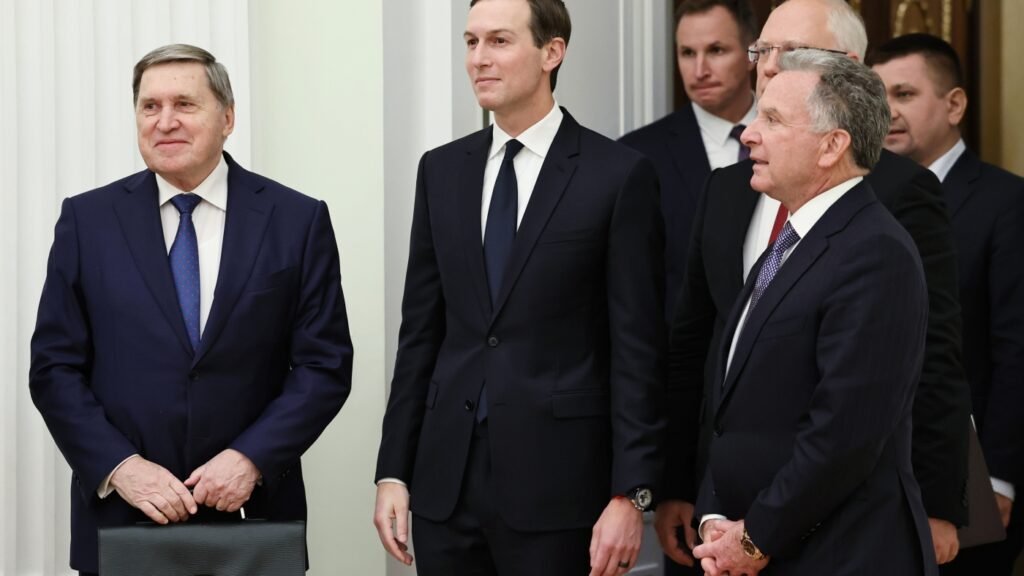
- U.S. negotiators Steve Witkoff and Jared Kushner held “constructive” discussions with Russian envoy Kirill Dmitriev in Miami.
- Ukraine War Peace Talks have intensified as the Trump administration pushes for a resolution before the year’s end.
- Media reports suggest Russian demands remain a major hurdle, though U.S. officials rejected claims that Moscow wants “all of Ukraine.”
- President Zelenskyy expressed openness to a trilateral meeting format involving the U.S., Russia, and Ukraine to facilitate prisoner swaps.
In a significant escalation of diplomatic activity aimed at resolving the nearly four-year conflict in Ukraine, senior U.S. and Russian officials met in Florida this past weekend.
The talks, held in Miami, represent the latest effort by the Trump administration to broker a peace agreement between Moscow and Kyiv. While the atmosphere was described by participants as “constructive,” the meetings have been shadowed by media reports suggesting a wide chasm remains between the two sides, with Russia allegedly maintaining “too demanding” conditions for a ceasefire.
Constructive Dialogue Amid Heavy Demands
The meeting involved a high-profile U.S. delegation, including special envoy Steve Witkoff and Jared Kushner, who sat down with Russian President Vladimir Putin’s special envoy, Kirill Dmitriev. Following the discussions on Saturday, Dmitriev informed reporters that the dialogue was proceeding constructively and was slated to continue through Sunday.
MBS’s Visit To USA: A White House Welcome That Mirrors Trump’s Royal Reception in Riyadh
Despite the optimistic tone from the negotiators, several media reports surfaced suggesting that the Russian side’s requirements for ending the war were prohibitively high. These reports hinted at a stalemate caused by Moscow’s refusal to budge on core territorial and political demands.
Interestingly, neither the U.S. nor the Russian official delegations issued formal public reactions to these specific media claims, opting instead to keep the details of the “constructive” progress behind closed doors.
Clarifying the Scope of Russian Ambitions
U.S. officials privy to the development confirmed that while Russia is indeed “demanding too much,” they sought to temper some of the more alarmist media narratives. Specifically, officials rejected reports suggesting that Russia is currently demanding the entirety of Ukraine and territories beyond its borders. These officials characterized such reports as “creating hype” and potentially undermining the delicate negotiation process.
However, this internal U.S. effort to manage expectations faces a significant challenge from the intelligence community. According to sources familiar with recent U.S. intelligence reports, there remains a persistent warning that Vladimir Putin has not abandoned his long-term goal of capturing all of Ukraine and reclaiming influence over former Soviet territories. This creates a striking duality in Washington:
- Negotiators are focused on finding “overlap” and a “workable” peace plan.
- Intelligence Agencies warn that Putin’s ultimate strategic objectives remain unchanged and maximalist.
The Push for a Trilateral Resolution
As the talks in Florida progressed, Ukrainian President Volodymyr Zelenskyy voiced his cautious support for a new diplomatic format. Speaking in Kyiv, Zelenskyy stated that Ukraine would back a U.S. proposal for trilateral talks involving the United States, Russia, and Ukraine, provided such meetings facilitate immediate humanitarian goals like prisoner exchanges and pave the way for a summit between national leaders.
“America is now proposing a trilateral meeting with national security advisers… If the results are exchanges or some other agreements, I cannot be against it,” Zelenskyy told journalists.
This openness to dialogue comes as Marco Rubio, the U.S. Secretary of State and National Security Advisor, emphasized that the U.S. role is to identify any common ground. Rubio noted that while progress has been made, there is “still a way to go,” expressing hope that a deal could be reached before the end of the year.
The Road Ahead: Security Guarantees vs. Territorial Reality
The crux of the negotiations appears to hinge on a 20-point peace plan that includes robust security guarantees for Ukraine—potentially involving European security forces and U.S.-backed air patrols—in exchange for territorial concessions.
While the Florida meetings have concluded for the weekend, the fundamental tension remains:
- Russia insists on its June 2024 terms, which require Ukraine to abandon NATO ambitions and cede four regions.
- Ukraine remains steadfast in its refusal to officially cede land that Russia has failed to capture on the battlefield.
- The U.S. continues to navigate between these two immovable positions, seeking a “constructive” middle ground that has yet to be publicly defined.
As negotiators return to brief their respective leaders, the world watches to see if the “constructive” spirit of Miami can survive the harsh realities of the front lines and the deeply rooted demands of the Kremlin.