


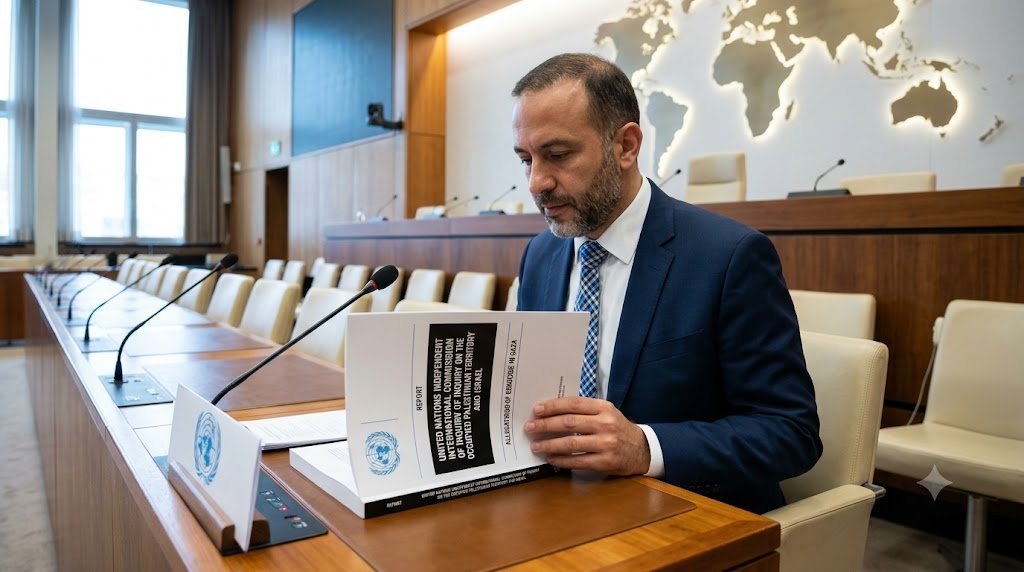
- UN Commission Israel Genocide Report reveals deliberate targeting of Palestinian children in Gaza and the West Bank.
- Senior international jurists documented systematic state-sanctioned violence and war crimes.
- The findings spark massive diplomatic ripples and re-evaluations of international jurisprudence.
- Global leaders face mounting pressure to address institutional complicity and structural corporate risks.
A newly released report by the Independent United Nations International Commission of Inquiry on the Occupied Palestinian Territory and Israel has fundamentally altered the geopolitical landscape. Chaired by former Indian jurist Srinivasan Muralidhar alongside senior international legal experts, the commission declared that the Israeli military has deliberately targeted children in the Gaza Strip and the West Bank.
The commission explicitly stated that these systematic operations satisfy the legal thresholds for genocide in Gaza and constitute distinct war crimes in the West Bank. The report substantiates these findings with testimonies from deployed medical personnel, forensic trajectory analyses of high-yield and precision munitions, and documented instances of non-discretionary force against minors.
State and Regional Accountability Movements
In response to inquiries regarding whether Palestinian, Iranian, or Gulf entities will initiate formal litigation: sovereign states and international advocacy groups are already leveraging this report to expand existing judicial proceedings.
MUST READ: Britain’s Bold Recognition of Palestine Has Redrawn the Map of Global Diplomacy
While individual citizens or non-state groups cannot directly sue a sovereign state in traditional international courts, regional actors are moving through established legal mechanisms:
- The International Criminal Court (ICC): Public prosecutors and legal teams representing Palestinian victims, backed by diplomatic coalitions in the Gulf and broader Middle East, are actively submitting these UN findings as supplementary evidence to fast-track arrest warrants against specific political and military figures.
- The International Court of Justice (ICJ): Sovereign blocks are using the commission’s determination of “genocidal intent” to bolster state-sponsored non-compliance metrics and support multi-state interventions in existing state-responsibility litigations.
Official Domestic Response
The state of Israel reacted with severe condemnation. The Israeli Foreign Ministry categorically dismissed the report as an “outrageous propaganda piece,” a “libelous sham,” and a “modern blood libel.”
READ MORE: Israel deliberately targeted Palestinian children in Gaza, U.N. commission says
The state argued that the document lacks a credible verification mechanism, actively conceals evidence of asymmetric terrorist operations, and deliberately omits crimes committed against Israeli children. The Israel Defense Forces (IDF) declined independent commentary, formally deferring to the Foreign Ministry’s diplomatic position.
Insight: Structural Implications for Global Leadership
For heads of state, diplomatic corps, and multinational CEOs, this development signals a transition from rhetorical condemnation to institutionalized risk. The commission’s recommendation to “target institutions” implies that international risk profiles are shifting from individual accountability to institutional complicity.
- The Corporate Compliance Risk: For enterprises operating in tech, defense, and logistical infrastructure, continuing business-as-usual operations with entities flagged by a UN independent inquiry introduces unprecedented environmental, social, and governance (ESG) vulnerabilities, alongside severe exposure to future secondary sanctions.
- Sovereign Diplomatic Strain: Western and regional governments face acute pressure. The detailed documentation of systematic violations forces a recalculation of bilateral trade frameworks, defense procurement pacts, and intelligence-sharing protocols.
Forecasting: The Next Phase of Global Market and Legal Shifts
- Targeted Institutional Sanctions: Over the next fiscal quarters, expect a proliferation of localized, state-level sanctions targeting third-party supply chains, specific military manufacturing sub-units, and dual-use technology transfers to the region.
- Expansion of Universal Jurisdiction Cases: National judiciaries in states recognizing universal jurisdiction will likely see an influx of criminal complaints filed by human rights syndicates against transit-traveling military and administrative officials.
- Strategic Supply Chain Decoupling: Multinational corporations will increasingly accelerate the de-risking of assets and partnerships tied directly to contested geographic zones to safeguard sovereign portfolio investments and avoid institutional litigation.
Outlook on Institutional Accountability
Ultimately, this landmark inquiry forces an unprecedented re-evaluation of sovereign legal immunity. As regulatory bodies and state actors transition from diplomatic condemnation to targeted institutional frameworks, multinational organizations must proactively insulate their operations from compounding global compliance, supply chain, and litigation risks.