


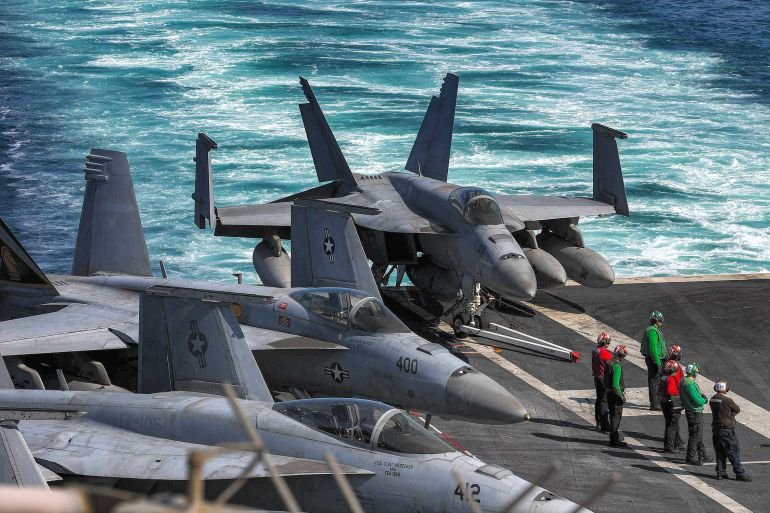
- US attack on Iran appears increasingly likely as American military forces reach full operational readiness across the Middle East.
- President Trump has yet to authorize strikes despite mounting pressure and ongoing internal deliberations.
- Iran has fortified nuclear facilities while rejecting continued negotiations, raising fears of diplomatic collapse.
- Regional states are preparing contingency measures amid concerns that conflict could spread beyond Iran’s borders.
Rising tensions between Washington and Tehran have pushed the Middle East to the brink of a potential new conflict, as senior Western media outlets report that the United States has completed extensive military preparations for a possible strike on Iran—an operation that could unfold at any moment pending authorization from President Donald Trump.
According to sources cited by major U.S. networks, including CNN, American military planners have informed the White House that forces in the region could be ready to launch coordinated attacks as early as this weekend. The final decision, however, remains with Trump, who officials say is still weighing political, military, and strategic consequences before issuing a green signal.
“He is spending a lot of time thinking about this,” one source familiar with internal deliberations said, reflecting uncertainty inside the administration even as operational readiness reaches its peak.
US Attack On Iran: Military Buildup Signals Readiness
In recent days, the United States has significantly reinforced its air and naval presence across the Middle East. Long-range strategic bombers and advanced stealth fighter jets have reportedly been placed on operational alert at regional bases, while multiple aircraft carrier strike groups have moved into international waters within striking distance of Iran.
U.S. Prepares for Iran Attack: Military Buildup, Tehran Tensions, and Drone Threats
Among the most notable deployments is the USS Gerald R. Ford, the most technologically advanced aircraft carrier in the U.S. fleet, expected to arrive in the region imminently. Additional U.S. Air Force assets stationed in the United Kingdom—including aerial refueling tankers and combat aircraft—are also being repositioned closer to potential theaters of operation.
Defense analysts say the scale and coordination of the buildup suggest planning beyond limited deterrence, pointing instead toward preparations capable of supporting sustained military operations, including potential strikes aimed at weakening Iran’s leadership structure.
Diplomacy Falters as Tensions Rise
The military escalation comes as diplomatic efforts appear increasingly fragile. Iranian and U.S. negotiators recently engaged in indirect talks in Geneva, exchanging messages for more than three hours through mediators. While Iranian officials described agreement on a “set of guiding principles,” American officials emphasized that significant differences remain unresolved.
The situation worsened after Iran’s Supreme Leader, Ayatollah Ali Khamenei, publicly rejected continued negotiations, canceling momentum generated by earlier diplomatic contacts and accusing Washington of negotiating under coercion. His remarks have further heightened fears that diplomacy may be collapsing just as military options reach readiness.
White House Press Secretary Karoline Leavitt confirmed that diplomacy remains Trump’s preferred path but stressed that military action remains firmly on the table.
“There are many reasons and arguments that one could make for a strike against Iran,” she said, adding that the president is consulting closely with his national security team before making any decision.
Secretary of State Marco Rubio is expected to travel to Israel later this month to brief Prime Minister Benjamin Netanyahu, underscoring Washington’s coordination with regional allies as tensions escalate.
Regional and Global Calculations
Iran, for its part, has begun reinforcing key nuclear facilities. Satellite imagery analyzed by independent security experts indicates that Tehran is burying sensitive infrastructure beneath layers of concrete and soil, an apparent effort to reduce vulnerability to potential airstrikes.
Across the region, Iran’s neighbors are quietly taking precautionary measures, strengthening air defenses and preparing contingency plans amid fears that any U.S. attack could trigger retaliation affecting energy routes, shipping lanes, and regional stability.
Global geopolitical dynamics also shape calculations. With Russia deeply absorbed in its ongoing war in Ukraine, analysts believe Moscow is unlikely to intervene directly in a U.S.–Iran conflict, limiting Tehran’s prospects for major-power military backing.
An Imminent Decision
Despite growing military readiness, Trump has yet to publicly define clear operational objectives beyond preventing Iran from acquiring a nuclear weapon and signaling openness to regime change. The absence of a defined end-state has fueled debate within Washington and concern among lawmakers about the risks of escalation.
Still, the convergence of military deployments, stalled diplomacy, and increasingly confrontational rhetoric has led many observers to conclude that the region may be approaching a decisive moment.
Whether diplomacy can still slow the momentum toward conflict remains uncertain. But with forces positioned, allies alerted, and negotiations faltering, officials and analysts increasingly warn that a U.S. strike on Iran now appears less hypothetical—and more imminent than at any point in recent years.