


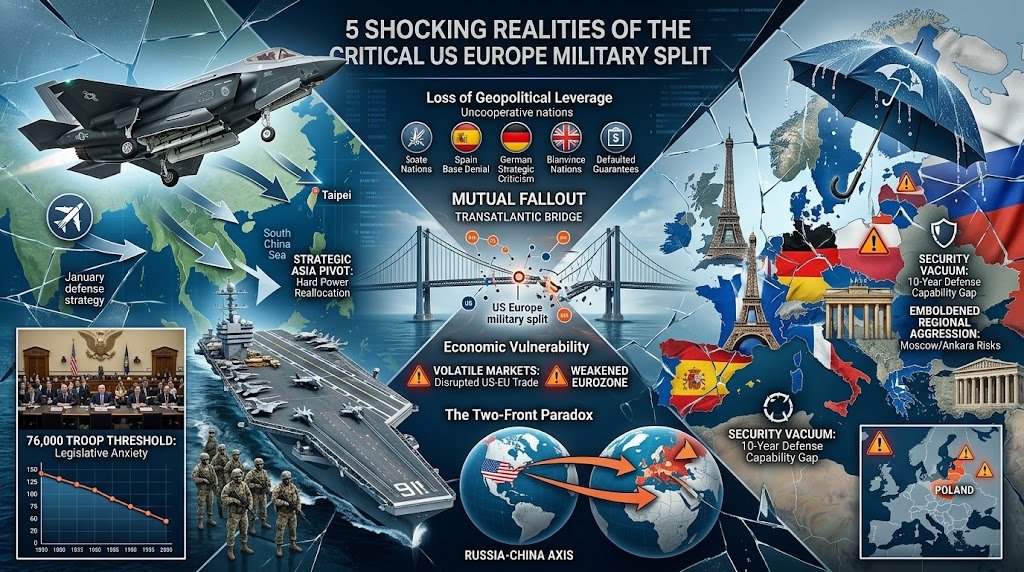
- US Europe Military Split And Functional Decoupling: Recent internal Pentagon disputes over immediate troop drawdowns signal that the U.S. has functionally and irreversibly drifted away from its traditional European security commitments.
- Strategic Asia Pivot: Driven by the January defense strategy, Washington is systematically shrinking its European footprint to aggressively reallocate hard power and resources toward countering Beijing in the Western Pacific.
- European Vulnerability: The sudden American security vacuum exposes severe logistical and intelligence vulnerabilities across the EU, leaving frontline nations highly exposed to regional aggression.
- Mutual Geopolitical Fallout: The isolationist pivot severely damages both powers—leaving the U.S. economically isolated against a rising Russia-China axis, while stripping Europe of its historical defense umbrella.
WASHINGTON — The internal drama ripping through the Pentagon over troop withdrawals is no longer just a policy debate; it is the definitive signal that the United States has functionally parted ways with Europe. While Washington currently frames its hesitation as a “six-month force posture review,” strategic data and political realities indicate that the post-WWII transatlantic alliance has fractured irreversibly.
This decoupling is not a strategic masterstroke—it is a dangerous pivot that forecasts severe economic, military, and geopolitical fallout for both the U.S. and the European Union.
The Hard Data Behind the Departure
The recent blocking of Defense Secretary Pete Hegseth’s bombshell announcement to abruptly slash European troop levels was only a temporary bureaucratic pause, not a reversal of intent.
EXCLUSIVE: US Troop Withdrawal Europe: Hegseth’s NATO Shock Signals Strategic Shift and Rising Risk for Russia-Ukraine War
The trajectory toward American abandonment is already deeply embedded in U.S. policy actions:
- Executed Force Reductions: Washington has already quietly withdrawn an infantry brigade from Romania and canceled a crucial nine-month rotation of an armored brigade to Poland.
- The Asia Pivot Priority: The Pentagon’s defense strategy explicitly mandates a reduction of the European footprint to reallocate finite resources toward countering Beijing in the Western Pacific.
- The 76,000 Troop Threshold: Congressional anxiety has hit a fever pitch, with lawmakers desperately embedding provisions in draft military spending legislation to bar the Pentagon from dropping troop levels below a baseline of 76,000.
Why This Split Explodes into Bad News for Europe
For the EU, the sudden vacuum of American hard power exposes structural vulnerabilities that cannot be mended overnight.
1. An Immediate Security Vacuum
Europe remains heavily dependent on U.S. logistics, intelligence, and nuclear deterrence. A rapid drawdown leaves frontline states—particularly Poland and the Baltic nations—acutely vulnerable. Despite rhetoric demanding Europe “step up,” building matching conventional defense capabilities will take a decade that the continent does not have.
2. Emboldening Regional Aggression
An American exit effectively signals to Moscow that Washington’s umbrella has folded. Rather than showcasing unity at upcoming summits, like the high-stakes meeting in Ankara, Turkey, the alliance is fraying, even prompting NATO officials to consider canceling future summits entirely.
READ MORE: Hegseth Prepared a Bombshell Plan to Cut Troops in Europe. Then It Got Nixed.
Why the U.S. Suffers Equally from the Isolationist Pivot
Proponents of the drawdown argue that the U.S. saves money by forcing Europe to fund its own defense. However, data-driven forecasting reveals that a fractured NATO severely undermines American global supremacy.
- Loss of Geopolitical Leverage: Washington cannot expect European alignment on secondary conflicts if it defaults on primary security guarantees. Spain’s refusal to grant base access during the U.S.-Iran war, and Germany’s vocal criticism of American strategy, are early symptoms of an uncooperative Europe.
- Economic Vulnerability: Security instability in Europe directly translates to volatile global markets. A weakened, unstable Eurozone will severely disrupt the U.S. supply chain and heavily hit bilateral trade relations.
- The Two-Front Paradox: Shrinking the U.S. footprint in Europe to counter China assumes Beijing operates in a vacuum. In reality, fracturing the transatlantic alliance isolates the U.S., leaving it to face a highly coordinated Russia-China axis without its wealthiest bloc of democratic allies.
Forecast: The Irreversible Horizon
Make no mistake: the “review” announced in Brussels is a managed retreat. As senior administration strategists advocate for stripping European obligations to address Asian theaters, the U.S. is trading a stable, historical alliance for an isolated geopolitical position. When Trump meets NATO leaders next week, the rhetoric may focus on defense spending budgets, but the baseline reality is set. The U.S. has already drifted away, setting the stage for a fragmented West that leaves both Washington and Brussels fundamentally less secure.