


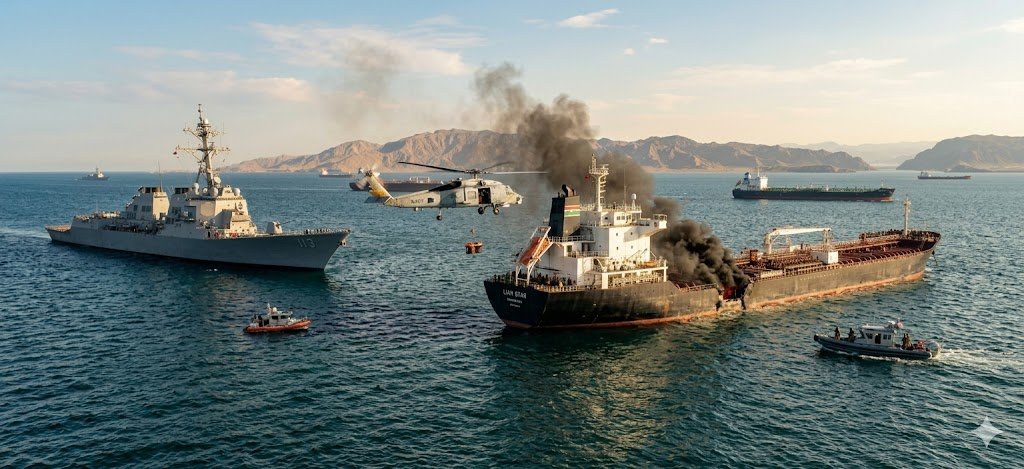
- The US Iran conflict has reached a fever pitch following a direct missile strike disabling a commercial vessel attempting to bypass the naval blockade.
- Tensions are mounting globally as the strategic maritime corridor remains a highly contested chokepoint.
- Internal division within Iran is widening, pitting anti-regime youth activists against staunch state loyalists.
- Diplomatic backchannels continue to stall over severe conditions regarding uranium enrichment and frozen assets.
A high-stakes U.S. missile strike on a commercial vessel evading the Strait of Hormuz blockade threatens to upend delicate ceasefire negotiations, exposing deep domestic fractures within a war-weary Iran.
The volatile waters of the Middle East grew more precarious this week after U.S. military forces fired a Hellfire missile at a commercial ship in the Gulf of Oman. The vessel, identified as the Gambia-flagged merchant ship Lian Star, was targeted by American aircraft in its engine room after repeatedly ignoring more than 20 naval warnings. According to U.S. Central Command (Centcom), the ship was attempting to evade the American naval blockade of the Strait of Hormuz to reach an Iranian port.
While the strike successfully disabled the ship without reported casualties, it has dramatically raised the geopolitical temperature. The kinetic action comes at a highly sensitive moment, threatening to rupture a fragile bilateral ceasefire maintained since April 7, even as senior diplomats from both nations attempt to hammer out a formal framework to end the broader conflict.
Escalation in a Fragile War Zone
The attack marks the sixth commercial vessel disabled by American forces since the naval blockade was launched in mid-April, alongside 116 others that have been forcefully redirected. The blockade is a cornerstone of Washington’s strategy to squeeze Tehran’s economy and force structural concessions. Defense Secretary Pete Hegseth reaffirmed the military’s unyielding stance, asserting that the critical economic artery of the Strait of Hormuz must ultimately become “an open strait, a toll-free strait that the entire world can use.”
US Iran Strikes Escalation Raises Fears of Wider Regional Conflict Amid Fragile Ceasefire
The timing of the strike is precarious. Hours before the attack, U.S. and Iranian negotiators in Doha, Qatar, reported progress on a tentative framework to extend the current ceasefire for another 60 days. This extension is intended to give both sides time to iron out the logistics of removing enriched uranium from Iran and permanent maritime rules. However, critics in Washington, including several high-profile Republican senators, have expressed deep skepticism, warning that a premature deal could allow the Iranian regime to retain regional influence and access billions in frozen assets.
Trump’s Abraham Accords Ambition
President Donald Trump has taken a characteristically bold, if highly scrutinized, approach to the crisis. On Truth Social, Trump signaled that while crucial negotiation conditions remain—such as the total destruction of Iran’s highly enriched uranium and the immediate demining of the Strait of Hormuz—he envisions a sweeping diplomatic resolution.
U.S. military hits commercial ship trying to reach Iran as peace talks continue
In a surprising policy pivot, Trump urged several major Muslim-majority nations, including Saudi Arabia, Qatar, Turkey, and Pakistan, to join the Abraham Accords as part of the final settlement. Most notably, the president extended this invitation to Tehran itself.
“If Iran signs its Agreement with me… it would be an Honor to have them also be part of this unparalleled World Coalition,” Trump posted, claiming it would bring long-term peace to the region.
However, regional analysts and former diplomats have labeled the proposal highly unrealistic given the current climate. Tensions remain at an all-time high not just in Iran, but across interconnected conflict theaters in Gaza and Lebanon. Furthermore, a foundational pillar of Tehran’s state ideology remains the non-recognition of Israel, making any immediate accession to the normalization pact highly improbable.
Mojtaba Khamenei Retreats Underground — and the Behaviour Signals Strategic Weakness
A Fractured Iranian Public
As external military and diplomatic pressures mount, the internal fabric of Iranian society is showing profound signs of strain. The war—ignited in late February by joint U.S. and Israeli airstrikes that killed Iran’s Supreme Leader, Ayatollah Ali Khamenei, on its opening day—has exposed deep, generational divisions among the Iranian people.
In the country’s marginalized border regions, such as the Kurdish communities, decades of state oppression followed by a brutal government crackdown on nationwide protests late last year have left many yearning for regime change. For exiled dissidents and internal opposition fighters, the Western military campaign is viewed as a historic catalyst to topple the Islamic Republic. Activists operating along the mountainous Iran-Iraq frontier report that underground resistance networks are actively preparing for a potential collapse of central authority, viewing the conflict as a battle for sheer existence.
Conversely, a powerful and highly vocal segment of the population has rallied fiercely behind the state. The targeted killing of Khamenei by a foreign power has, paradoxically, fostered a fierce nationalistic wave among religious conservatives, seminarians, and state-aligned militias. For these citizens, the war is an existential defense of the homeland against foreign imperialism. Many young religious students and paramilitary fighters have openly vowed to return to Iran to fight and die on the front lines if a ground invasion occurs, viewing defense of the state as a sacred national duty.
With the economic system fracturing under the weight of the blockade, soaring inflation, and severe shortages of basic goods, the average Iranian citizen is caught in the crossfire. Whether the latest escalation in the Gulf of Oman triggers a collapse of diplomacy or forces a breakthrough, the social and political stability of Iran hangs in a precarious balance.