


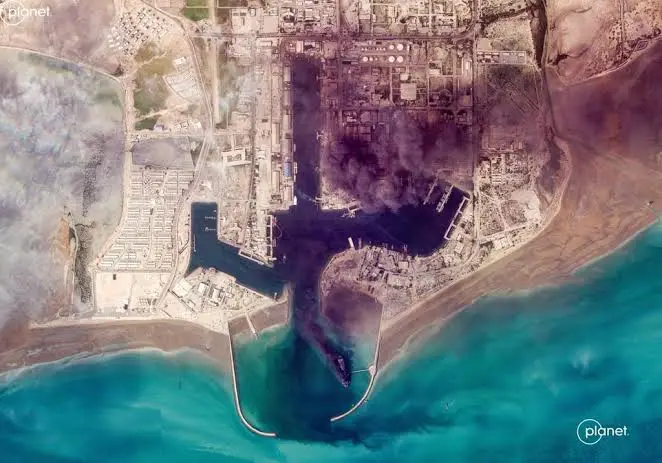
- US-Iran military escalation reaches a critical flashpoint on Thursday following a rapid succession of direct tit-for-tat airstrikes across deep Iranian territory and regional US hubs.
- The Iranian military command ordered a complete closure of the strategic Strait of Hormuz to all commercial shipping and oil tankers, sending shockwaves through global energy markets.
- Precision strikes destroyed critical water networks in Iran’s southern Hormozgan province, leaving more than 20,000 residents without access to clean drinking water.
- President Donald Trump issued an ultimatum on Fox News, demanding Iran sign a proposed peace pact immediately or face continuous, intensified bombardment tomorrow night.
The first intense phase of the direct military confrontation between the United States and the Islamic Republic of Iran has drawn to a temporary, fragile halt. Following 48 hours of unprecedented, direct tit-for-tat airstrikes that shattered a tenuous ceasefire, both Washington and Tehran have pause targeted operations, leaving the global community on edge.
The latest explosion of violence has fundamentally altered the security landscape of the Middle East. While US President Donald Trump has aggressively claimed operational victory—asserting that the United States successfully achieved its strategic targets inside Iranian territory—Tehran responded with widespread retaliatory strikes against American assets deployed across Kuwait, the United Arab Emirates (UAE), Bahrain, and Jordan. With the vital chokepoints of global trade caught in the crossfire, energy analysts warn that global oil prices are poised to skyrocket as markets calculate the risk of a full-scale regional war.
Background: The Apache Downpoint and the Path to Escalation
The baseline of this latest flare-up tracks back to an incident off the coast of Oman involving a US Army Apache helicopter. Following the aircraft’s crash near the strategic Strait of Hormuz, the White House directly blamed Tehran for downing the helicopter, using it as the catalyst to unleash a long-planned, high-intensity kinetic campaign.
U.S. Attack on Iran: Trump Orders Massive Strikes After Iranian Drone Downs US Apache
According to US Central Command (CENTCOM), American forces deployed precision-guided munitions and 49 Tomahawk cruise missiles to neutralize high-value threats. The initial wave focused heavily on Iran’s southern coastline, striking seven critical points including the port city of Bandar Abbas, Qeshm Island, and logistics hubs in Sirik and Minab.
[Apache Helicopter Incident] ➔ [US Tomahawk Strikes (7 Coastal Points)] ➔ [IRGC Regional Retaliation] ➔ [Current Fragile Pause]
President Trump, speaking directly to Fox News from the Situation Room, announced that the initial objectives had been successfully completed. He claimed that senior Iranian officials had contacted his administration directly to plead for a halt to the intense bombardment. Trump signaled that US fighter jets remain active over Iranian airspace but confirmed that the first phase of the campaign had achieved its intended goal: degrading Iran’s military surveillance, communications nodes, and forward-deployed air defense networks.
Retaliation: The IRGC Strikes Back Across the Gulf
Tehran quickly and forcefully rejected Trump’s characterization of the conflict. The Islamic Revolutionary Guard Corps (IRGC) and the Iranian Foreign Ministry denied making any frantic calls to the White House, calling the claims a political smokescreen designed to hide the vulnerabilities of American forces in the region.
U.S. Launches Fresh Wave of Strikes Against Iran
Instead of backing down, the IRGC launched a coordinated wave of retaliatory missile and drone strikes targeting the sprawling web of US military installations in neighboring Gulf states. Iranian state media confirmed that precision projectiles successfully targeted:
-
Bahrain: Home to the US Navy’s Fifth Fleet, which faced direct drone swarms.
-
Kuwait & UAE: Logistics hubs and radar installations supporting western operations.
-
Jordan: Where an allied strike force targeted four distinct US facilities, allegedly destroying an F-35 hangar.
-
Strait of Hormuz: The IRGC claimed the successful downing of an American MQ-9 Reaper drone over Jam in Bushehr Province.
Furthermore, Iran’s military command ordered the complete closure of the Strait of Hormuz to all maritime traffic, including commercial oil tankers. Reports surfaced of air defense activations west of Tehran and deep within Fars province as Iranian infrastructure braced for subsequent waves.
Global Reactions: A Fractured International Community
The sudden shift from a proxy standoff to direct state-on-state warfare has triggered sharp reactions across major global capitals, reflecting deep geopolitical divides.
               ┌── Russia: Condemns "Unprovoked US-Israeli Aggression"
               ├── China: Urges Diplomatic Restraint & Open Lanes
US-Iran Pause ─┼── Iran: Warns of Direct Redefined Rules of Engagement
               └── Pakistan: Deeply Concerned for Regional Stability
Tehran’s Defiance
Iranian Foreign Ministry Spokesman Esmaeil Baqaei declared that diplomacy cannot function in a vacuum of military pressure and bad-faith actions. “Diplomacy and the battlefield are not separate; they operate alongside each other to safeguard our national sovereignty,” Baqaei stated. He emphasized that while Tehran remains open to structured dialogue, its armed forces will instantly enforce new rules of engagement if struck again.
Moscow’s Condemnation
In Moscow, Russian Foreign Ministry Spokeswoman Maria Zakharova pinned the blame entirely on Washington. “We are extremely concerned about this new round of armed confrontation, which began with unprovoked US-Israeli aggression against the Islamic Republic,” Zakharova stated, calling for an immediate and permanent cessation of hostilities before the conflict spirals completely out of control.
Beijing’s Call for Calm
China took a more measured, diplomatically focused stance. Foreign Ministry Spokesperson Lin Jian urged all relevant parties to remain calm, exercise maximum restraint, and halt actions that exacerbate confrontation. Beijing emphasized the critical need to preserve political paths and safeguard international shipping routes, given China’s heavy reliance on Middle Eastern crude.
Regional Alignment
Pakistan’s UN Ambassador, Asim Iftikhar, speaking at the UN Security Council, expressed profound concern over the breakdown of the April 8 ceasefire. He warned that the collapse of diplomatic channels has severely disrupted the IAEA’s verification mandates and created unbearable security consequences for neighboring states.
Economic Fallout: Oil Prices Ready to Skyrocket
The economic fallout of the blockade and subsequent military actions is already reverberating through global financial centers. Prior to this escalation, a study by Moody’s Analytics noted that prolonged tensions in the Persian Gulf had already cost typical US households roughly $750 each due to persistent inflationary pressures.
With the complete, active closure of the Strait of Hormuz—the transit route for twenty percent of the world’s petroleum—energy analysts are predicting an immediate, parabolic spike in crude prices. If the current pause fails to transition into a formal ceasefire, Brent crude is expected to comfortably surpass historic highs, severely impacting global supply chains and triggering fresh waves of inflation across western economies.
Future Perspective: The Dilemma of a Fragile Peace
The current halt in airstrikes offers a brief, highly unstable window for backchannel diplomacy. US Secretary of Defense Pete Hegseth noted that while the initial strikes were intended to strengthen America’s negotiating position and force Tehran to accept a sweeping new accord, CENTCOM’s target bank is continuously being updated.
The fundamental dilemma remains unresolved:
-
The US Position: The White House is caught between wanting a face-saving diplomatic exit and facing intense domestic pressure to not look weak against Iranian regional alignment.
-
The Iranian Position: Tehran has demonstrated that its structural military capacity remains largely intact despite decades of sanctions, and it shows no willingness to negotiate under the direct threat of bombardment.
As fighter jets patrol the skies over the Gulf and naval forces sit on high alert, this temporary pause is less of a peace agreement and more of a tactical reset. The world now watches to see if the next 24 hours will bring a return to the negotiating table or a catastrophic escalation into the second, more destructive phase of the Gulf war.