


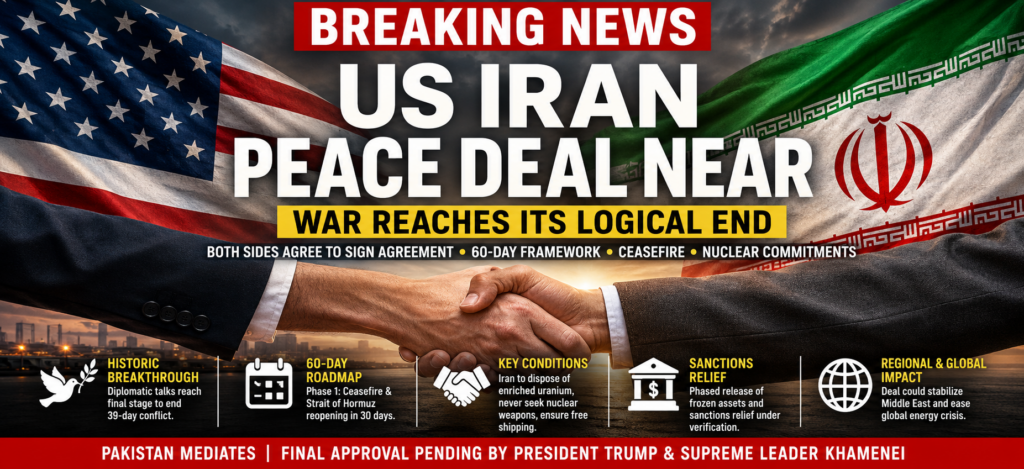
- US Iran peace deal enters final stage as both sides agree on framework to end war
- 60-day roadmap includes ceasefire, Strait of Hormuz reopening, and nuclear commitments
- Pakistan emerges as key mediator in high-stakes diplomacy between Washington and Tehran
- Sanctions relief and frozen assets remain major sticking points in final negotiations
The United States and Iran are moving decisively toward what officials on both sides describe as the “logical end” of a brief but intense war, with a preliminary peace agreement now within reach and negotiations entering their most critical phase yet.
Speaking at the White House on Thursday, U.S. Treasury Secretary Scott Bessent confirmed that Washington and Tehran have exchanged multiple proposals and are now close to finalizing a framework that could halt hostilities and begin a structured de-escalation process. “We perhaps have the makings of a deal here,” Bessent told reporters, signaling growing confidence within the administration that a breakthrough is imminent. However, he emphasized that the final decision rests with President Donald Trump, who has yet to formally approve the terms.
The emerging agreement, according to U.S. officials, outlines a 60-day roadmap aimed at ending the conflict in phases. The first 30 days would focus on dismantling maritime blockades and restoring full access to the Strait of Hormuz, a critical global energy artery through which nearly one-fifth of the world’s oil supply passes. The remaining period would be used to negotiate a broader and more durable settlement, including long-term restrictions on Iran’s nuclear program.
Central to Washington’s conditions is Iran’s commitment to dispose of its stockpile of highly enriched uranium, provide verifiable assurances that it will never pursue nuclear weapons, and guarantee the uninterrupted flow of commercial shipping through the strait. These demands, officials say, form the backbone of a proposed memorandum of understanding that could serve as the foundation for a lasting peace.
US Iran Strikes Escalation Raises Fears of Wider Regional Conflict Amid Fragile Ceasefire
Iran, for its part, has signaled cautious optimism while maintaining that key issues remain unresolved. Officials in Tehran have indicated that a final draft of the agreement is still under discussion, with sensitive provisions related to sanctions relief, frozen assets, and regional security arrangements yet to be fully agreed upon. Notably, Iran is seeking the unfreezing of billions of dollars held abroad under U.S. sanctions, as well as assurances of a durable ceasefire in Lebanon.
Diplomatic sources suggest that Pakistan has played a pivotal role as the primary mediator in the talks, facilitating backchannel communications and helping bridge gaps between the two adversaries. Iranian officials have hinted that any final agreement could be formally announced through Islamabad, underscoring Pakistan’s growing influence as a regional negotiator.
U.S. and Iran Have ‘Makings of a Deal,’ Bessent Says
Despite the progress, significant political hurdles remain. President Trump has repeatedly stated that he will not rush into an agreement and insists that any deal must align with broader U.S. strategic objectives, including the expansion of the Abraham Accords to include additional Middle Eastern countries. His administration has also warned that failure to reach an acceptable deal could result in a resumption of military operations.
On the Iranian side, the decision-making process has been complicated by the reported isolation of Supreme Leader Mojtaba Khamenei, who is believed to be operating from a secure and undisclosed location with limited direct communication with senior officials. His approval is considered essential for any final agreement, adding an additional layer of uncertainty to the negotiations.
Iran Prepares Possible Retaliation Against US Bases as Ceasefire Teeters on Brink
The conflict, which has lasted 39 days, has inflicted significant damage on both sides. U.S. strikes targeted key Iranian military and nuclear facilities, while Tehran responded with attacks on regional energy infrastructure and disruptions to maritime traffic in the Gulf. The economic fallout has been severe, with global oil prices surging and financial markets experiencing heightened volatility.
Even as negotiations have advanced, tensions have not fully subsided. This week alone has seen exchanges of fire between U.S. and Iranian forces, including a ballistic missile launch by Tehran toward Kuwait that was successfully intercepted. These incidents highlight the fragile nature of the current ceasefire and the urgency of securing a formal agreement.
Under the proposed framework, the United States would consider phased sanctions relief and the gradual release of Iranian funds, contingent on strict verification measures. However, Washington has made clear that its “maximum pressure” campaign—referred to by officials as “Economic Fury”—will remain in place until Iran fully complies with its obligations.
If finalized, the agreement would mark the first step in a broader diplomatic effort to reshape U.S.-Iran relations and stabilize the Middle East. It could also pave the way for a more comprehensive nuclear deal, potentially extending restrictions on Iran’s program for decades.
For now, both sides appear aligned in their desire to bring the war to a close. While challenges remain, the trajectory of negotiations suggests that the conflict is approaching its logical end, with a historic peace deal increasingly within reach. The coming days will determine whether political will on both sides can translate diplomatic progress into a lasting resolution.