


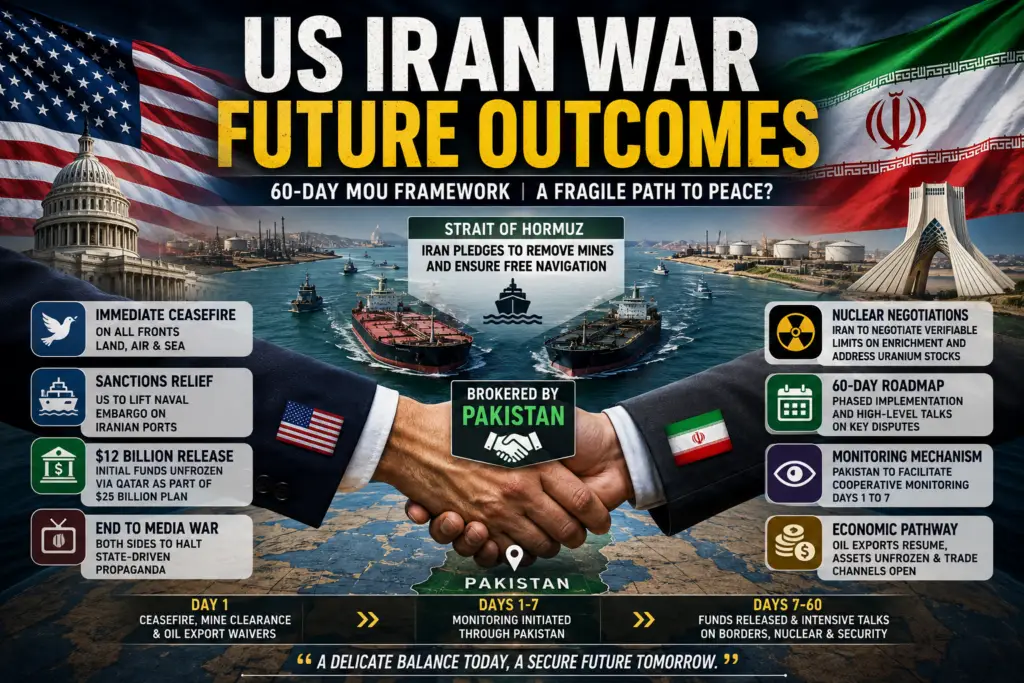
- US Iran War Future Outcomes hinge on a 60-day MoU framework brokered by Pakistan
- Strait of Hormuz reopening tied to sanctions relief and oil export resumption
- $12 billion in frozen Iranian assets may be released via Qatar under phased plan
- Nuclear verification remains the biggest obstacle to final agreement
The 60-day transitional framework known as the Memorandum of Understanding (MoU), which is presently being finalized, was created by Pakistani mediators to close the gap between Iranian circumstances and American demands. This draft serves as a high-stakes roadmap rather than a permanent peace treaty and quickly ends hostilities and establishes a rigorous “relief-for-performance” schedule to resolve the most contentious topics.
To understand the core terms for MoU ,includes the Strait of Hormuz Reopening where Iran pledges to remove naval mines right away and allow free, unrestricted commercial shipping passage through the Strait of Hormuz.
In exchange for free waterways, Iran will be able to immediately resume its international oil shipments if the United States lifts its wartime naval embargo on Iranian ports.
Furthermore, MoU draft phased as Iranian assets overseas will be gradually unfrozen. As part of a larger $25 billion financial settlement plan under discussion, an initial $12 billion in frozen funds will be released; these funds may be safely routed through Qatar to maintain transparency.
Trump Iran Surgical Strikes Continue as Ceasefire Holds Despite Apache Helicopter Incident
According to the plan, both parties agree to a complete pause of hostilities on all fronts (land, air, and sea) and a stop to state-driven media warfare, while the United States agrees to scale back its enormous naval and military presence near Iranian waters.
The MoU uses a precise timeline to distinguish between the immediate end of the war and more complicated geopolitical disputes in order to prevent the agreement from collapsing over long-standing disputes.
Iran war live: ‘We’re going to be attacking’ – Trump threatens Iran again
Iran starts clearing mines in the Strait of Hormuz, the US eases port blockades to provide initial waivers for oil exports, and an instantaneous ceasefire on all fronts is implemented on the first day of the official announcement.
In order to secure the truce, cooperative monitoring processes are formally initiated through Pakistan between days 1 through 7. The release of the first $12 billion in frozen assets through Qatari banking networks marks the beginning of a critical negotiation window that runs from days 7 to 60.
Middle East war updates: Israel strikes Iran after major Sunday missile barrage terminates April ceasefire
Both countries hold intense talks over the course of these two months about long-term regional borders, which will finally result in the completion of verified nuclear processes and the removal of Iran’s uranium stocks.
The proposed Memorandum of Understanding’s handling of Iran’s nuclear material is its most sensitive feature. However, Tehran initially objected to having its nuclear program included in the first phase of the truce, However, a compromise was made due to intense pressure from US negotiators, who also threatened to resume military operations.
Iran has agreed to negotiate rigidly, verifiable restrictions on its uranium enrichment and has pledged in writing not to pursue nuclear weapons under the current plan. More, it contains a clear pledge to deal with the removal or surrender of its highly enriched uranium stocks within the 60-day period.
Although President Trump has publicly described the agreement as “mostly negotiated,” he insists that his approval is “50/50” until Tehran signs the final language pertaining to nuclear verification. A formal announcement is anticipated in the next several days as Pakistani, American, and Iranian diplomats continue to refine the draft.