


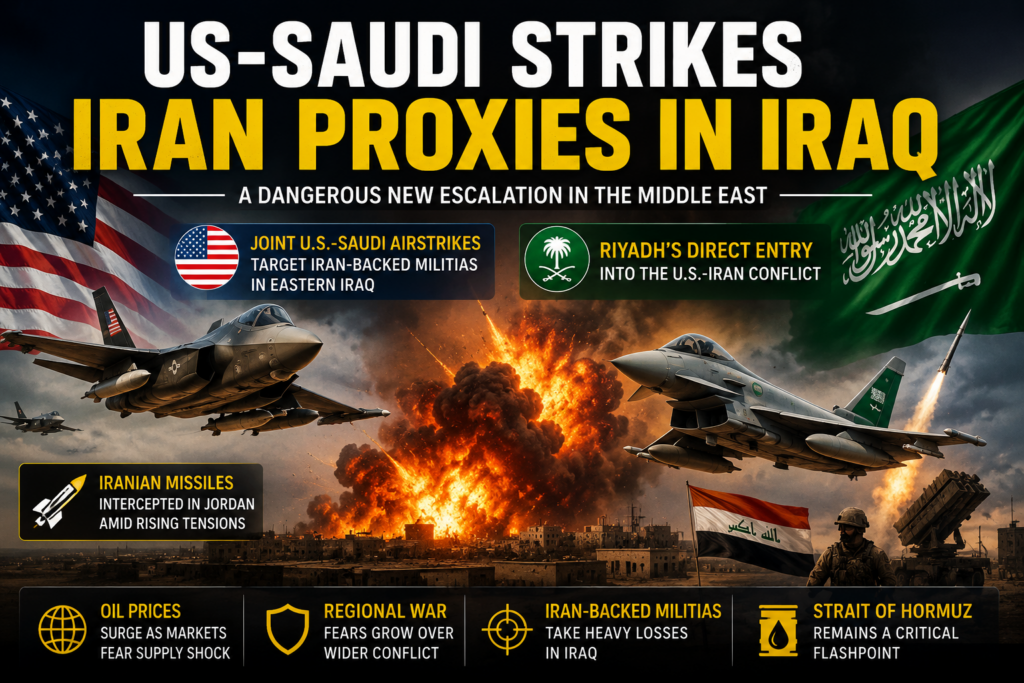
- US Saudi strikes Iran proxies mark a major escalation in Iraq, signaling Riyadh’s direct military entry into the conflict.
- Forces strikes Iran proxies follow Iranian missile launches and drone attacks targeting American forces in the region.
- Strikes on Iran’s proxies have triggered oil price surges and heightened fears of a wider Middle East war.
U.S.–Saudi Airstrikes on Iran-Backed Militias Signal Dangerous New Phase in Middle East Conflict
Fighter jets from the United States and Saudi Arabia carried out coordinated overnight strikes on Iran-backed militia targets in Iraq, marking a significant escalation in the regional conflict and signaling Riyadh’s direct military entry into a war that has steadily intensified between Washington and Tehran.
According to U.S. Central Command, the joint operation targeted “logistics and weapons facilities across eastern Iraq,” in retaliation for a surge of more than 30 drone attacks attributed to Iran’s Islamic Revolutionary Guard Corps (IRGC) in recent days. Saudi Arabia confirmed its participation, though officials offered limited operational details, underscoring the sensitivity of the move.
The strikes came just hours after U.S. air defenses intercepted multiple Iranian ballistic missiles aimed at American personnel in the region—an incident officials described as an “attempted surprise attack.” The rapid sequence of events has raised fears of a broader regional confrontation, potentially derailing already fragile diplomatic efforts.
The escalation threatens to undo a tentative pause in hostilities that had been promoted by President Donald Trump to revive stalled negotiations with Iran. While it remains unclear whether the intercepted missile attack and the subsequent U.S.–Saudi strikes were directly coordinated responses, the timing underscores the volatility of the conflict and the narrowing space for diplomacy.
Iran, meanwhile, claimed responsibility for launching missiles toward a U.S. military base in Jordan, describing the move as retaliation against “aggressive actions by the U.S. military.” Jordanian authorities confirmed that their air defense systems intercepted five incoming missiles, preventing casualties and damage.
READ NEXT: A New Maritime Crisis Unfolds as Red Sea Blockade Deepens Global Trade Risks
Analysts say Saudi Arabia’s direct involvement marks a strategic turning point. Mark Cancian, a senior adviser at the Center for Strategic and International Studies, described the move as a “major step” for Riyadh, indicating a shift from cautious positioning to active military engagement.
“Saudi Arabia appears to have lost patience,” Cancian noted. “This signals a willingness not only to confront Iran’s proxy network directly but also to potentially allow expanded U.S. military operations from its territory.”
Riyadh justified its actions by citing repeated attacks on its oil infrastructure by Iran-backed militias operating in Iraq. In a statement, the Saudi Foreign Ministry said the kingdom “does not seek escalation” but would respond decisively to threats against its national security.
READ MORE: Saudi Arabia joins U.S. military strikes on Iranian proxies
On the ground, Iraq’s Popular Mobilization Forces (PMF)—a coalition of mostly Iran-aligned armed groups—reported that at least 20 of its fighters were killed in the strikes, highlighting the human toll and the risk of further retaliation.
Global markets reacted swiftly. Brent crude prices rose by approximately 3.5 percent to $87 per barrel, reflecting renewed fears over supply disruptions. The Strait of Hormuz, a critical chokepoint for global energy shipments, remains at the center of tensions, with Iran continuing to leverage its strategic position amid ongoing disputes with the United States.
The broader conflict has already seen Iran-linked Houthi forces in Yemen declare a blockade on Saudi oil shipments in the Red Sea, further complicating energy security and regional stability. Saudi air operations against Houthi positions in recent days suggest a widening military campaign aimed at weakening Iran’s network of regional allies.
Despite the intensifying military activity, experts caution that Saudi Arabia is unlikely to abandon diplomatic engagement altogether. Anna Jacobs of the Arab Gulf States Institute noted that Riyadh’s actions are as much about deterrence as escalation.
“This is a calibrated signal to Iran,” Jacobs said. “Saudi Arabia is demonstrating resolve while still keeping diplomacy as a core pillar of its broader regional strategy.”
The conflict, now entering its sixth month, has already exacted a heavy toll. At least 18 U.S. service members have been killed and more than 600 wounded since hostilities began, with recent casualties underscoring the persistent risks faced by American forces in the region.
What began as a limited confrontation has steadily evolved into a complex, multi-front conflict involving state and non-state actors across Iraq, Yemen, the Gulf, and beyond. The latest U.S.–Saudi strikes may prove to be a decisive moment—either reinforcing deterrence or accelerating the region toward a wider and more dangerous war.