


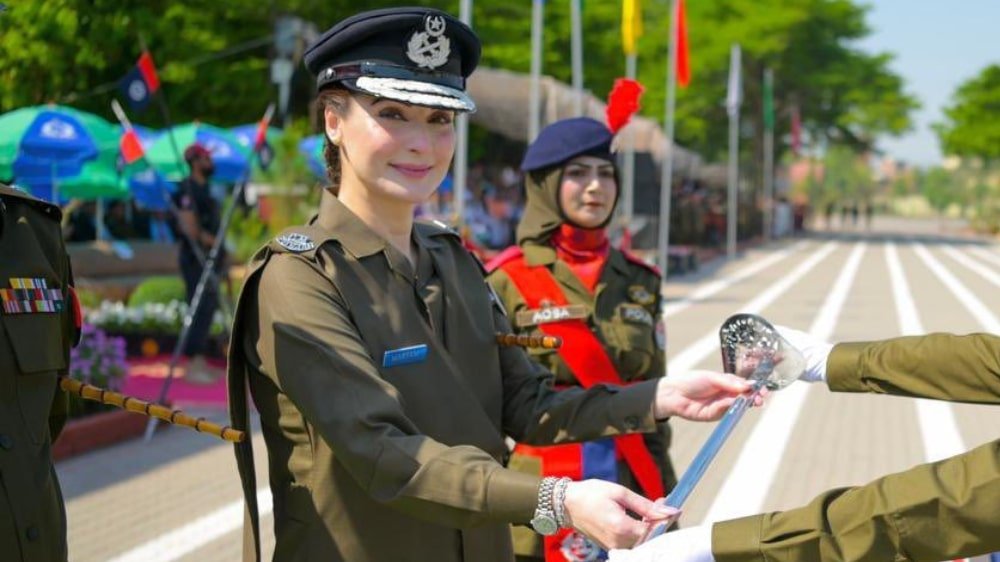
- Maryam Nawaz Sharif’s visionary leadership brought the first-ever female officers into the century-old Border Military Police, breaking deep-rooted traditions in South Punjab.
- By appointing Ashfaq Ahmed Chaudhary as Commissioner of Dera Ghazi Khan, Maryam ensured merit-based governance and a results-driven reform agenda.
- Together, Maryam and Ashfaq delivered a transparent recruitment process praised by the United Nations, global leaders, and women’s rights advocates worldwide.
- Their partnership is setting a new benchmark for gender inclusion in Pakistan’s security forces, inspiring reforms across South Asia.
DERA GHAZI KHAN, Pakistan — In a move that is reshaping the contours of policing in Pakistan’s rugged tribal belt, the Border Military Police (BMP) has, for the first time in its century-long existence, inducted female officers. The unprecedented step — hailed by the United Nations, former U.S. First Lady Melania Trump, and a princess of the United Arab Emirates — is being celebrated as a milestone for women’s empowerment in South Asia’s traditionally male-dominated security sector.
At the heart of this transformation is Chief Minister Punjab Maryam Nawaz Sharif, whose commitment to gender inclusion has begun to translate into concrete change on the ground. For her, the induction of female officers into the BMP is more than a staffing decision — it is a statement of political will, a demonstration that even the most entrenched institutions can be reformed to reflect the values of equality and representation.
The Commissioner’s Mandate
When Ashfaq Ahmed Chaudhary assumed the role of Commissioner of Dera Ghazi Khan Division in January 2025, he carried with him a singular mission: to improve the lives of hundreds of thousands living in one of Punjab’s most underdeveloped regions, and to do so in line with the vision of Chief Minister Maryam Nawaz Sharif. His appointment, made after a rigorous merit-based selection process involving the Chief Minister, Punjab’s Chief Secretary, and senior decision-makers in Islamabad and Rawalpindi, placed him at the helm of a division that has long struggled with security challenges and socio-economic deprivation.
Trump’s Warm Welcome to Field Marshal Asim Munir Signals New Era in Pakistan-U.S. Ties
One of the earliest challenges Commissioner Chaudhary faced was the urgent need for recruitment within the Border Military Police, a force tasked with maintaining law and order in the semi-autonomous tribal areas of South Punjab. For decades, its ranks had been closed to women, leaving a gaping hole in its ability to address crimes against female victims and to interact with communities where cultural norms restrict women from speaking to male officers.
“From my first day in office, I knew we had to change this,” Chaudhary said in an interview. “The absence of women in the BMP wasn’t just a staffing issue — it was a human rights issue. And I knew the Chief Minister shared that conviction.”
Breaking a Hundred Years of Tradition
With the full backing of Maryam Nawaz Sharif, Chaudhary set out to make history. The recruitment drive, launched in early 2025, was the first in 27 years — the last intake of BMP personnel having taken place in 1998. In that time, the force had faced mounting challenges: cross-border smuggling, insurgent activity, and the complexities of policing tribal territories where modern law often intersects uneasily with traditional codes.
READ MORE: A Razor’s Edge Between India and Pakistan
This time, the recruitment process was different. A high-powered selection committee — headed by Commissioner Chaudhary and including officers from military intelligence, two deputy inspector generals, district commissioners, and political agents — was tasked with ensuring transparency and meritocracy. No political favors, no nepotism. Every candidate would be evaluated on their abilities, physical fitness, and qualifications.
ALSO READ: Maryam Nawaz Sharif’s Symbolic Gesture: A Beacon of Empowerment in Pakistani Law Enforcement
The results spoke for themselves: out of 646 total recruits, 53 were women — 41 in Dera Ghazi Khan and 12 in Rajanpur. For an institution that had, until now, been exclusively male, the inclusion of women was nothing short of revolutionary.
International Praise
The announcement was met with swift and enthusiastic reactions from abroad. The United Nations released a statement commending Punjab’s leadership for “demonstrating that gender inclusion in security forces is not only possible in conservative societies, but essential for building trust with local communities.”
Melania Trump, speaking at a women’s leadership forum in Washington, called the move “a symbol of courage for women serving in conflict-prone regions” and praised Maryam Nawaz Sharif for “leading by example in the Muslim world.”
From the Gulf, a princess of the UAE issued a public congratulations, describing the induction of female officers as “a defining moment for women in the Islamic world, where tradition and modernity can walk side by side in service of justice and peace.”
Transforming Policing in the Tribal Belt
For local communities, the implications of this change are profound. In many parts of the tribal belt, cultural restrictions have long discouraged women from reporting crimes — particularly those involving domestic abuse, harassment, or sexual violence — to male officers. The presence of female personnel within the BMP is expected to significantly increase the reporting of such cases and to improve the quality of investigations.
Security experts also point to operational advantages. Female officers can play critical roles in intelligence gathering, community outreach, and search operations where male officers are not permitted to interact with women. In counter-terrorism and anti-smuggling operations, their inclusion adds both capability and credibility.
“This is not just about equality; it’s about effectiveness,” said Dr. Nadia Farooq, a security analyst based in Islamabad. “When half the population is excluded from the security apparatus, you are operating at half capacity. Maryam Nawaz Sharif’s decision changes that equation.”
Maryam Nawaz Sharif’s Broader Vision
The move is consistent with the Chief Minister’s broader political agenda, which places heavy emphasis on women’s empowerment, education, and economic inclusion. Since taking office, Maryam has launched initiatives aimed at increasing female enrollment in higher education, expanding healthcare access for rural women, and ensuring greater representation in provincial administration.
In her own words, “Empowering women is not just a social cause; it is an economic and national security imperative. A state that neglects its women neglects its own future.”
Political observers in Brussels note that this approach aligns with the European Union’s development priorities in Pakistan, which emphasize gender equality as a prerequisite for long-term stability and growth. The recruitment of women into the BMP, they argue, could strengthen Punjab’s case for enhanced international cooperation and funding for governance reforms.
A Model for South Asian Region
The significance of this reform extends far beyond the borders of Punjab. In South Asia, where policing traditions are often steeped in patriarchal norms, the induction of women into security forces has historically faced resistance from within the institutions themselves, as well as from segments of society. Pakistan’s example, particularly in a region as socially conservative as South Punjab, may inspire similar moves in neighboring countries.
Geneva-based human rights organizations have already taken note. “The lesson here is that leadership matters,” said Laurent Dubois, a senior adviser at the International Commission of Jurists. “Maryam Nawaz Sharif’s political commitment, combined with an honest and merit-based administrative process, has achieved in months what some countries have failed to do in decades.”
Challenges Ahead
Despite the widespread praise, challenges remain. Integrating female officers into a historically male force will require more than just recruitment. Training programs will need to address not only operational skills but also cultural sensitivities and the risk of internal resistance. Adequate facilities, such as secure barracks and gender-sensitive equipment, will be essential to ensure the safety and effectiveness of the new recruits.
Commissioner Chaudhary acknowledges these hurdles but remains optimistic. “Change is never easy, especially in institutions with deep traditions,” he said. “But these women have already proven their resilience by getting here. I have no doubt they will excel.”
A Turning Point
In the streets of Dera Ghazi Khan and Rajanpur, the sight of women in BMP uniforms is still new, still surprising. But for the young girls who watch them march in formation, it is also inspiring — a visual proof that their aspirations need not be limited by convention.
As one newly recruited officer put it during her training, “We are not just protecting borders; we are crossing them.”
For Maryam Nawaz Sharif, that sentiment captures the essence of her leadership. In a part of the world where political rhetoric often overshadows tangible results, she has delivered a policy change that will leave a lasting mark on Pakistan’s security landscape and its journey toward gender equality.
And in the annals of the Border Military Police — a force that has patrolled the edges of Pakistan for more than a century — 2025 will be remembered as the year the lines on the map did not move, but the boundaries of possibility did.