



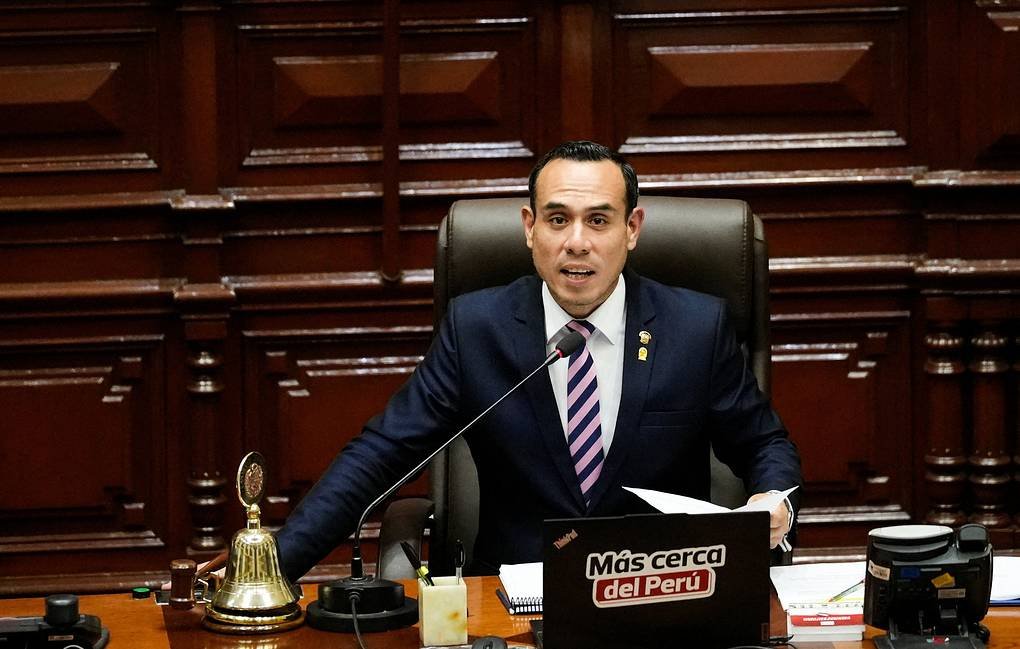
Peru’s President José Jerí is in hot waters.
In the volatile landscape of Peruvian politics, where presidents rarely complete their terms, José Jerí’s brief tenure as interim leader is already teetering on the edge. Sworn in on October 10, 2025, following the impeachment of Dina Boluarte amid soaring crime rates and corruption allegations, Jerí now faces his own crisis.
A preliminary investigation by the country’s prosecutor and looming impeachment proceedings in Congress stem from undisclosed meetings with Chinese businessman Zhihua Yang, igniting accusations of opacity and potential graft. This “Chifagate” scandal, named after the Chinese restaurant where one encounter occurred, underscores the perils of Peru’s deepening ties with China, blending economic opportunity with political risk.
A New Power Shift in Asia: South Korea Steps Back as Japan Confronts China
Jerí, a 38-year-old conservative former Congress president, assumed office promising stability and a crackdown on crime. Yet, just months into his role, local media outlets exposed two clandestine meetings with Yang: one on December 26, 2025, a hooded dinner at a chifa (Chinese-Peruvian restaurant) in Lima’s San Borja district, and another on January 6, 2026.
Peruvian protocol requires presidential agendas to be public, and Jerí’s failure to disclose these rendezvous fueled suspicions. In a televised apology, Jerí described the first as a “friendly” gathering tied to Peru-China Friendship Day, admitting it was a “mistake” but denying impropriety. He pledged cooperation with investigators, but critics remain unconvinced.
Peru’s president embroiled in scandal over failure to disclose meetings with Chinese businessman
Who is Zhihua Yang, and why the meetings? Known locally as “Johnny” Yang, he is a prominent Chinese entrepreneur with stakes in commercial retail and a lucrative energy concession from the Peruvian state. Reports suggest the discussions may have involved a contract worth 112 million soles (about $30 million), potentially linked to infrastructure or energy projects.
Yang’s status as a state contractor raises red flags, evoking fears of influence peddling in a nation scarred by scandals like Boluarte’s “Rolexgate.” Analysts argue the meetings reflect Jerí’s pattern of engaging Chinese interests, possibly for economic leverage amid Peru’s fiscal woes. Jerí’s past includes corruption allegations, including a dismissed bribery claim involving 150,000 soles for budget favors, and a shelved sexual assault probe—shadows that amplify scrutiny.
Chinese nationals Targeted in Deadly Kabul Hotel Siege
Bilateral trade statistics highlight this interdependence. In 2024, trade reached $43.36 billion, up 15.1% year-on-year, with Peru exporting $29.42 billion—primarily copper ore (60%), iron ore, fishmeal, and silver concentrate—to China, its top partner absorbing 39% of exports.
Imports from China totaled $13.94 billion, including machinery ($2.12 billion), electronics ($1.95 billion), and vehicles. From 2019-2024, trade grew from $23.7 billion to $43.36 billion, averaging 14.6% annual growth post-2023. By November 2025, monthly exports hit $3.89 billion, yielding a $2.39 billion surplus for Peru. This asymmetry—Peru as raw material supplier, China as manufacturer—fuels dependency critiques, but it sustains jobs and revenue.
Yet, this episode unfolds within robust China-Peru bilateral relations, a cornerstone of Peru’s economy. Diplomatic ties, formalized in 1971, have evolved into a strategic partnership, bolstered by Peru’s 2009 free trade agreement (FTA) with China—the first in Latin America—and its 2019 Belt and Road Initiative (BRI) accession. Upgraded in 2024, the FTA emphasizes mining, agriculture, and digital sectors.
The Chancay Port, a BRI flagship opened in November 2024, positions Peru as a gateway for Chinese goods into South America, despite U.S. concerns over Beijing’s influence. Relations remain stable despite Peru’s turmoil, with Chinese investments dominating mining (over 30% of Peru’s output) and energy.
Analytically, the scandal exposes tensions in this alliance. China’s “no-strings” investments offer Peru quick wins, but opaque dealings risk corruption in a fragile democracy. U.S. countermeasures, like funding a $1.5 billion naval base expansion, signal escalating rivalry.
If impeachment succeeds, it could chill relations, delaying projects like CNPC’s $500 million gas venture in Cusco, slated for late 2026. Yet, economic imperatives may prevail; successive Peruvian governments have prioritized Beijing for stability.
The prosecutor’s probe focuses on potential abuse of power and corruption, while Congress, Jerí’s former domain, debates impeachment for “moral incapacity”—the same charge that felled Boluarte. This comes against Peru’s chronic instability: Jerí is the eighth president in a decade, with public trust eroded by protests and crime waves.
The scandal risks derailing his interim mandate, set to end in July 2026, and could trigger fresh unrest, as seen in October 2025 clashes that left one dead.
Jerí’s fate hinges on transparency. In a nation weary of scandals, this could mark another short-lived presidency, testing the resilience of Peru-China bonds. As elections loom in April 2026, the scandal may reshape alliances, but trade’s momentum suggests enduring ties—provided politics doesn’t derail progress.