



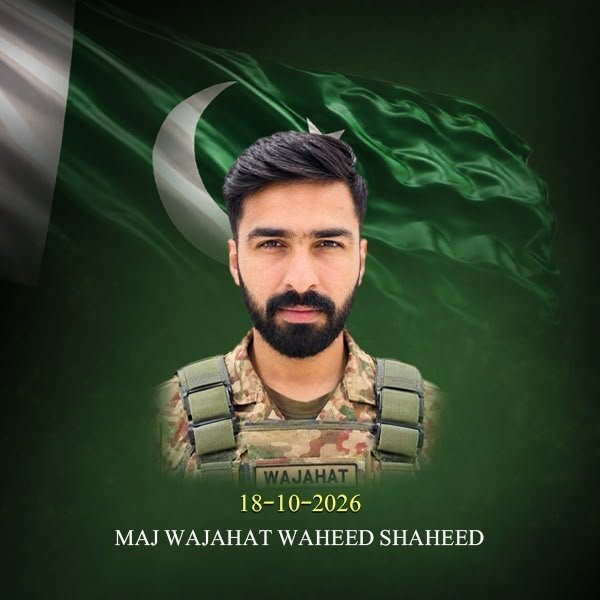
Pakistan Army fights terrorism on multiple fronts as Major Wajahat Waheed is martyred during an operation in Balochistan.
Security forces report killing eight militants in three operations and recovering 490 kilograms of explosives in Khuzdar.
Pakistan’s security commitments to Saudi Arabia add a regional dimension to its ongoing domestic counterterrorism campaign.
Another son of the soil, Major Wajahat Waheed, was martyred while fighting terrorists in Pakistan’s restive Balochistan province, as the country’s armed forces pressed a widening counterterrorism campaign against what authorities describe as foreign-sponsored militants.
Waheed, 34, from Lahore, was leading soldiers during a clearance operation in Shadi Kaur, near Pasni in Gwadar district, when an improvised explosive device struck the force on October 18, according to the military’s Inter-Services Public Relations directorate. His death came as troops confronted militant hideouts.
Pakistan Army Counterterrorism Operation in Balochistan Crushes 216 Terrorists as Global Support Pours In After Deadly Attacks
In nearby Jattakabad, Kalat district, security forces killed four militants after an intense exchange of fire and recovered weapons and ammunition, the military said. The operations followed intelligence reports of hideouts linked by Pakistani authorities to Fitna al-Hindustan, a term Islamabad uses for militants it alleges are backed by India. Those allegations are part of Pakistan’s official account and could not be independently verified.
The losses underline the pressure on Pakistan’s military, which is fighting on two major fronts at home while also supporting Saudi Arabia’s security amid Houthi attacks. Pakistan has deployed military capabilities to the Kingdom under its defence arrangements, with the Gulf News reporting on the trilateral commitment to help protect Saudi security. The deployment adds a regional responsibility as Pakistani forces continue operations at home.
Pakistan army chief vows separatist militants will not succeed in disintegrating country
In Balochistan, armed groups have attacked security personnel, transport routes and infrastructure while seeking to challenge the government’s authority. On October 17, security forces conducted operations in Quetta, Nushki and Khuzdar, killing eight militants, according to the military. In Panjpai, troops intercepted an attempt to establish a roadblock; in Nushki, they raided a hideout; and in Khuzdar, they recovered 490 kilograms of explosives.
The explosive seizure suggests a threat beyond isolated attacks, including bombings against patrols, roads, installations and civilians. Authorities say clearance and sanitisation operations will continue to find remaining militants and prevent them from regrouping.
The Express Tribune’s report on the October 17 operations detailed the deaths of eight militants and the recovery of the explosives. The Islamabad Telegraph has also examined the security challenge in Balochistan, where the contest involves not only armed engagements but public confidence, economic opportunity and the state’s ability to protect communities.
Pakistan’s military says its counterterrorism campaign will continue under Azm-e-Istehkam, the framework approved by the Federal Apex Committee under the National Action Plan. The stated objective is to dismantle terrorist networks and remove the threat of foreign-sponsored violence. The campaign’s effectiveness, however, will depend on sustained intelligence work, cooperation from local communities, credible governance and protection for civilians caught in the conflict.
The challenge is particularly acute in Khyber Pakhtunkhwa, where militants have continued to target security forces and state institutions, and in Balochistan, where separatist violence and attacks on infrastructure have disrupted daily life. The two theatres require local approaches and persistent pressure on armed networks.
Al Arabiya English’s Pakistan coverage follows Islamabad’s security ties across the Gulf and wider region closely, too.
Pakistan’s wider security commitments are also evolving. The Gulf News report on the Mecca defence agreement describes coordination among Saudi, Pakistani and Turkish military leaders amid threats to the Kingdom. The arrangement reflects Islamabad’s close security relationship with Riyadh, but also means Pakistani planners must balance regional commitments with an ongoing domestic campaign.
Mustansar Klasra, commenting on the national security challenge, said: “Every soldier who stands between a terrorist and an ordinary family is defending Pakistan’s future; the nation must honour that sacrifice by standing united against violence.” A serving Pakistan Army brigadier, speaking on condition of anonymity because he was not authorised to brief the media, said: “Our mission is to protect the people, deny terrorists safe havens and keep pressure on every network threatening the country.”
These lines capture the military’s resolve, though no campaign can be judged by statements alone. Progress must be measured in safer roads, fewer attacks, communities able to return to normal life and institutions that remain present after clearance operations end.
For Waheed’s family and fellow soldiers, the immediate reality is more personal. A commander who led from the front will not return home. His death reminds the country that the fight against terrorism is paid for in individual lives.
Pakistan’s armed forces say they will continue until the threat is rooted out. The task is formidable: protect citizens in two troubled provinces, disrupt foreign-backed networks alleged by Islamabad, and meet obligations to a partner facing regional threats. The determination is clear; lasting success will require security gains to be matched by public trust, effective governance and a durable peace.