



- Balochistan terrorism remains a major security challenge, but Pakistan’s armed forces continue sustained counterterrorism operations across the province.
- Field Marshal Asim Munir says foreign-sponsored proxies are attempting to destabilise Balochistan and create a wedge between the state and its people.
- Pakistan’s Army, political leadership and Balochistan’s people are presenting security, youth empowerment and economic development as pillars of the province’s future.
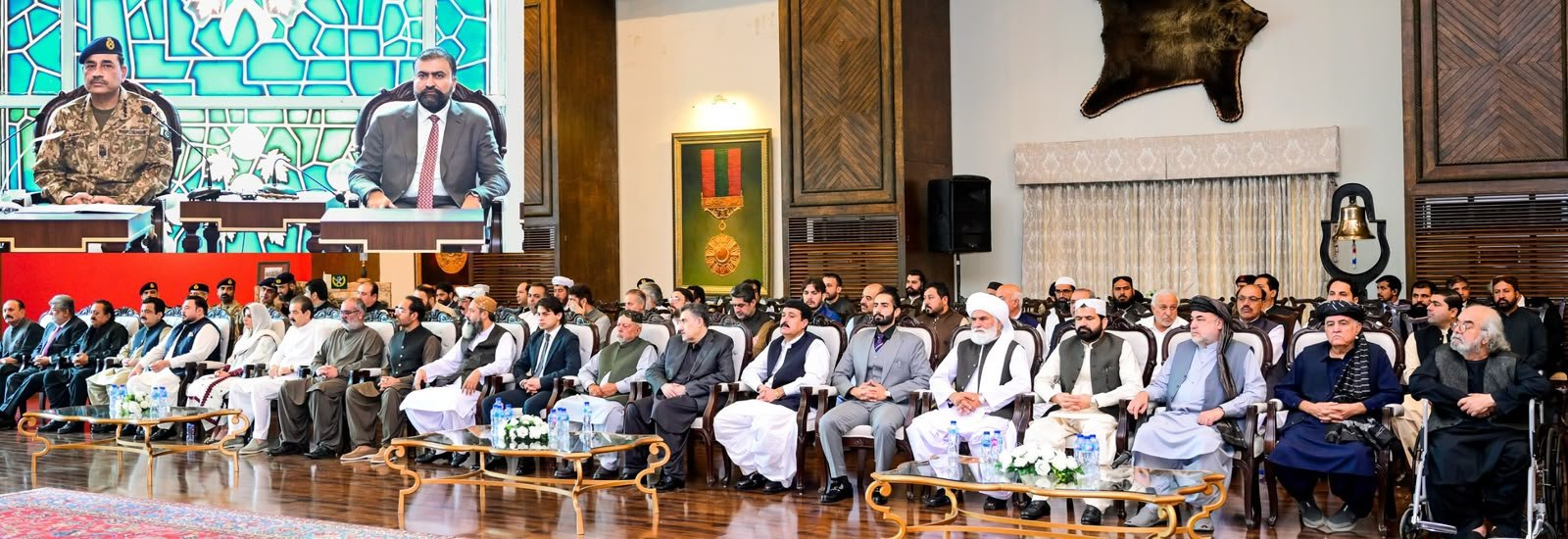
Field Marshal Syed Asim Munir looked composed, confident and determined in his commando uniform as he sat alongside Balochistan Chief Minister Sarfraz Bugti, a well-educated and widely respected political leader of the province.
The scene itself carried unusual political and strategic weight.
Pakistan’s powerful military commander was sharing the stage with the elected political leadership of Balochistan. Around them sat the notables and elders of the province—representatives of tribes, cities, communities and different sections of Balochistan’s social and political landscape.
This was not merely another official meeting.
It was a gathering of Pakistan’s military leadership, Balochistan’s political elite and representatives of its people, brought together at a moment when the province’s security, development and future remain central to Pakistan’s national strategy.
READ NEXT: Pakistan Army Counterterrorism Operation in Balochistan Crushes 216 Terrorists as Global Support Pours In After Deadly Attacks
At the centre of the gathering was Field Marshal Asim Munir, Chief of Army Staff and Chief of Defence Forces, whose standing within Pakistan’s military establishment was elevated further after Pakistan’s confrontation with India in May 2025. Following that conflict, he was promoted to the rank of Field Marshal, reflecting the political and military leadership’s assessment of his command during the confrontation.
Beside him was Chief Minister Sarfraz Bugti, representing Balochistan’s political leadership.
And before them were the elders and notables of Balochistan, representing the people whose future was ultimately being discussed.
The symbolism was difficult to miss.
The Army. The political leadership. The people of Balochistan.
All three were in the same room discussing the future of Pakistan’s largest province by land area.
For Pakistan, Balochistan is not simply another administrative unit. It is a strategic frontier, a gateway to the Arabian Sea, a bridge toward Iran and Afghanistan, a repository of immense mineral wealth and home to Gwadar, one of the strategically important locations in the China-Pakistan Economic Corridor.
Its stability therefore matters not only to Balochistan but to the future of Pakistan itself.
And Field Marshal Asim Munir arrived with a clear message.
“The present and future of Balochistan and Pakistan are one and forever”
The Field Marshal told the gathering that the present and future of Balochistan and Pakistan were “one and forever.”
The statement captured the central theme of the meeting.
He described Balochistan as a province blessed with talented, resilient, patriotic and proud people and stressed that enduring peace and stability were essential to unlocking its economic potential. Dawn’s report on Field Marshal Munir’s Balochistan address
The Field Marshal placed particular emphasis on the province’s youth.
There was, he said, no shortage of talent or opportunity among Balochistan’s young people. Empowering them and giving them opportunities to participate in national progress was essential to sustainable development.
That emphasis is significant.
Pakistan’s answer to terrorism in Balochistan cannot be military operations alone. The country’s long-term strategy must also involve education, employment, investment, political participation and economic opportunity.
A young Baloch who sees a future in education, business, technology, government or industry is less vulnerable to the recruitment narratives of terrorist organisations.
The future of Balochistan, therefore, will ultimately be decided not only on the battlefield but in classrooms, universities, businesses, communities and workplaces.
A direct warning to foreign-sponsored terrorism
The most forceful part of Field Marshal Munir’s address concerned terrorism.
He stated that Fitna al-Khawarij and Fitna al-Hindustan were foreign-sponsored proxies being employed by hostile elements to destabilise Balochistan, obstruct development and create a wedge between the state and its people.
The Pakistani military leadership has repeatedly accused India of sponsoring terrorism inside Pakistan, particularly in Balochistan. The News has previously reported Field Marshal Munir’s assertion that India, following its defeat in the May 2025 confrontation, had intensified its alleged proxy campaign against Pakistan through what Islamabad calls Fitna al-Khawarij and Fitna al-Hindustan. The News report on India’s alleged proxy campaign
India rejects these allegations.
For international readers, that distinction is important. Pakistan’s allegation of Indian sponsorship remains fiercely contested by New Delhi. But it is equally important to understand that Pakistan’s military leadership regards foreign-sponsored terrorism as a direct national-security threat and has built its counterterrorism strategy accordingly.
Field Marshal Munir’s message was uncompromising: these designs will be defeated through the collective resolve of the Pakistani nation and a decisive response by the state.
In other words, Pakistan does not intend to allow terrorism to dictate Balochistan’s political or economic future.
Balochistan Terrorism: The battlefield has changed
Balochistan has experienced terrorism for years.
Terrorist organisations have attacked security installations, targeted civilians, assaulted infrastructure, attempted to disrupt development projects and sought to create an atmosphere in which the state appears incapable of protecting its citizens.
But the security environment has also changed.
Pakistan’s armed forces and law-enforcement agencies have maintained sustained counterterrorism operations across the province. Intelligence-based operations, raids, area domination and targeted actions have placed continuous pressure on terrorist networks.
The Islamabad Telegraph’s report on Pakistan Army counterterrorism operations in Balochistan
Recent reporting by The Express Tribune has also documented intelligence-based operations across Balochistan in which security forces killed terrorists in several districts, demonstrating the scale of the continuing security campaign. The Express Tribune’s Balochistan coverage
The terrorists remain capable of launching attacks.
But they have not been permitted to establish an alternative authority over Balochistan.
That distinction matters.
The objective of Pakistan’s security forces is not simply to respond to terrorist attacks after they occur. It is to dismantle terrorist infrastructure, prevent terrorists from establishing permanent sanctuaries and protect the communities that have rejected violence.
Pakistan’s soldiers are paying the ultimate price in that campaign.
They are being martyred while fighting terrorists across the province.
Civilians are also being martyred.
Police officers, intelligence personnel and members of community-based peace structures have sacrificed their lives.
The security campaign is therefore a national struggle involving the state and the people of Balochistan.
The people of Balochistan are not spectators
This was another important element of the Field Marshal’s address.
He appreciated the role of Balochistan’s notables and social leaders in promoting peace, strengthening social cohesion and developing a constructive national discourse.
That acknowledgement reflects an important reality: Pakistan’s security forces cannot secure Balochistan permanently without the cooperation of Balochistan’s people.
The province’s tribal elders, political leaders, religious figures, youth and ordinary citizens have an essential role in denying terrorists the social environment they require.
Communities that provide information to security forces help expose terrorist networks.
Citizens who refuse to shelter terrorists deny them sanctuary.
Young people who reject extremist recruitment deny terrorist organisations their future manpower.
And local leaders who publicly stand for peace weaken the propaganda through which terrorist organisations attempt to portray themselves as representatives of Balochistan.
This is why the meeting in Balochistan was much more than a military briefing.
It represented an attempt to consolidate a social, political and military consensus around peace.
Pakistan’s soldiers have paid heavily
The cost of this campaign cannot be ignored.
Recent security data illustrates how intense the violence has become.
According to the Pakistan Institute for Conflict and Security Studies, 372 people were martyred in Balochistan during July 2026, compared with 109 in June. The casualties included security personnel, civilians and members of peace committees, while 238 terrorists were reported killed during the violence and subsequent security operations.
The figures demonstrate the severity of the challenge.
They also demonstrate the scale of Pakistan’s response.
The Pakistan Army is not merely holding positions and waiting for attacks.
Its soldiers are moving into areas where terrorists operate.
They are conducting intelligence-based operations.
They are securing roads and communities.
They are hunting terrorist networks.
And some are making the ultimate sacrifice.
The News has previously documented the scale of the sacrifice, including the martyrdom of 18 soldiers while thwarting a terrorist attack in Kalat and the subsequent elimination of 23 terrorists during the engagement and follow-up operation. The News report on the martyrdom of Pakistani soldiers in Balochistan
For Pakistan’s armed forces, these are not abstract statistics.
Every martyred soldier leaves behind parents, spouses, children and families.
Yet the campaign continues because the alternative—allowing terrorist organisations or foreign-sponsored proxies to dictate the future of Balochistan—is unacceptable to the Pakistani state.
Balochistan’s resources and Pakistan’s future
The security battle ultimately has an economic dimension.
Balochistan is extraordinarily rich in natural resources.
Its geography gives Pakistan access to the Arabian Sea and provides a potential bridge connecting South Asia with Iran, Afghanistan, Central Asia and the Gulf.
Its coastline and Gwadar provide strategic maritime opportunities.
Its mineral wealth could attract major international investment.
Its young population could become one of Pakistan’s most important economic assets.
But investors require security.
Industries require functioning roads.
Mining projects require stability.
Ports require protection.
Schools and universities require peace.
Businesses require an environment in which people can travel and work without fear.
This is why Pakistan’s military leadership sees counterterrorism and development as inseparable.
The security operation is not an end in itself.
It is intended to create the conditions in which Balochistan can realise its economic potential.
The message from the meeting
The image of Field Marshal Asim Munir sitting alongside Chief Minister Sarfraz Bugti, surrounded by Balochistan’s elders and notables, therefore carries significance beyond the meeting itself.
It represented three pillars of Pakistan’s approach to Balochistan:
Security. Political leadership. People.
The military can provide security.
The political leadership can provide governance and development.
The people provide the legitimacy and social foundation without which neither can succeed.
The meeting brought these three elements together.
Field Marshal Munir told the gathering that the destiny of Balochistan rests in the hands of its people. The Express Tribune likewise reported his emphasis on the province’s youth, development and the need to defeat foreign-sponsored proxies through national resolve. The Express Tribune’s report on Munir’s Balochistan meeting
That is perhaps the most consequential part of his message.
Pakistan’s Army may fight terrorism, but it cannot determine the destiny of Balochistan by itself.
The people of Balochistan must determine it.
And the message emerging from the meeting was that the province’s political leadership, elders and communities intend to stand with the state and armed forces against terrorism and foreign-sponsored threats.
A province choosing stability over terrorism
Balochistan is still facing terrorist attacks.
The threat has not disappeared.
But Pakistan’s security forces have demonstrated that terrorist organisations will not be allowed to take control of the province or permanently derail its development.
The battle continues every day.
Soldiers are being martyred.
Civilians are being martyred.
Terrorist networks are being dismantled.
Communities are cooperating with the state.
And political leaders are increasingly placing development and stability at the centre of Balochistan’s future.
Field Marshal Asim Munir’s message was ultimately about more than defeating terrorists.
It was about preventing terrorism from defining an entire province.
It was about telling Balochistan’s youth that their future lies in opportunity rather than violence.
It was about assuring investors that Pakistan intends to secure the province.
And it was about making one fundamental proposition unmistakable:
Balochistan is Pakistan’s future, and Pakistan will defend Balochistan’s future.
For the Pakistani soldier standing guard in the province, that future is worth the ultimate sacrifice.
For the people of Balochistan, it is a future of peace, dignity, development and prosperity.
And for Pakistan, it is a future that the state, the Army and the people of Balochistan have declared they will protect together.