



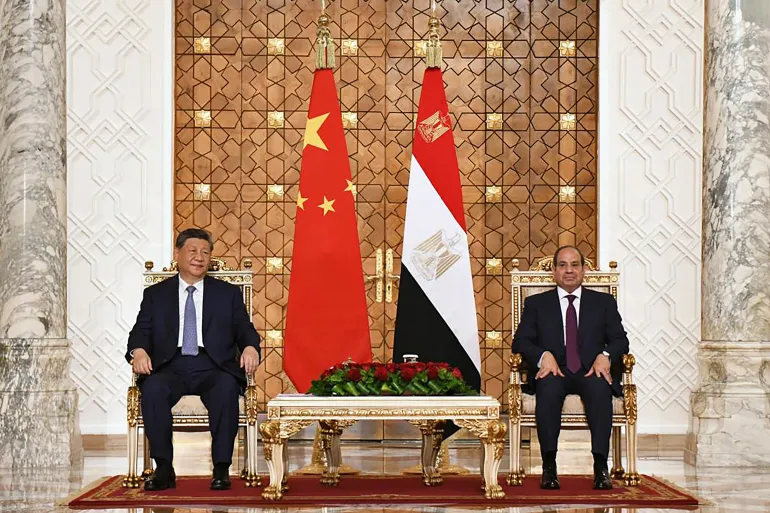
- Xi Jinping Egypt visit reflects China’s effort to deepen its influence around the Middle East’s most important maritime corridor.
- Suez, Hormuz and Bab el-Mandeb are increasingly interconnected strategic chokepoints for global energy and trade.
- Egypt is not abandoning the United States; Cairo is using Chinese investment, technology and defence cooperation to pursue greater strategic autonomy.
Xi Jinping’s return to Egypt is far more than a diplomatic anniversary. His first visit to the country in a decade, and his first trip to the Middle East in four years, comes at a moment when the region’s strategic architecture is being tested by war, disrupted maritime trade and growing doubts about the durability of the US-led security order.
The choice of Cairo is particularly significant. Egypt sits at the intersection of the Mediterranean, Red Sea, Arab world and Africa, while controlling the Suez Canal, one of the world’s most important commercial arteries. For China, Egypt is therefore not simply another Middle Eastern partner. It is a potential bridge connecting Chinese economic power with the Gulf, Europe and Africa.
Xi’s visit also comes after months of disruption around the Strait of Hormuz and Bab el-Mandeb. The crisis has exposed the vulnerability of global supply chains and highlighted China’s dependence on secure maritime routes. Beijing’s economic interests in the Middle East are now so extensive that instability in these waterways can quickly become a Chinese economic problem.
Xi Jinping Egypt visit: The Hormuz-Bab el-Mandeb-Suez Triangle
The strategic importance of Egypt becomes clearer when the three maritime chokepoints are viewed as one system.
READ MORE: Strait of Hormuz Crisis: Is America Losing Its Grip on the Middle East?
Hormuz is the principal energy gateway of the Gulf. Before the current crisis, more than 20 million barrels of oil and petroleum products a day moved through the strait during much of 2025. The waterway also carried a substantial share of global LNG shipments, much of it destined for Asian economies including China, India and South Korea.
Bab el-Mandeb is the gateway between the Indian Ocean and Red Sea. When attacks on commercial shipping disrupted traffic through the waterway, many vessels were forced to sail around the Cape of Good Hope, adding thousands of nautical miles to Asia-Europe journeys and increasing fuel, insurance and freight costs.
Then comes Suez.
The canal connects the Red Sea with the Mediterranean and provides the shortest maritime route between Asia and Europe. The Red Sea crisis badly affected Egypt’s canal revenues, demonstrating that geopolitical instability thousands of kilometres away can directly damage the Egyptian economy.
For Beijing, the equation is compelling. China cannot control Hormuz or Bab el-Mandeb, but it can build deeper relationships with the countries surrounding these strategic corridors. Egypt, sitting at the western end of the Red Sea-Suez system, becomes indispensable to that strategy.
A Decade of China-Egypt Economic Expansion
China-Egypt relations have changed dramatically since President Abdel Fattah el-Sisi visited Beijing in 2014 and the two countries established their comprehensive strategic partnership.
Bilateral trade reached approximately $21 billion in 2025, making China Egypt’s largest trading partner in non-petroleum goods. During the first half of 2026, Egyptian exports to China surged by almost 200 percent to about $841 million, while imports from China reached approximately $10.4 billion.
READ MORE: China’s Xi visits Egypt’s el-Sisi: Why it matters
The figures reveal both the strength and weakness of the relationship.
Trade is expanding rapidly, but it remains heavily imbalanced in China’s favour. Egypt is therefore seeking to move from being primarily a destination for Chinese goods to becoming a manufacturing base for Chinese companies.
The Suez Canal Economic Zone is central to this ambition.
The China-Egypt TEDA industrial zone at Ain Sokhna has attracted billions of dollars of Chinese investment and hosts around 200 companies. Chinese firms have established or invested in industries ranging from tyres and iron products to electric vehicles, solar energy and other manufacturing sectors.
This gives Beijing something more valuable than access to the Egyptian market: access to Egypt as a production and logistics platform.
China’s Gateway to Africa
The African dimension may ultimately prove to be the most important element of the partnership.
Egypt is both an Arab and African power, with a population exceeding 110 million and strategic connections stretching from North Africa to the Red Sea. Chinese companies operating around Suez can potentially use Egypt as a manufacturing and distribution base for African, European and Middle Eastern markets.
China’s cooperation with Egypt has also moved into high technology.
The launch of Egypt’s MisrSat-2 satellite from China in 2023 demonstrated growing cooperation in space technology. Chinese assistance in developing Egyptian satellite assembly and testing capabilities further indicated that the relationship is no longer confined to roads, ports and construction projects.
Xi’s latest visit is expected to expand cooperation in areas including artificial intelligence, data centres, semiconductors, critical minerals, transport and manufacturing.
For Beijing, Egypt is consequently becoming a multidimensional strategic platform: industrial, technological, commercial, diplomatic and geographic.
Xi Jinping Egypt visit: From Trade to Defence
The relationship’s most sensitive development, however, has been defence cooperation.
Egypt remains deeply connected to the United States militarily and receives approximately $1.3 billion annually in US military assistance. American weapons, training and interoperability remain central to the Egyptian armed forces.
Yet Cairo has spent the past decade diversifying its defence partnerships, purchasing sophisticated French and Russian systems while expanding military exercises with China.
The recent Eagles of Civilization exercise was particularly revealing.
Chinese J-16 fighters, supported by YU-20 aerial refuelling aircraft, KJ-500 airborne early-warning aircraft and Z-20 helicopters, travelled roughly 6,000 kilometres to Egypt. The J-16’s deployment was its first to Africa.
Even more significant was the training between Chinese J-16s and Egyptian Rafale fighters.
This was not merely ceremonial military diplomacy. It gave both sides an opportunity to study different operational doctrines and aircraft capabilities while demonstrating China’s growing ability to project advanced airpower far beyond East Asia.
Yet it would be a mistake to conclude that Egypt is switching from Washington to Beijing.
Cairo’s Strategic Balancing Act
Sisi’s foreign policy is better understood as strategic diversification.
Egypt wants American security assistance, European investment, Gulf financing and Chinese infrastructure and technology. It also wants to maintain diplomatic flexibility with Russia and other powers.
China does not necessarily need Egypt to become anti-American. Beijing’s objective is more subtle: it wants Egypt to become less dependent on any single external power.
Xi’s call for Middle Eastern states to become “masters of their own destiny” and explore a new regional security architecture fits directly into this approach.
The message resonates in a region increasingly questioning whether traditional security arrangements remain adequate after Gaza, the Iran war and repeated attacks on maritime trade.
Why Cairo Matters to Beijing
Xi’s Egypt visit ultimately reflects a much larger transformation.
China is not replacing America in the Middle East overnight. Nor is Egypt abandoning Washington. Instead, both Beijing and Cairo are exploiting the emergence of a more multipolar regional environment.
For China, Egypt offers access to the Suez Canal, the Red Sea, Africa and the Arab diplomatic system. For Egypt, China provides capital, technology, infrastructure and an alternative source of strategic leverage.
The deeper story is therefore not simply about a Chinese president visiting Cairo.
It is about geography.
Hormuz controls the Gulf’s energy lifeline. Bab el-Mandeb connects the Indian Ocean with the Red Sea. Suez connects that system to Europe. Egypt sits at the centre of the final link.
That is why Xi chose Cairo.
In the emerging Middle East, China may not need to replace America to become indispensable. It only needs to ensure that Egypt—and the strategic waterways surrounding it—remain firmly within Beijing’s expanding network of economic, diplomatic and security relationships.