


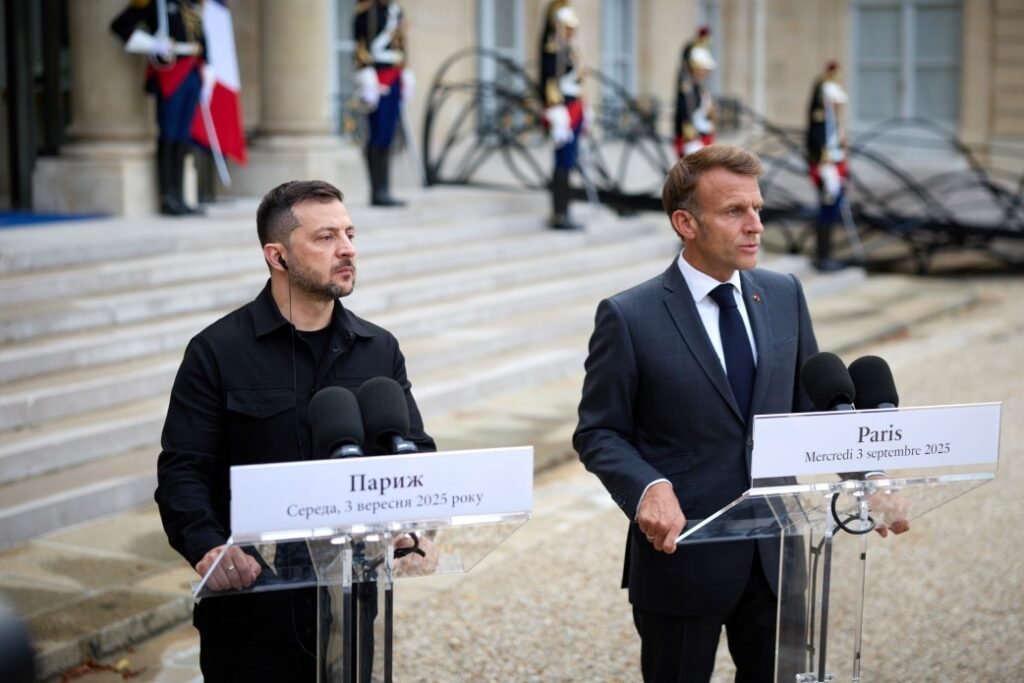
- Nearly 30 pro-Ukraine allies met in Paris with President Zelenskiy to discuss security guarantees in response to Putin’s threat of ending the war “by force.”
- France, the U.K., and other European states finalized “technical plans” for security guarantees but acknowledged they cannot move forward without U.S. backing.
- Donald Trump’s envoy held side meetings in Paris, with European leaders hoping to pressure Washington into providing a credible security “backstop.”
- Analysts warned Putin’s statements were meant to divide the coalition, while diplomats stressed that peace remains a “remote” prospect.
PARIS — With the war in Ukraine grinding into its fourth year and diplomatic efforts stagnating, nearly 30 world leaders gathered in Paris on Thursday for high-stakes talks with Ukrainian President Volodymyr Zelenskiy. At the heart of the meeting was Russian President Vladimir Putin’s chilling warning: negotiate or face a war brought to an end by force.
Western allies took Putin’s latest statement as a direct threat rather than an opening. While the Kremlin leader insisted he preferred talks, his blunt caveat—military victory if diplomacy failed—sent shockwaves through European capitals. It was against this backdrop that the so-called “coalition of the willing” convened in Paris, aiming to devise a framework of long-term security guarantees for Kyiv.
Xi’s Military Parade Sends a Defiant Message: China Will Not Be Bullied Again
The gathering, hosted by French President Emmanuel Macron, included leaders from Europe, Australia, Japan, and Canada. Although some neighboring governments joined only by video-link, the turnout underscored the urgency of the moment. The United States was conspicuously absent, a reminder of the central challenge: European powers want to secure Ukraine, but few believe it can be done without American backing.
Security Guarantees in Focus
For months, coalition members have debated how to structure military and political support for Ukraine in the event of a ceasefire. The logic is straightforward: any peace deal must be buttressed by firm guarantees, otherwise Moscow could regroup and strike again. Yet the details remain contentious.
READ MORE: Trump’s Gamble for Peace: A New Map, Old Foes, and the High Stakes of the Ukraine War
Two European officials confirmed Thursday that “technical” plans for such guarantees had been finalized, though they declined to elaborate. British and French military chiefs presented the outlines to leaders, offering options ranging from stepped-up arms deliveries to the deployment of an international stabilization force.
“We are ready, us Europeans, to provide security guarantees to Ukraine for when there is a signed peace,” Macron declared alongside Zelenskiy. “Now it is a question of seeing how sincere Russia is.”
Trump’s Shadow
The debate, however, is not just about Europe. The elephant in the room remains U.S. President Donald Trump, who has oscillated between offering rhetorical support for Ukraine and hinting at a quick deal with Moscow. Without Washington’s security umbrella, any European force would be politically fragile and militarily limited.
ALSO READ: Ukraine’s allies meet amid doubts over guarantees, US backing
Trump’s special envoy, Steve Witkoff, met European officials in Paris hours before the summit, fueling speculation about Washington’s next move. According to diplomats, one aim of the Paris meeting was to send a clear political message to Trump: Europe is prepared to act, but it cannot do so alone.
NATO Secretary General Mark Rutte echoed this sentiment, saying clarity from the coalition was needed “to pave the way for more intense discussions with Washington.”
Putin’s Calculations
Putin’s timing has not gone unnoticed. Just a day earlier, he had offered Ukraine “a chance” to end the war through negotiations “if common sense prevails,” while warning that Russia could end the conflict by force. Analysts say the statement was designed to sow division among allies, offering a diplomatic fig leaf while brandishing military power.
“Putin wants to pressure Zelenskiy into talks on his terms and force Europe into a corner,” said John Foreman, a former British defense attaché to Kyiv and Moscow. “But there is also growing realization that peace will require a strong Ukraine and Ukrainian army, supported for the long haul.”
Western officials are equally wary. Several noted that any deployment of international forces inside Ukraine would be fiercely opposed by Moscow and could risk escalation. Still, the notion of troops stationed in neighboring states as a deterrent remains on the table.
Peace Still a Remote Prospect
Despite the flurry of activity, few in Paris believed a breakthrough was imminent. “This is all prep work for a peace which remains illusory and remote,” Foreman observed. He cited Trump’s “incoherent diplomacy” and the absence of substantive Russian-Ukrainian talks as major obstacles.
The French presidency said several leaders planned to call Trump after the summit to press him on concrete commitments. But until Washington clarifies its role, Europe faces an uncomfortable paradox: it wants to show unity and resolve, yet knows that without the United States, its guarantees may lack teeth.
For Zelenskiy, the stakes could not be higher. The Ukrainian leader, who has repeatedly warned against premature peace, is walking a fine line. On the one hand, he needs security guarantees to reassure a war-weary population. On the other, he cannot afford to be seen caving to Putin’s threats.
A Divided but Determined Front
Diplomats admitted that divisions persist within the coalition, particularly over whether to commit troops. But there was broad consensus on one point: Ukraine’s armed forces must remain robust, capable of deterring Russia independently. Military aid, training, and equipment flows will continue, even as leaders debate the more politically sensitive issue of boots on the ground.
Putin, for his part, is watching closely. Having showcased solidarity with Chinese and North Korean leaders at a Beijing parade earlier this week, he appears increasingly confident. Western officials fear his threats may not be mere bluster.
“The danger is that he actually means what he says,” one European diplomat said. “If we don’t prepare now, we could wake up to a very different Ukraine in a matter of months.”
As the Paris summit wrapped up, leaders pledged to keep pushing for a framework that would lock in Ukraine’s security. Yet the fundamental dilemma remained unresolved: can Europe—and Ukraine—rely on Trump’s America to stand behind them if Putin decides to test their resolve?
For now, the answer remains as uncertain as the war itself.