


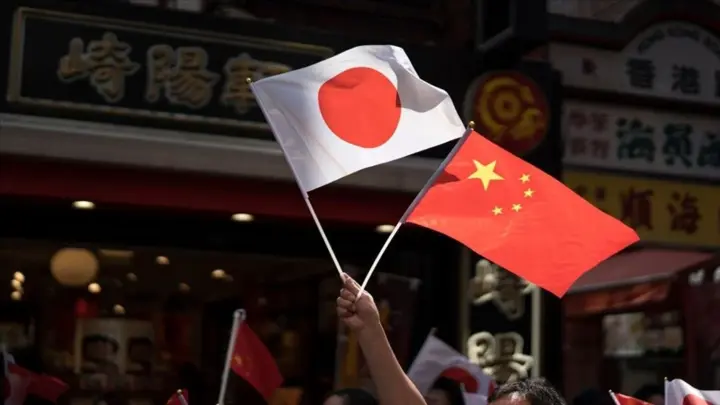
- China-Japan Taiwan Standoff: Military Maneuvers: China and Russia conducted joint patrols over the South China Sea and Miyako Strait, signaling power projection amid tensions with Japan.
- Alliance Dynamics: The U.S. openly backs Japan, while QUAD members strengthen regional counterbalance against China’s growing influence.
- Strategic Posturing: Analysts liken the standoff to an “Inter vs Liverpool” clash—calculated moves and signaling dominate over actual combat.
- Global Division on Taiwan: Nations like Pakistan, Germany, Russia, and Iran support the One China policy, while Japan and the U.S. reject it, deepening diplomatic divides.
The simmering tensions between China and Japan over Taiwan are fast escalating, signaling a potential realignment of power in East Asia. The dispute, triggered by Japanese Prime Minister Sanae Takaichi’s remarks last month regarding a hypothetical Chinese attack on Taiwan, has evolved into a series of military maneuvers that have captured global attention. The world appears to be dividing once again, with Russia openly supporting China, the United States siding with Japan, and many nations watching cautiously from the sidelines.
Recently, a striking display of Chinese-Russian military cooperation underscored the gravity of the situation. Two Russian Tu-95 nuclear-capable strategic bombers conducted joint patrols with two Chinese H-6 bombers over the South China Sea, accompanied by four Chinese J-16 fighter jets.
China’s Silent Victory: How Xi Jinping Turned Trump’s Tariffs Into a $1 Trillion Trade Surplus
The operation, lasting several hours, traversed international waters between Japan’s Okinawa and Miyako islands, while Japan simultaneously detected additional Russian air activity in the Sea of Japan, including an early-warning A-50 aircraft and two Su-30 fighters. Japan responded by scrambling fighter jets to implement air defense identification measures, reflecting the seriousness with which Tokyo views these maneuvers.
The United States, for its part, has openly criticized China for targeting Japanese military aircraft with radars during training exercises—a claim Beijing disputes, stating that its operations were lawful and carefully conducted. A U.S. State Department spokesperson emphasized that “China’s actions are not conducive to regional peace and stability” and reaffirmed America’s commitment to its ally, Japan.
READ MORE: Japan-China Tensions: Why a China–Japan Collision Over Taiwan Could Transform the Asia-Pacific Strategic Order
Japanese Chief Cabinet Secretary Minoru Kihara welcomed these remarks, highlighting the strengthened U.S.-Japan alliance amid mounting tensions.
The background to this escalating conflict is not solely military. The U.S., Japan, India, and Australia have consolidated their efforts under the QUAD alliance, explicitly aimed at counterbalancing China’s regional influence.
While analysts largely dismiss the possibility of outright military conflict, they acknowledge that the current standoff functions as a high-stakes pressure game, with China and the U.S. locked in a strategic mind contest. In essence, the world is witnessing a geopolitical “knicks vs raptors” scenario—a high-intensity, attention-grabbing rivalry with every move scrutinized by global audiences.
China and Russia’s burgeoning military cooperation adds another layer of complexity. Beyond joint flights, the two nations have coordinated missile-defense drills, anti-missile exercises on Russian territory, and live-fire naval drills in the South China Sea.
ALSO READ: US backs Japan in dispute with China over radar incident
Russian media reported that the recent joint patrol lasted eight hours, demonstrating the logistical and operational capabilities that Beijing can leverage in any regional contingency. Meanwhile, South Korea also reported Russian and Chinese aircraft entering its air defense zone, signaling that the situation has implications beyond the immediate China-Japan context.
The territorial flashpoint remains Taiwan, which China considers a part of its sovereign territory. Taiwan’s democratically governed status complicates the issue, particularly given its proximity—just over 100 kilometers from Japanese territory—and its critical sea lanes essential to regional trade.
Taiwan’s President Lai Ching-te condemned China’s drills as “very inappropriate behavior,” urging Beijing to act responsibly. The stakes are high: any misstep could trigger a chain reaction affecting not only Japan and China but the broader Indo-Pacific region.
Interestingly, the international community remains divided over the “One China” policy. Nations like Pakistan, Germany, Russia, and Iran officially recognize Taiwan as part of China, while countries such as the U.S. and Japan challenge this position.
This dichotomy is reminiscent of major sporting rivalries like “barcelona vs eintracht frankfurt” or “inter vs liverpool,” where allegiances are passionately held, strategies closely monitored, and outcomes unpredictable, though the game rarely escalates into complete chaos.
Japan’s concerns are further magnified by China’s assertive posture near disputed territories. The Miyako Strait, though classified as international waters, witnessed the Chinese-Russian flight exercises. Similarly, the Senkaku/Diaoyu islands have seen increased Chinese coast guard activity, which Tokyo interprets as provocative.
Japanese Defence Minister Shinjiro Koizumi called the joint operations “a serious concern for our national security,” emphasizing that these demonstrations of force are intended to project power and influence regional narratives.
Despite these tensions, experts caution against interpreting these maneuvers as precursors to war. Rather, they reflect strategic signaling, pressure tactics, and geopolitical chess moves. The situation resembles a high-stakes sports finale—much like “knicks vs raptors” in basketball or “barcelona vs eintracht frankfurt” in football—where every move is calculated, every response measured, and the stakes remain globally consequential.
The broader geopolitical implications are profound. A U.S.-Japan alignment against China signals a recommitment to existing alliances, while Russia’s support for China highlights a growing multipolarity in global politics. For smaller nations, maintaining diplomatic balance is critical, as the world seems to be polarizing once again.
Analysts emphasize that while the rhetoric and posturing may appear alarming, most nations are working to avoid direct conflict. It is a display of brinkmanship designed to test limits, demonstrate capabilities, and influence negotiations.
In conclusion, the ongoing China-Japan tensions over Taiwan exemplify the complex interplay of military readiness, alliance politics, and global signaling. While the rhetoric might suggest imminent conflict, the reality points toward a strategic standoff—an intricate game of power, perception, and influence.
Nations like the U.S., Japan, and China are leveraging these confrontations as tools to strengthen positions, reassure allies, and project strength, while the majority of the world cautiously observes, aware that even the slightest miscalculation could have wide-reaching consequences.
As the situation unfolds, the international community watches with bated breath, wondering whether the world will navigate this high-stakes geopolitical “inter vs liverpool” match with restraint or risk spiraling toward confrontation.