


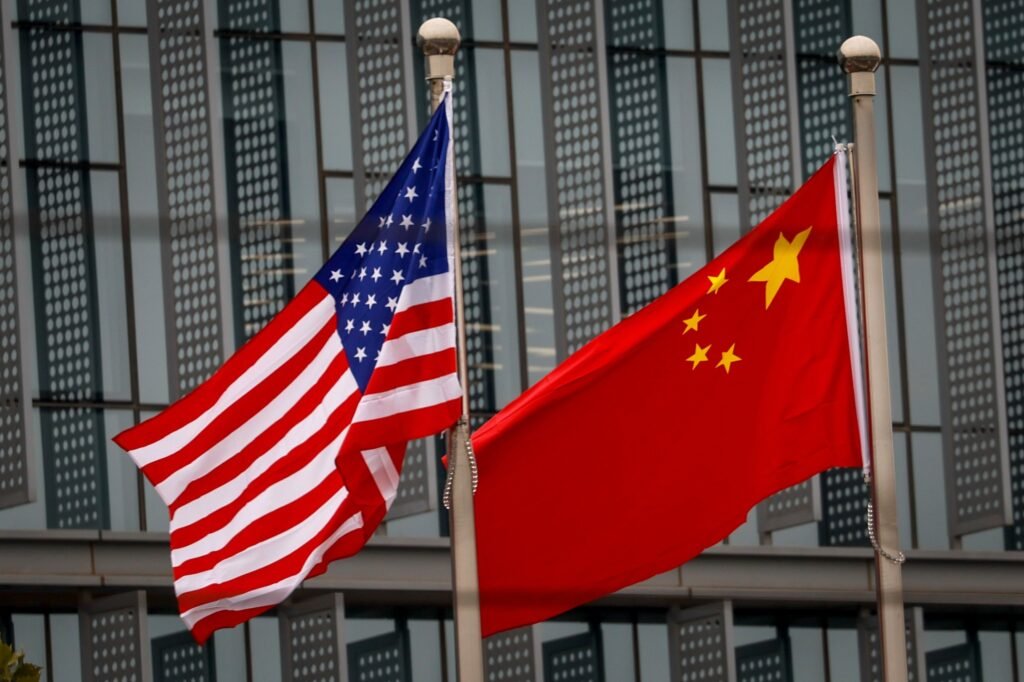
- China’s Commerce Ministry launched twin investigations into U.S. chip policies—one on trade discrimination and another on suspected dumping of analog chips.
- Trigger: U.S. recently added 32 firms (23 Chinese) to its restricted trade list, tightening export controls on semiconductor equipment.
- Impact: With bilateral trade at $665 billion in 2023 and semiconductors making up 15% of it, both U.S. tech firms and China’s manufacturing sector face economic risks.
- Way Forward: Madrid trade talks (Sept 14–17) will focus on tariffs, chip restrictions, TikTok, and agriculture, with both sides aiming to preserve the 90-day tariff truce.
China has launched twin investigations into U.S. trade practices over semiconductors, signaling that the battle for technological dominance between Washington and Beijing has entered a new phase.
The Ministry of Commerce confirmed on Saturday that it will examine whether U.S. chip trade policies discriminate against Chinese firms, alongside a probe into alleged dumping of American analog chips such as those used in hearing aids, Wi-Fi routers, and temperature sensors.
The timing is no accident. The announcement came a day before Chinese Vice Premier He Lifeng heads to Madrid for the fourth round of trade talks this year, underscoring Beijing’s willingness to pressure Washington even as dialogue continues.
What Triggered Beijing’s Move
Over the past two years, the U.S. has ramped up restrictions on Chinese access to high-end semiconductors and manufacturing equipment. In just the last week, Washington added 32 companies—23 of them Chinese—to its restricted trade list, accusing two of diverting U.S. equipment to chip giant SMIC. These moves hit at the heart of Beijing’s ambitions in advanced computing and artificial intelligence.
Exclusive: U.S. and China Resume Trade Talks in Stockholm Amid Global Economic Crossroads
China’s commerce ministry denounced the actions as “protectionist,” arguing they were designed not for national security but to suppress China’s technological rise. The probe into dumping appears equally strategic, aimed at challenging Washington’s leverage and signaling that Beijing is prepared to use its own trade laws against U.S. firms.
Impact on the Two Economies
The stakes are massive. Semiconductors are the backbone of modern economies—powering smartphones, EVs, AI systems, and defense technology.
-
In 2023, U.S.–China goods trade reached $665 billion, with Chinese exports to the U.S. at $493 billion and U.S. exports to China at $172 billion. Chips accounted for over 15% of bilateral trade value.
-
U.S. firms such as Qualcomm, Texas Instruments, and Analog Devices rely heavily on Chinese demand. For example, China made up 64% of Qualcomm’s revenue in 2023. A hostile regulatory environment could dent these revenues sharply.
-
China, for its part, remains dependent on foreign technology. In 2023, it imported $349 billion worth of semiconductors, much of it from U.S.-aligned suppliers. Any escalation could choke its own manufacturing supply chains.
Financial markets already reacted with volatility: the Dow Jones fell 0.6% on Friday while the Nasdaq rose 0.4%, highlighting investor uncertainty.
The Way Forward
Despite fiery rhetoric, both powers have reasons to avoid a collapse. The Madrid talks—following earlier sessions in Geneva, London, and Stockholm—are built on a 90-day tariff truce extended by President Trump in August.
MUST READ: Trump, China Seek Common Ground as Trade Talks Resume in Washington
That truce has preserved the flow of Chinese rare earth minerals to the U.S. and paused retaliatory duties that once dragged bilateral trade down by 16%.
READ MORE: China launches discrimination and dumping probes into US chips ahead of trade talks
The agenda in Madrid will be heavy:
-
Tariffs: Both sides must decide whether to extend the truce past November 10.
-
Technology controls: China wants Washington to ease export restrictions, while the U.S. is likely to demand safeguards against tech transfer to military projects.
-
TikTok: With Trump’s September 17 deadline for divestiture looming, the issue could overshadow chip talks.
-
Agriculture: A potential Chinese pledge to boost U.S. farm imports may serve as a bargaining chip.
Ultimately, both economies remain intertwined. For the U.S., decoupling risks alienating its own corporations and consumers. For China, severing chip imports would stall its industrial modernization. Analysts predict a compromise—perhaps a phased rollback of export restrictions in exchange for expanded U.S. market access in finance and services.
What Next?
China’s investigations are more than legal probes; they are political signals. Beijing is telling Washington that restrictions have costs, and that it will not remain passive. The U.S., meanwhile, is leveraging its chip dominance to guard strategic advantage.
The outcome of the Madrid talks will determine whether this latest flare-up hardens into another trade war or evolves into a fragile but workable framework for technological coexistence. With bilateral trade projected to exceed $700 billion by 2025, the stakes could not be higher.