


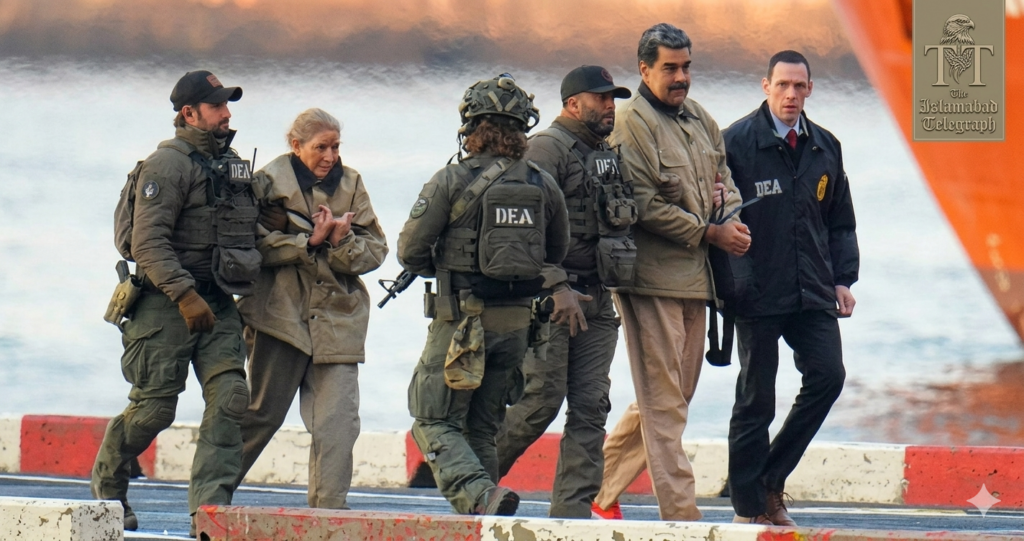
- Gannon Ken Van Dyke: U.S. Special Forces executed a top-secret operation to capture Nicolás Maduro with precision.
- Soldier Gannon Ken Van Dyke allegedly used classified intelligence to place winning bets worth $400,000.
- Federal prosecutors charged him with fraud, theft, and misuse of confidential government information.
- Case raises global concerns about insider trading risks in emerging prediction markets.
It began as one of the most tightly guarded operations in modern U.S. military history—an elite Special Forces mission conceived in silence, rehearsed in fragments, and executed with near-clinical precision. Inside secure rooms in Washington and forward command centers, only a handful of officials—including then-President Donald Trump and a select group of operatives—knew the true objective: the capture of Venezuelan leader Nicolás Maduro.
For weeks, the unit refined every contingency. Intelligence streams were cross-verified, simulations run repeatedly, and entry-exit timelines shaved down to seconds. By the time boots hit the ground in Caracas on January 3, the mission unfolded exactly as designed—flawless, swift, and decisive.
But behind the precision of the operation, federal prosecutors say, a troubling breach of trust had already taken place.
Venezuela U.S. Attack Death Toll Reaches 100 as Maduro Faces Trial
According to an indictment unsealed Thursday, Master Sergeant Gannon Ken Van Dyke, a decorated 18-year veteran of the U.S. Army’s Special Forces, allegedly exploited his access to highly classified information to place a series of covert bets on the outcome of the very mission he helped plan.
Confident in the operation’s success after days of intensive briefings and rehearsals, Van Dyke reportedly wagered on prediction markets that Maduro would soon be removed from power and that U.S. forces would enter Venezuela. When the operation succeeded, those bets paid off—netting him more than $400,000.
The case, first reported by the The Washington Post, has stunned national security officials and raised urgent questions about the intersection of classified intelligence and the rapidly expanding world of online prediction markets.
The $20 Billion Gambit: Will Trump’s Secret Negotiations Finally Neutralize Iran’s Nuclear Threat?
Prosecutors allege that Van Dyke began modestly, placing a $96 wager on December 27 through Polymarket, a site where users bet on real-world events. But in the days leading up to the raid, his activity intensified. He reportedly funneled approximately $34,000 into highly targeted contracts tied to Maduro’s fate—many of them executed just hours before the operation commenced. His final bet came at 9:58 p.m. Eastern Time on January 2, mere hours before U.S. forces launched their assault.
When news of the successful raid broke in the early hours of January 3, those contracts surged in value. By the end of the day, Van Dyke had turned his calculated wagers into a windfall exceeding $400,000.
Army soldier involved in Maduro capture arrested for allegedly using classified intel to win $410K in bets
Authorities say his actions went beyond mere opportunism—they represented a fundamental breach of national security protocols. He now faces multiple federal charges, including wire fraud, commodities fraud, theft of government property, and misuse of classified information for personal gain. Officials believe this is the first criminal case of its kind involving insider trading through prediction markets, a rapidly growing but loosely regulated sector.
“This case sends a clear message,” said federal prosecutors in Manhattan. “Those entrusted with safeguarding national secrets cannot—and will not—be allowed to exploit them for financial gain.”
Investigators were initially alerted by unusual betting patterns flagged by Polymarket itself. Data revealed a single anonymous trader placing increasingly confident wagers on a scenario that most market participants considered unlikely. The precision and timing of those bets raised immediate suspicion, triggering a deeper probe that eventually traced the activity back to Van Dyke.
In an apparent attempt to cover his tracks, prosecutors say Van Dyke transferred his winnings through a series of cryptocurrency accounts before moving funds into a newly created brokerage account. He also allegedly attempted to erase his digital footprint by requesting account deletion and altering linked email credentials.
Trump’s Iran Confusion Deepens as Contradictory Statements Shake Washington Ahead of Islamabad Talks
Yet, in a twist of irony, it was his own moment of triumph that may have accelerated his downfall. On the day of the operation, Van Dyke reportedly posted a photograph of himself aboard a military vessel, clad in combat gear alongside fellow soldiers—an image that investigators later used to corroborate timelines and movements.
The arrest of Van Dyke in Fayetteville, North Carolina, has sent shockwaves through defense and intelligence circles. Stationed most recently at Fort Bragg and promoted to Master Sergeant in 2023, he was regarded as a seasoned and reliable operative—precisely the kind entrusted with America’s most sensitive missions.
Officials at the U.S. Department of Justice warn that the case highlights a dangerous precedent. With the rise of digital betting platforms, access to confidential or classified information now carries not only strategic risks but financial temptations that existing safeguards may not fully address.
Acting Attorney General Todd Blanche underscored the gravity of the situation, noting that “widespread access to prediction markets is a relatively new phenomenon, but federal laws protecting national security information fully apply.”
Even President Trump, responding to questions about the case, expressed unease about the broader trend. “The whole world, unfortunately, has become somewhat of a casino,” he said, adding that he had never supported the concept of event-based betting platforms.
As the case moves toward trial in Manhattan, it is already reshaping internal discussions within the Pentagon and intelligence agencies. What was once considered a futuristic concern—the monetization of classified foresight—has now become a prosecutable reality.
For many within the national security establishment, the lesson is stark: in an age where information is currency, even the most elite warriors are not immune to its corrupting power.