


- Hormuz Flashpoint Crisis escalates after the Pentagon confirms four U.S. soldiers killed in Iranian drone strikes, marking a major turning point in the US-Iran-Israel conflict.
- Iranian retaliatory attacks target Gulf embassies and military assets, widening the war’s regional footprint and raising fears of a multi-front Middle East escalation.
- Oil prices surge as President Donald Trump signals potential U.S. naval escorts through the Strait of Hormuz to secure global energy routes.
- Analysts warn that continued maritime disruption and proxy warfare could transform the Hormuz Flashpoint Crisis into a prolonged regional confrontation with global economic fallout.
The Hormuz Flashpoint Crisis escalated sharply Tuesday after the Pentagon confirmed the deaths of four U.S. soldiers killed in an Iranian retaliatory drone strike, underscoring how rapidly the war between the United States, Israel and Iran is spiraling into a wider regional confrontation. The soldiers, assigned to the 103rd Sustainment Command based in Des Moines, were killed in Kuwait, marking one of the deadliest single incidents for American forces since hostilities erupted days ago.
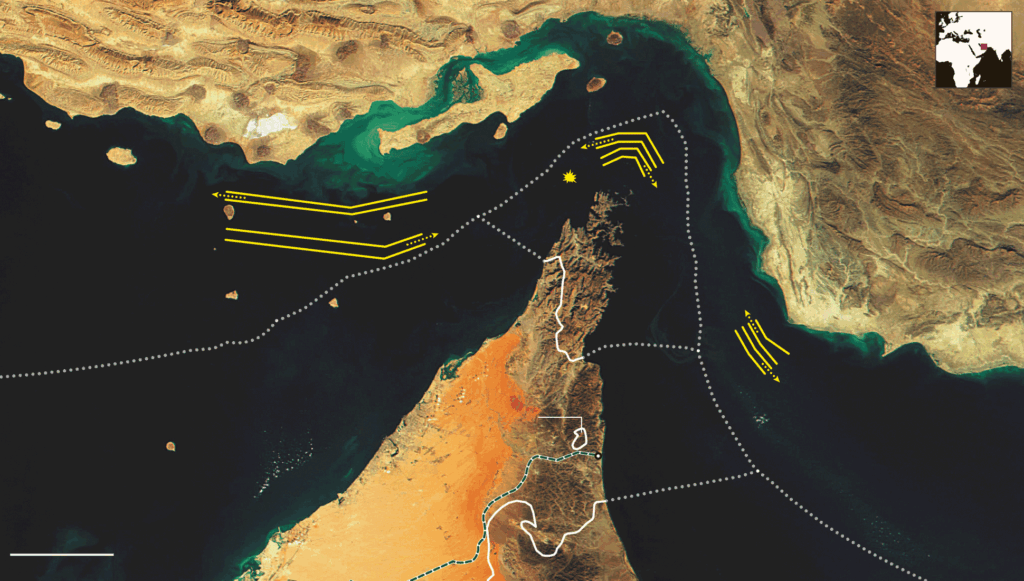
The Pentagon’s confirmation came shortly before President Donald Trump announced emergency measures aimed at securing maritime traffic through the Strait of Hormuz, a chokepoint Iran claims is effectively under the control of its Revolutionary Guards. Tehran’s assertion that it can disrupt or close the strategic waterway has transformed the Hormuz Flashpoint Crisis into a high-stakes global energy emergency.
Across the Persian Gulf, at least five U.S. partner states reported coordinated drone and missile attacks. Washington temporarily shuttered embassies in Saudi Arabia and Kuwait, while U.S. personnel in Riyadh were ordered to shelter in place after drones struck the embassy compound. Two drones hit the U.S. Embassy complex in Riyadh, causing structural damage and smoke contamination, according to official alerts. No CIA personnel were injured, though one of the agency’s largest regional stations was reportedly affected.
The widening conflict has also drawn Israel deeper into combat operations. Israeli officials confirmed fresh airstrikes on high-value targets in Tehran, including government facilities, while signaling preparations to push ground forces further into southern Lebanon. Hezbollah, in turn, claimed it launched drone salvos against Israeli positions. The multi-front escalation is fueling fears that the Hormuz Flashpoint Crisis could ignite a broader Middle East war with global economic consequences.
Dr Richard A E North Warns: Iranian Military Must Confront IRGC as War Risks Global Escalation
A suspected drone strike also ignited a small fire at the U.S. Consulate in Dubai, amplifying concerns that American diplomatic and intelligence assets across the Gulf are now primary targets. Analysts warn that Tehran’s asymmetric warfare doctrine—relying on drones, proxy forces, and maritime disruption—is calibrated to stretch U.S. resources without triggering a conventional ground invasion.
As the war entered its fourth day, the death toll mounted on all sides. President Trump signaled that U.S. strike capabilities could be sustained “far longer” than the four-to-five-week window initially projected by military planners. The scale and tempo of operations make the Hormuz Flashpoint Crisis the most significant U.S. military engagement in the region since the 2003 Iraq invasion.
Oil markets reacted instantly. West Texas Intermediate crude futures have surged roughly 10 percent since Friday, while the national average price for gasoline in the United States climbed to $3.11 per gallon, the highest level since mid-October. Trump acknowledged the near-term economic pain but insisted energy prices would fall once the conflict stabilizes. Standing beside German Chancellor Friedrich Merz, Trump framed the price spike as temporary. Merz offered a more cautious assessment, warning that prolonged instability would damage both oil and gas markets across Europe.
Strait of Hormuz: the corridor of power
To mitigate shipping risks, Trump ordered the U.S. International Development Finance Corporation to provide government-backed insurance guarantees for vessels transiting the Gulf. He also signaled that the U.S. Navy stands ready to escort tankers through the Strait of Hormuz if necessary—an extraordinary step reflecting the gravity of the Hormuz Flashpoint Crisis.
Strategically, Iran appears intent on leveraging geography as its primary bargaining chip. Nearly 20 percent of the world’s oil flows through the Strait of Hormuz. Even the perception of disruption can send shockwaves through global supply chains, from Asian refineries to European manufacturing hubs. Tehran’s leadership, under severe pressure following devastating Israeli and U.S. strikes that reportedly killed senior political and military figures, may view controlled escalation as a means of forcing negotiations.
Higher Oil Prices Shake Global Economy as Middle East Conflict Redraws Energy Market Future
Yet risks are multiplying. A direct hit on American intelligence infrastructure in Riyadh carries symbolic weight, given the CIA’s fraught history with Tehran dating back to the 1953 coup. Such incidents deepen mistrust and complicate diplomatic off-ramps. The Hormuz Flashpoint Crisis is therefore as much psychological warfare as kinetic combat.
Forecasting the next phase remains fraught with uncertainty. If Iran escalates maritime harassment or attempts a full blockade of Hormuz, U.S. naval retaliation would likely follow swiftly, potentially expanding the theater of operations. Conversely, backchannel diplomacy—reportedly encouraged by several Gulf states—could seek to freeze hostilities before oil markets spiral further.
The political clock is also ticking in Washington. With midterm elections approaching, sustained high fuel prices and market volatility could reshape domestic calculations. Trump’s administration must balance deterrence with de-escalation to prevent the Hormuz Flashpoint Crisis from morphing into a protracted regional war.
For now, the Middle East stands at a volatile crossroads. The convergence of drone warfare, energy geopolitics, and great-power rivalry has created a combustible mix. Whether the Hormuz Flashpoint Crisis becomes a brief but violent episode or the opening chapter of a longer strategic confrontation will depend on decisions made in Washington, Tehran, and Jerusalem in the coming days.