


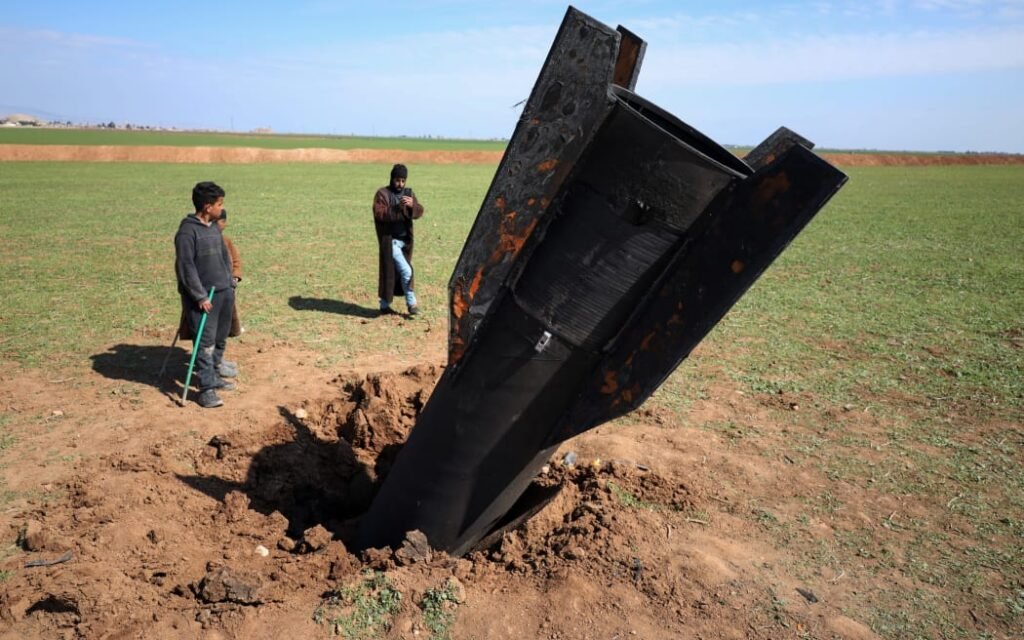
- Iran ballistic missile to Turkey confirmed by NATO and Ankara, marking a verified escalation and a potential new NATO flashpoint in the expanding Middle East war.
- NATO deterrence posture strengthened as France and United Kingdom move naval and air assets to standby, signaling alliance unity and rapid response capability.
- Command-and-control questions intensify inside Tehran, with analysts debating whether the strike reflects centralized strategic intent or fragmented wartime escalation dynamics.
- Regional war risks widening into Euro-Atlantic confrontation, as the Iran ballistic missile to Turkey incident raises fears of Article 4/5 implications and broader NATO involvement.
The confirmation by NATO and Turkey that an Iranian ballistic missile was fired toward Turkish territory — and successfully intercepted — marks a defining escalation in an already combustible regional war. What began as a high-intensity confrontation centered on Iran, Israel and the United States has now edged dangerously toward a broader NATO entanglement. The Iran ballistic missile to Turkey incident is no longer speculative; it is a verified act that has altered the strategic geometry of the conflict.
Officials in NATO confirmed that allied air defense systems tracked and neutralized the projectile before impact. Authorities in Turkey corroborated the interception, describing it as a “serious breach” of regional stability. The fact that the missile was launched — and crossed into Turkish airspace — has moved the crisis from diplomatic tension into the realm of direct military confrontation.
Dr Richard A E North Warns: Iranian Military Must Confront IRGC as War Risks Global Escalation
The immediate question confronting policymakers is intent. Turkey had not formally entered the war against Iran. While it hosts NATO infrastructure, those facilities were not publicly reported to be engaged in active strikes against Iranian targets. Why, then, risk provoking one of the alliance’s most capable militaries?
The Iran ballistic missile to Turkey episode triggered urgent diplomatic engagement. Turkey’s foreign minister held a telephonic consultation with the U.S. Secretary of State within hours of the interception. Emergency consultations under NATO’s Article 4 framework followed, underscoring that member states view the incident as a collective security concern. Shortly thereafter, France and United Kingdom — both nuclear-armed NATO powers — signaled readiness to deploy additional naval and air assets to standby positions in the Eastern Mediterranean. The message from the alliance was calibrated but firm: escalation will be monitored, and deterrence reinforced.
Strategically, the verified launch transforms the calculus. Turkey is not a peripheral actor; it fields NATO’s second-largest standing military and occupies a geopolitical hinge between Europe, the Black Sea, and the Middle East. A sustained confrontation between Tehran and Ankara would inevitably internationalize the war. Energy corridors, maritime chokepoints, and regional airspace security would all be implicated.
The Iran ballistic missile to Turkey crisis also raises a deeper structural concern: command authority in Tehran. Iran’s power architecture is complex, divided between the regular armed forces and the Islamic Revolutionary Guard Corps (IRGC), both operating under the authority of the Supreme Leader. In times of war, operational autonomy and centralized political oversight can blur. Was this missile launch a calculated strategic directive from the highest levels, or a tactical escalation driven by field commanders? The answer carries enormous implications.
Turkey says NATO defences destroyed Iran missile, risking war expansion
If centrally authorized, the strike signals a deliberate expansion of the battlefield — an acceptance of the risk that NATO might become more directly involved. If the decision emerged from a narrower operational chain, it suggests dangerous escalation dynamics within Iran’s military command structure. Either scenario intensifies global concern about escalation control.
From a military standpoint, Iran retains formidable missile and drone capabilities, and it has demonstrated the capacity to project power across the region. Yet the sustainability of a multi-front war is another matter. Tehran is already engaged in confrontation with Israel, facing U.S. strikes, and navigating economic strain under heavy sanctions. Opening friction with Turkey risks strategic overextension. The Iran ballistic missile to Turkey incident multiplies adversaries rather than isolates them.
For NATO, the interception represents a proof of defensive integration. Air defense coordination functioned as designed. But deterrence is a fragile equilibrium. If further projectiles were launched, political pressure within the alliance could intensify toward a more assertive response. While Article 5 — collective defense — has not been invoked, the trajectory of escalation now sits under intense scrutiny.
Financial markets are reacting accordingly. Oil prices have ticked upward amid fears of regional spillover. Insurance premiums for maritime traffic through adjacent waterways are climbing. Investors interpret the Iran ballistic missile to Turkey event as evidence that the war’s geographic boundaries are dissolving.
There is also a perception battle unfolding. For Ankara, the interception reinforces its role as a frontline NATO state. For European allies, it sharpens debates over deterrence versus de-escalation. For Tehran, the risk is diplomatic isolation at a moment when strategic maneuverability is already constrained.
Can Iran sustain such a war strategy? Militarily, it can absorb and project limited blows. Politically and economically, prolonged confrontation with an expanded coalition would strain internal cohesion. History suggests that wars broadened beyond initial objectives often erode strategic focus and domestic resilience.
The Iran ballistic missile to Turkey confirmation has therefore done more than add a new headline; it has shifted the center of gravity of the conflict. What was once a contained Middle Eastern battlefield now brushes directly against NATO’s core security architecture. Whether Tehran recalibrates or doubles down will determine if this moment becomes a contained flashpoint or the prelude to a far wider confrontation.
In high-stakes geopolitics, escalation control is as critical as firepower. The coming days will reveal whether diplomatic channels can outpace missile trajectories — or whether the widening arc of this war becomes increasingly difficult to reverse.