


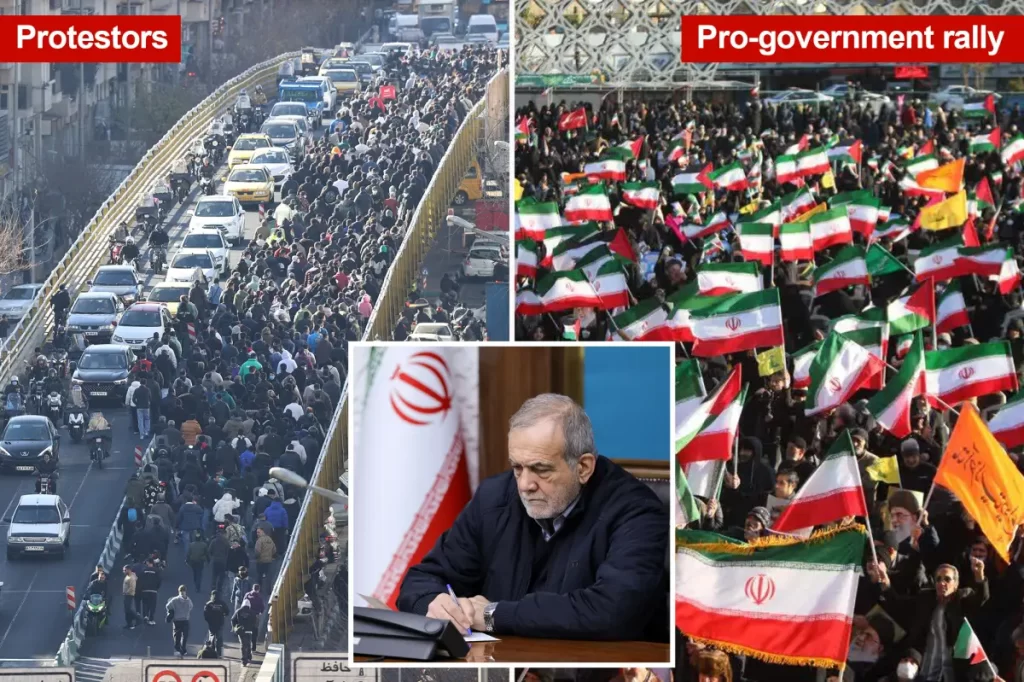
- Iran Protests: Human rights groups report at least 16 dead as security forces clash with demonstrators.
- Protests are fueled by a 40% inflation rate and the rial’s historic loss of value.
- Women and youth are leading the charge against systemic curbs on free speech and violence.
- Geopolitical tensions rise as the U.S. warns of intervention while Tehran claims foreign destabilization.
For the Islamic Republic of Iran, the first week of 2026 has been defined not by the calculated manoeuvres of its “deterrent diplomacy,” but by the raw, uncoordinated fury of its own streets.
What began as a strike by bazaar traders over a hemorrhaging currency has transformed into a nationwide uprising. Human rights organizations, including HRANA and Hengaw, report that at least 16 people have been killed and hundreds more arrested as security forces struggle to contain a populace that no longer fears the state’s shadow.
The current unrest is the most significant challenge to Tehran’s legitimacy since the “Woman, Life, Freedom” movement of 2022. Yet, the 2026 protests possess a more volatile chemistry. While the 2022 demonstrations were sparked by the singular tragedy of Mahsa Amini, today’s movement is a “perfect storm” of systemic failure.
Strike on Iran: Why the Trump-Netanyahu Strategy Faces a Resilient Regime
The rial has lost nearly half its value in months, inflation is entrenched above 40%, and the ghost of the “Twelve-Day War” with Israel in June 2025 has left the nation’s infrastructure—and its sense of invulnerability—in ruins.
Rights group says at least 16 dead in Iran during week of protests
A Familiar Echo, a Different Resonance
Policy makers must distinguish this wave from the Green Movement of 2009 or the gasoline riots of 2019. In 2009, the dissent was internal, led by reformers seeking to fix the system. By 2022, the mask of reform had fallen, replaced by a cultural rejection of theocratic mandates. Today, the movement has fused the cultural grievances of the youth and women with the existential desperation of the working class.
The regime’s response has been characteristically bifurcated. On one hand, officials offer “dialogue” with trade unions; on the other, the Islamic Revolutionary Guard Corps (IRGC) characterizes the unrest as a Trojan horse.
Maduro captured in daring U.S. Delta Force raid on Miraflores Palace: What Next?
Tehran’s narrative—that these protests are a Western-Israeli plot designed to justify a “locked and loaded” U.S. intervention—is a tired refrain. However, in the current high-stakes environment where the U.S. administration has signaled a readiness for military action, this paranoia is driving the regime toward a “security-first” mindset that prioritizes survival over even the most basic concessions.
The Geopolitical Powder Keg
The international community stands at a perilous junction. U.S. rhetoric, while emboldening to those on the streets, provides the hardliners in Tehran with the nationalist “enemy” they need to justify a bloodier crackdown. Rights groups have rejected the regime’s allegations of foreign orchestration, but the optics of external support remain a double-edged sword for the Iranian opposition.
For global policy makers, the perspective must be clear: Iran is no longer a state dealing with “episodes” of dissent. It is a state in a permanent war of attrition with its society. The economic tools used to pressure the regime—sanctions and “snapback” mechanisms—have successfully hollowed out the state’s capacity to govern, but they have also pushed the population to a level of misery where they have nothing left to lose.
The Forecast for Tehran
The future of this uprising depends on whether the regime’s security apparatus remains cohesive. Unlike the 2022 protests, the current economic collapse strikes at the heart of the Basij and the rank-and-file police, whose own families are suffering under the same 40% inflation they are tasked with defending.
In the coming months, we should expect a widening of the “gray zone”—an environment where the state cannot fully suppress the protests, and the protesters cannot fully topple the state.
This stalemate is the most dangerous phase for regional stability. Policy makers should prepare for a regime that may choose external escalation—likely via its remaining regional proxies—to distract from the internal rot. The streets of Tehran and Qom are no longer just demanding bread or a change in dress code; they are signaling the terminal exhaustion of a revolutionary project.