


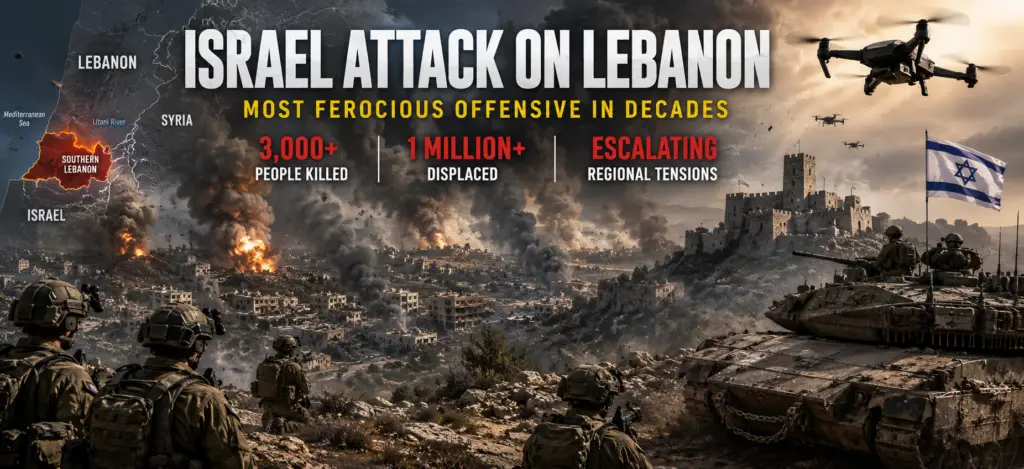
- Israel attack on Lebanon has evolved into a large-scale ground and air offensive with strategic territorial gains.
- Over 3,000 people killed and more than 1 million displaced in southern Lebanon since March escalation.
- Hezbollah’s drone warfare tactics are reshaping modern battlefield dynamics and challenging Israeli defenses.
- Rising geopolitical tensions complicate U.S.-Iran negotiations and risk a broader Middle East conflict.
Israel’s latest military offensive in Lebanon marks one of the most coordinated and ferocious escalations on the northern front in decades, dramatically reshaping the security landscape of the Middle East and sending shockwaves across an already volatile region. What began as cross-border exchanges has rapidly evolved into a deep and sustained ground incursion, coupled with intensive aerial bombardment and a strategic push to establish a new security reality along the Israel-Lebanon frontier.
At the center of this escalation is Israel’s capture of the Beaufort Castle ridge, a commanding high-ground position overlooking southern Lebanon. The fortress, known historically as Qalaat Al Chakif, sits roughly nine miles north of the Israeli border and beyond the Litani River—a long-contested geographic marker in past conflicts. Israeli forces had previously occupied the site during the 1982 Lebanon War before withdrawing in 2000 after years of sustained insurgent attacks. Its recapture now is both symbolically and militarily significant, providing Israeli forces with a vantage point over Hezbollah strongholds in the Nabatieh region.
Israeli Prime Minister Benjamin Netanyahu has framed the operation as a necessary response to an evolving threat environment, particularly the increasing effectiveness of Hezbollah’s drone warfare. In recent weeks, Hezbollah has intensified its use of first-person-view (FPV) explosive drones—cheap, precise, and difficult to intercept—causing mounting casualties among Israeli troops. Israeli military data suggests that these drones have become the leading cause of battlefield deaths, responsible for the majority of Israeli fatalities since the fragile ceasefire in April.
US Iran conflict Escalates as Missile Strike Blocs Key Vessel in Gulf of Oman
This technological shift in warfare has exposed vulnerabilities in Israel’s traditionally robust defense systems. Hezbollah’s use of fiber-optic guided drones—immune to electronic jamming—combined with night operations and improved targeting tactics, reflects lessons drawn from the الحرب في أوكرانيا (Russia-Ukraine war), where drones have transformed battlefield dynamics. Israeli forces, by contrast, have faced criticism for slow adaptation, with reports highlighting inadequate protective measures and clustering of military assets, making them easy targets.
Israel Captures Crusader Castle as It Expands Invasion of Lebanon
In response, Israel has launched a multi-pronged campaign: expanding ground operations, seizing strategic terrain, and conducting hundreds of airstrikes targeting Hezbollah’s infrastructure, including drone production and launch sites. Defense Minister Israel Katz has indicated that the ultimate goal is to create a “forward defense line”—effectively a buffer zone inside southern Lebanon, similar to the controversial security strip maintained prior to 2000 and more recently mirrored in Gaza.
The human cost of this escalation has been severe. Lebanese health authorities report that more than 3,000 people have been killed since early March, with over one million displaced from their homes in southern Lebanon alone. Entire villages have been flattened as Israeli forces demolish buildings to deny Hezbollah cover and operational space. Civilians on both sides of the border are living under constant threat. In northern Israel, towns like Shomera and Adamit experience daily drone alerts, forcing residents into prolonged shelter and psychological distress.
US Iran Strikes Escalation Raises Fears of Wider Regional Conflict Amid Fragile Ceasefire
The political ramifications are equally profound. Lebanon’s fragile government, already crippled by economic collapse and political paralysis, is under immense strain. It lacks both the authority and capability to control Hezbollah, which continues to operate as a powerful, Iran-backed militia independent of state command. This disconnect complicates diplomatic efforts, particularly ongoing U.S.-Iran negotiations aimed at de-escalating broader regional tensions. Tehran has reportedly made an end to hostilities in Lebanon a key condition for any agreement, placing additional pressure on Washington to restrain Israel’s actions.
However, Netanyahu faces domestic pressure in the opposite direction. Critics within Israel argue that U.S. constraints have limited the military’s ability to strike decisively, particularly in Beirut, where Hezbollah maintains significant influence. Calls for a more aggressive campaign—including deeper strikes into urban centers—are growing louder, especially from northern residents who feel increasingly abandoned and exposed.
Strategically, analysts believe Israel’s seizure of Beaufort and surrounding areas may be temporary, intended to gain leverage in future negotiations rather than establish a permanent occupation. Past experience has shown that holding such positions comes at a high cost in both manpower and resources, especially against a determined insurgent force like Hezbollah.
Yet, the immediate trajectory remains one of escalation. With both sides adapting rapidly to new forms of warfare and political pressures limiting diplomatic breakthroughs, the risk of a broader regional conflict is rising. The Lebanon front, once a contained flashpoint, is now a central theater in a wider confrontation that intertwines military innovation, geopolitical rivalry, and the fragile balance of power in the Middle East.