


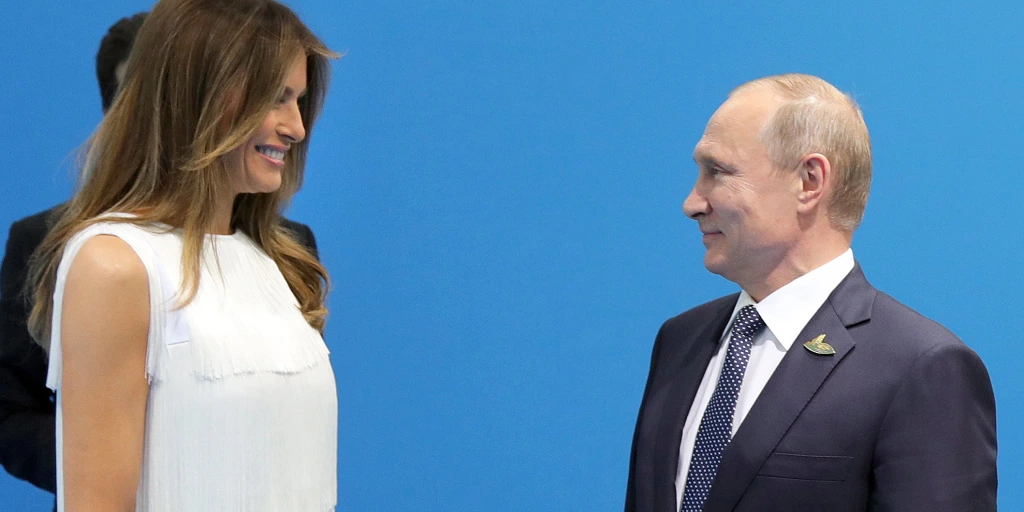
- Melania Trump’s “open channel” with Vladimir Putin marks a surprising humanitarian breakthrough amid the Ukraine conflict.
- Trump and Putin’s longstanding rapport—the “Spirit of Alaska”—has rekindled hopes of U.S.–Russia cooperation and peace.
- Both leaders share incentives: Trump seeks legacy, Putin seeks relief from sanctions and war fatigue.
- A revived U.S.–Russia relationship could reset the global order and bring long-awaited stability to Europe.
In an age of noise, cynicism, and mistrust, a quiet story has emerged—one that might yet change the rhythm of world affairs. On a cold Alaskan runway two months ago, Donald Trump and Vladimir Putin shook hands, smiled for the cameras, and seemed to suggest that peace, however improbable, was no longer impossible. Reporters dubbed it the Spirit of Alaska—a phrase that now carries fresh meaning after First Lady Melania Trump’s remarkable revelation this week.
Standing beneath the chandeliered foyer of the White House, Melania announced that she has maintained “an open channel of communication” with President Putin over the welfare of children displaced by the war in Ukraine. In just twenty-four hours, eight Ukrainian children—some separated by the chaos of shelling, others lost across borders—were reunited with their families.
The initiative, she said, began with a letter she wrote to Putin in August—hand-delivered by her husband during the Anchorage summit. Her words were simple but piercing: a plea to “restore the melodic laughter” of children caught in the conflict. Putin, in a gesture that surprised even seasoned Kremlin watchers, responded personally.
A Mother’s Cry Across Oceans: Emine Erdoğan’s Plea for Gaza’s Children
Since then, the two have maintained regular contact, discussing the welfare of Ukrainian children in Russia and coordinating reunifications through trusted representatives. “This remains an ongoing effort,” Melania said. “Plans are already under way to reunify more children in the immediate future. I hope peace will come soon.”
It was not a speech of politics, but of purpose—and it spoke volumes about the understated diplomacy that the Trumps and the Kremlin have quietly pursued. Behind the grand posturing of Washington and Moscow lies a subtler story: that of two leaders, once seen as adversaries, now playing the long game of rapprochement.
From Adversaries to Architects of a New Order
Trump and Putin’s relationship has never fit the usual script of international diplomacy. It has been too personal, too unpredictable, too human. Their chemistry—once dismissed as theatrics—has matured into something more consequential: an understanding that the world’s stability may depend not on bureaucracy, but on trust between men willing to defy convention.
READ MORE: The Spirit of Alaska: Can Trump And Putin End War In Ukraine?
Earlier reports by The Islamabad Telegraph revealed that the two maintained private contact even through the frostiest years of the Biden administration. Aides on both sides confirm that a back-channel, facilitated by a handful of loyal envoys, remained open—sometimes for humanitarian coordination, sometimes for quiet conversation. It is this continuity, sustained quietly and deliberately, that now gives the Spirit of Alaska its unusual power.
For Putin, embattled by sanctions and a grinding war, the path to peace runs through pragmatism. For Trump, returning to power with an eye on legacy, it offers a chance to prove what his critics have always doubted—that his instincts for deal-making could extend beyond real estate and into history itself.
Melania’s Letter: The Human Face of Diplomacy
If Trump and Putin provide the strategy, Melania offers the soul. Her initiative on behalf of displaced Ukrainian children may seem symbolic, but symbolism has power. For months, global institutions have condemned Russia over child abductions, while progress remained elusive. Yet through a single letter—delivered not by diplomats but by a husband to another head of state—doors opened.
ALSO READ: Melania Trump Says ‘Back Channel’ With Putin Led to Return of Ukrainian Children
The Kremlin, in response, provided biographical dossiers of children in its custody and initiated verifications through international intermediaries. The result: the first confirmed reunifications in months, verified quietly by U.S. officials. It is diplomacy as empathy, stripped of spectacle.
“People underestimate Melania,” one White House source told The Islamabad Telegraph. “She may have achieved what the State Department couldn’t—getting Moscow to talk about children, not sanctions.”
In her meeting with Olena Zelenska during the U.N. General Assembly, Melania hinted that “motherhood transcends politics.” Those words now ring prophetic.
The Spirit of Alaska: A Second Chance for History
The Anchorage meeting was not merely a photo opportunity. It was the opening of a new chapter in U.S.–Russia relations, one that seeks to blend hard realism with human decency. Trump, unlike his predecessors, approaches Putin not as a rival to be contained but as a peer to be engaged. The contrast is striking—and perhaps, necessary.
Skeptics scoff, pointing to the history of dashed hopes: Reykjavik in 1986, Helsinki in 2018. Yet history also shows that great shifts often begin with small acts—letters, handshakes, or in this case, the reunion of children long thought lost.
Trump and Putin, each pragmatic in his own way, seem to understand that power is best exercised not in threats, but in timing. With Western economies fatigued by war costs and Russia seeking a dignified exit, the moment for peace may be approaching.
A Fragile Hope, But a Real One
To end a war is to rewrite history. To even attempt it requires courage, timing, and a willingness to be misunderstood. Trump and Putin, through their unpredictable rapport, have already proven that they defy expectations. Theirs is a partnership born not of ideology but of necessity—a recognition that the world can no longer afford permanent confrontation.
As Melania Trump put it, “Every child who laughs again is a step closer to peace.” It is a sentiment that transcends politics and, perhaps, captures the essence of what the Spirit of Alaska really means: a reminder that diplomacy, at its best, is human.
In that handshake in the Alaskan wind, and in the quiet messages that followed, lie the seeds of something rare—a chance for redemption, for both nations and their leaders.
The world, bruised and weary, deserves such a chance.