


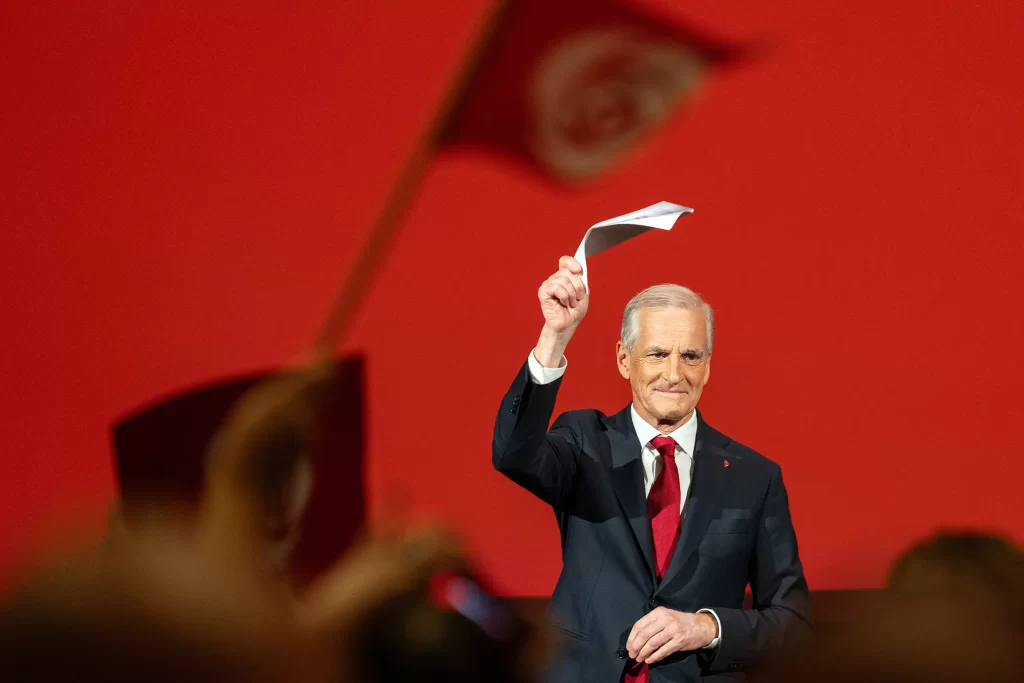
- Labour holds power, but narrowly: Prime Minister Jonas Gahr Støre’s Labour Party secured a second term, but remains dependent on smaller left-leaning allies to govern.
- Populist surge reshapes politics: Sylvi Listhaug’s Progress Party doubled its seats, signaling a rightward shift that could pressure future policymaking.
- Energy and economy at the core: Norway’s role as Europe’s top gas supplier clashes with domestic calls to limit oil exploration, while inflation and rising costs dominate public debate.
- Foreign policy continuity with caution: Norway remains a strong NATO ally, but must carefully balance relations with Trump’s Washington and the European Union.
When Norwegians went to the polls last week, they delivered a message that resonated far beyond Oslo: social democracy still has staying power in an era dominated by populist insurgencies. Prime Minister Jonas Gahr Støre’s minority Labour Party government, against the odds, secured a second term, winning just enough support from four smaller allies to surpass the parliamentary majority threshold. Yet beneath the surface of this victory lies a complex reality—one that reveals both the resilience of Norway’s political center and the growing clout of a populist right wing that has doubled its representation in parliament.
For international observers, Norway’s election is more than a domestic affair. It speaks to broader questions: how will this Nordic country, with its outsized role in global energy markets and diplomacy, navigate deepening divisions at home while maintaining its standing abroad? What will Labour’s win mean for relations with the United States under Donald Trump’s second presidency, and for Norway’s place in Europe as conflicts rage in Ukraine and Gaza?
Social Democracy Holds, But With Strings Attached
Støre’s win was not resounding but functional. Labour and its allies captured 87 seats, just above the 85 needed for a majority. This razor-thin cushion forces Støre to rely heavily on smaller, more ideologically rigid partners. Already, disagreements loom over core issues such as taxation, climate policy, and the management of Norway’s vast $2 trillion sovereign wealth fund.
The fund, the world’s largest, has been central to debates about ethics and geopolitics. Pressure is mounting from junior coalition partners to accelerate divestments from Israeli companies over the war in Gaza. Critics warn that such moves could strain Norway’s reputation as a pragmatic broker in the Middle East, while supporters argue that financial policies must reflect international law and humanitarian values.
READ MORE: Norway ruling Labour Party wins reelection while populists score gains
At the same time, questions about the country’s oil and gas industry remain deeply divisive. Norway emerged as Europe’s top natural gas supplier after Russia’s 2022 invasion of Ukraine, replacing Gazprom as the continent’s lifeline. While this role has bolstered state revenues, younger and greener voices in Støre’s coalition want to curtail new oil exploration. Balancing the economic realities of energy exports with environmental commitments will be a defining challenge for the next four years.
The Populist Surge
If Labour’s victory suggests stability, the performance of the Progress Party tells another story. Led by Sylvi Listhaug, the populist, anti-immigration force captured 48 seats—more than double its tally from the last election. Its platform of sweeping tax cuts, reductions in international aid, and a hard line on immigration struck a chord with younger voters, particularly young men disillusioned with high living costs.
ALSO READ: Europe’s Billion-Dollar Bet on American Missiles Could Rewrite the Ukraine War — and Trump Knows It
Listhaug, who openly admires Ronald Reagan and Margaret Thatcher, has softened her rhetoric compared to earlier firebrand years, yet her appeal is rooted in frustration with what many view as Norway’s bloated welfare state and excessive spending on green subsidies. While Progress is unlikely to enter government immediately, its momentum could shape the national agenda by pulling debates further to the right.
For Europe, the rise of Listhaug’s movement mirrors the broader populist wave reshaping politics from Rome to Helsinki. Yet unlike in some EU countries, Norway’s right-wing parties have steered clear of aligning themselves with Donald Trump, wary of alienating centrist voters and damaging Norway’s image as a cooperative NATO partner.
Foreign Policy Continuity—With Subtle Shifts
On the international stage, Støre’s second term is expected to deliver continuity. Norway will remain a staunch NATO ally, a critical stance as Russian aggression rattles Europe. The inclusion of former NATO Secretary-General Jens Stoltenberg in Støre’s cabinet has reinforced public confidence that the government is equipped to navigate escalating tensions. According to surveys, nearly 60 percent of Norwegians believe a new European war is likely within the next decade—an increase from last year—underscoring the urgency of defense preparedness.
Relations with Washington under Trump, however, present a different calculus. Trump’s skepticism toward NATO and transactional approach to alliances have unnerved European leaders. For Norway, which shares an Arctic border with Russia, American commitment to collective defense is existential. Støre will likely tread carefully, maintaining open lines with Trump while simultaneously deepening Norway’s integration with European defense initiatives. Unlike Hungary or Poland, Norway is unlikely to pivot toward Washington unconditionally; instead, it will hedge by binding itself closer to Brussels.
At the same time, Norway’s reputation as a diplomatic broker—from Middle East peace processes to Arctic governance—could be tested. The Gaza conflict has polarized domestic politics, while Ukraine continues to demand unwavering military and financial support. Norway’s challenge will be to sustain its mediator role without appearing compromised by economic interests, particularly in the energy sector.
Economic Realities: Inflation, Exports, and Trade
Behind these political maneuvers lies an economy grappling with inflation and shifting trade dynamics. Rising living costs were the election’s central theme, with households squeezed by higher energy prices, food inflation, and mortgage costs. While Norway’s oil and gas exports have generated record revenues, much of this windfall has been locked away in the sovereign wealth fund rather than directly easing consumer pressures.
Norway remains heavily export-oriented, with petroleum products accounting for more than half its foreign sales. Gas exports to Europe surged after 2022, reinforcing Norway’s indispensability to the EU. At the same time, imports of machinery, vehicles, and consumer goods have left the country exposed to global supply chain disruptions. Trade relations with the EU, Norway’s largest partner, will remain crucial, but diversification into green technologies and fisheries is expected to play a growing role in cushioning against energy price volatility.
The Labour government’s ability to manage inflation while maintaining robust exports will determine whether it can sustain legitimacy in the face of populist pressure. Should economic grievances persist, Listhaug’s Progress Party could emerge not just as a spoiler but as a contender for power in the next election.
Norway at the Crossroads
For now, Jonas Gahr Støre has secured four more years. Yet governing Norway in this turbulent moment will require constant balancing: between allies at home and partners abroad, between fossil fuel wealth and green ambitions, between the American security umbrella and European solidarity. The populist surge ensures that the rightward pull will remain strong, while inflation and geopolitical crises will test the patience of voters.
Internationally, Norway’s election demonstrates that social democracy is not dead, but it is under strain. The country remains in safe hands, but its political equilibrium grows more fragile. What happens in Oslo will not stay in Oslo—it will ripple through European energy markets, NATO strategy, and the global contest between populism and liberal democracy.