


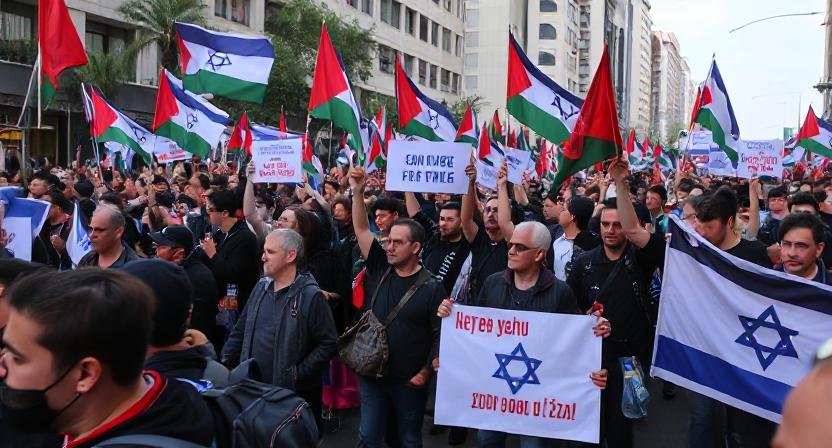
- Nearly one million Israelis joined unprecedented nationwide protests demanding an end to the Gaza war and the release of hostages.
- Demonstrators filled “Hostage Square” in Tel Aviv, chanting against Prime Minister Netanyahu’s war policy.
- Hamas accepted a 60-day ceasefire deal after decisive U.S. President Donald Trump intervention in Cairo and Washington.
- The breakthrough raises hopes for hostage releases and humanitarian relief in war-torn Gaza.
In Tel Aviv’s central plaza, now renamed “Hostage Square,” the air was filled with the beat of drums, the wail of megaphones, and the chants of a restless people. On Sunday night, hundreds of thousands of Israelis—women pushing strollers, teenagers draped in flags, veterans leaning on canes—marched together demanding one thing: bring the hostages home and end the war in Gaza.
The sight was unprecedented. For nearly two years, Israel has remained locked in a brutal war with Hamas. Yet never before have Israelis taken to the streets in such staggering numbers—close to a million nationwide, according to the Hostages and Missing Families Forum. Roads were blocked, bonfires lit, and even theaters and restaurants shuttered in solidarity. Tel Aviv’s protest alone drew some 400,000 people, one of the largest demonstrations in the country’s history.
BREAKING: Hamas Accepts Trump-Brokered Ceasefire Proposal in Gaza, Raising Hopes for Peace
Placards carried by protesters told the story: “Stop the genocide in Gaza.” “Life before revenge.” “Seal the deal now.” Families of hostages took to stages in trembling voices, urging Prime Minister Benjamin Netanyahu to abandon military escalation and strike an agreement with Hamas before more lives were lost.
Ruby Chen, whose son was killed in the October 7, 2023 attacks and whose body remains in Gaza, captured the sentiment: “The Jewish Bible speaks about the Jewish life. Life comes before revenge, and that is exactly what we are asking for this government to remember.”
Netanyahu Digs In
But if protesters hoped their voices would sway the government, Netanyahu’s response was unyielding. Addressing his Cabinet, he accused demonstrators of “hardening Hamas’s position and delaying the release of hostages.” His ultranationalist allies were harsher still. Finance Minister Bezalel Smotrich blasted the protests as “a toxic and harmful campaign” that amounted to surrender.
READ MORE: Hundreds of thousands protest Gaza war as frustration grows in Israel about new offensive
The government’s stance seemed bolstered by military momentum. Israeli media reported that Lt. Gen. Eyal Zamir had met with senior commanders to finalize a new offensive in northern and central Gaza, despite fears from hostage families that such a move would doom their loved ones.
And yet, the pressure was undeniable. Israeli society, fractured for years along ideological lines, appeared united in its demand for an end to the war. “I’m sure that most Israelis are with us now,” said Keren Leibovitz, who lost her son on October 7. “They want the war to end, and they want the hostages to come back.”
A Breakthrough Abroad
Even as Israelis shouted in the streets, a quieter drama was unfolding in Cairo and Washington. After months of deadlock, Hamas on Monday accepted a new ceasefire proposal. The deal, brokered by Egypt and Qatar but sealed by the personal intervention of U.S. President Donald Trump, promises a 60-day halt to hostilities and the release of half of the remaining hostages in exchange for Palestinian prisoners.
ALSO READ: Europe Scrambles to Define ‘Red Lines’ Before Trump–Putin Alaska Summit Amid Fears of Ukraine Sell-Out
An Egyptian official confirmed the framework: Israel would suspend military operations for two months, Hamas would free about 25 hostages, and both sides would commit to pursuing a broader peace framework with international mediators.
For millions of Palestinians, the ceasefire could mean temporary respite from a nightmare of bombardment, displacement, and starvation. For Israelis, it offers the first real hope in months that families torn apart by captivity might be reunited.
Trump’s Decisive Role
According to diplomatic sources, Trump’s intervention tipped the balance. Over 72 hours, he held a flurry of calls—three with Netanyahu, two with Egyptian President Abdel Fattah al-Sisi, and one with Qatar’s Emir Sheikh Tamim bin Hamad al-Thani.
“He told Netanyahu bluntly that prolonging the war would isolate Israel internationally,” said one Washington insider. “And he assured Hamas, through intermediaries, that the U.S. would guarantee implementation of any deal.”
For a leader often criticized for his unpredictable style, Trump’s diplomacy delivered results. The ceasefire marks his most significant foreign policy breakthrough since returning to the White House—a development likely to shape his legacy as much as any domestic reform.
Gaza’s Agony
Meanwhile, conditions in Gaza remain catastrophic. The U.N. estimates that 1.35 million people are in urgent need of shelter. Entire families are sleeping in rubble-strewn streets as aid convoys trickle in far below demand. The Gaza Health Ministry reports that more than 62,000 people have died since the war began, including at least 263 from malnutrition-related causes.
“Families drag suitcases through ruins, hospitals run without power, and children sleep under the open sky,” said one U.N. official. “A ceasefire is not just political—it is survival.”
What Comes Next?
The deal, however, is fragile. Netanyahu faces pressure from hawkish allies who see any truce as a concession to terrorism. Hamas, for its part, has previously used ceasefires to regroup. Analysts warn that without a broader framework—security guarantees for Israel, reconstruction aid for Gaza, and perhaps a renewed discussion on Palestinian statehood—the war could easily resume.
But for now, both Israelis and Palestinians cling to a rare sliver of hope.
In Hostage Square, the chants that once thundered against Netanyahu gave way to softer voices of relief at the ceasefire news. Some families wept, holding pictures of loved ones who might soon come home. Across the border in Khan Younis, a Palestinian mother put it simply: “We just want to sleep without fear for a few nights. That is all we ask.”