


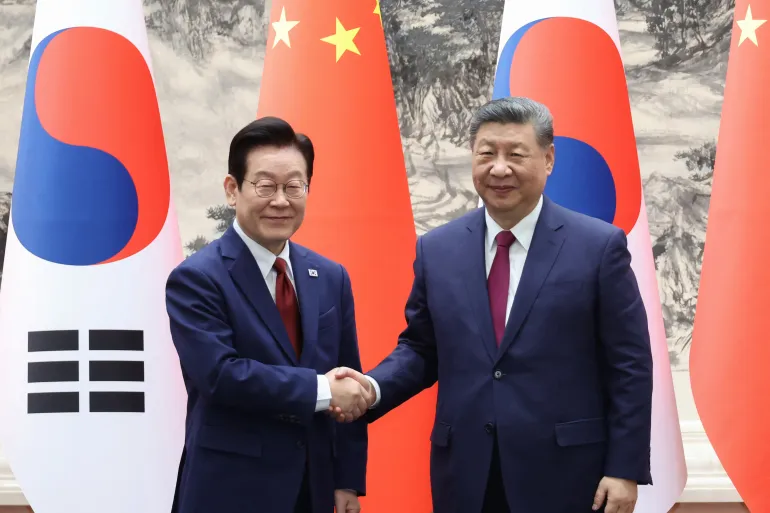
South Korean President requested Xi to mediate between North and South Korea. In early 2026, the diplomatic landscape of Northeast Asia has undergone a dramatic shift. Following the historic state visit of South Korean President
To understand why South Korean President Lee Jae-myung is currently leaning on Beijing, one must look back at the 2017 THAAD (Terminal High Altitude Area Defense) crisis. This event remains the single most significant “scar” on the bilateral relationship and explains why Lee is working so hard to move into a “new phase” of ties.
The following expansion explores the origins of the dispute, the economic fallout, and why this history makes the current request for mediation so delicate.
South Korean President Visit to China: A New Era of Pragmatic Diplomacy
The THAAD Crisis: A Geopolitical Fault Line
In 2016, following a series of North Korean nuclear and missile tests, the South Korean government (under then-President Park Geun-hye) agreed to host the U.S.-made THAAD anti-missile system. While Seoul and Washington maintained the system was purely defensive—intended to intercept North Korean missiles—Beijing saw it as a direct threat to its own national security.
South Korea’s Lee says he asked Xi to play a mediating role on North Korea
The core of China’s grievance wasn’t just the interceptors, but the system’s powerful X-band radar. Beijing argued that this radar could peer deep into Chinese territory, monitoring their own military movements and neutralizing their nuclear deterrent. For China, the South Korean President’s decision at the time was seen as a betrayal of regional “strategic balance” in favor of U.S. containment strategies.
The Economic “Cold War”
What followed was an unprecedented display of China’s “economic statecraft.” While Beijing never officially declared sanctions, South Korea felt the weight of a massive, coordinated boycott.
-
The Lotte Exit: The Lotte Group, which provided the land for the THAAD battery, saw its businesses in China crippled by sudden “safety inspections” and regulatory hurdles, eventually forcing them to exit the Chinese market entirely.
-
The K-Pop Ban: South Korean dramas, music, and films—enormously popular in China—were suddenly scrubbed from streaming platforms. Concerts were canceled, and “Hallyu” (the Korean Wave) was effectively locked out of the world’s largest consumer market.
-
The Tourism Collapse: Chinese tour groups were barred from traveling to South Korea, leading to billions of dollars in losses for the duty-free and hospitality sectors in Seoul and Jeju Island.
This era proved to Seoul that its economic prosperity was precariously dependent on a neighbor that was willing to use trade as a weapon.
Lee Jae-myung Xi Jinping Summit 2026: South Korea China Visit, Trade Deals, North Korea & Taiwan Tensions
Why Lee is Pushing for a “New Phase”
When the South Korean President tells Xi Jinping that “much progress has been made in restoring trust,” he is referencing the slow, painful process of moving past the THAAD trauma. Lee’s strategy is built on several pillars:
1. The “Three Nos” Policy
To appease Beijing, previous administrations hinted at a “Three Nos” policy: no additional THAAD deployments, no participation in a U.S.-led regional missile defense system, and no trilateral military alliance with the U.S. and Japan. Lee Jae-myung is navigating a razor-thin line, trying to maintain the security benefits of THAAD while convincing Xi that South Korea is not an instrument of U.S. “containment.”
2. Strategic Autonomy
By visiting Shanghai and speaking to the media about “restoring trust,” Lee is signaling a desire for “strategic autonomy.” He wants to show that the South Korean President can be a bridge between the West and the East, rather than just a frontline state for U.S. interests.
3. Xi’s “Patience” vs. Lee’s “Urgency”
The tension in their recent meeting is palpable. For Xi, “patience” is a way to maintain the status quo where North Korea remains a buffer. For Lee, however, the status quo is dangerous. North Korea is rapidly advancing its solid-fuel ICBM technology. Lee knows that without China’s active mediation, the window for a peaceful diplomatic solution might close, potentially forcing South Korea to consider its own nuclear armament—a scenario Beijing wants to avoid at all costs.
The Stakes: A New Regional Architecture
The geopolitical stakes of Lee’s request are massive. If Xi agrees to play a genuine mediator role, it would represent a historic shift where China takes primary responsibility for security on the peninsula. However, if Xi continues to prioritize “patience” over “action,” the South Korean President may find himself under immense domestic pressure to pivot back toward a more hawkish, U.S.-centric defense posture.
Ultimately, the THAAD dispute taught South Korea that it cannot ignore China’s security concerns without paying a heavy economic price. Lee’s current mission is to prove that Seoul can be a loyal U.S. ally and a trusted partner to Beijing—a diplomatic “grand slam” that few leaders have ever successfully achieved.