


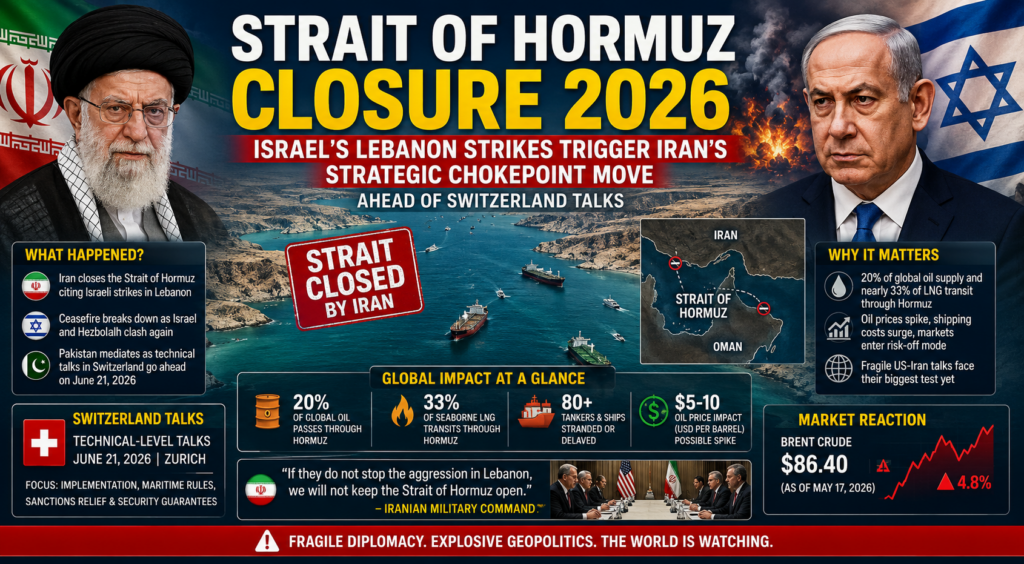
- Strait of Hormuz closure 2026 disrupts global oil flows and exposes fragile US-Iran diplomacy
- Iran links closure directly to Israeli strikes in southern Lebanon
- Switzerland technical talks downgraded to crisis-management amid tensions
- Pakistan-led mediation faces critical test as regional escalation intensifies
Israel’s latest strikes on southern Lebanon have triggered a sharp geopolitical recoil, with Iran’s decision to once again close the Strait of Hormuz exposing just how fragile the emerging U.S.–Iran détente remains—barely days before technical-level talks scheduled in Switzerland on June 21.
The timing is not coincidental. It is strategic signaling.
Iran’s joint military command announced Saturday that maritime traffic through the Strait of Hormuz would be suspended, citing Israel’s renewed offensive near Nabatieh and what Tehran described as Washington’s failure to enforce a core condition of the recently signed memorandum of understanding: de-escalation across the Lebanese front. The move effectively reverses the most tangible gain of the Trump-brokered agreement—free passage through one of the world’s most critical energy chokepoints.
The Strait of Hormuz carries roughly 20% of global oil supply and nearly a third of seaborne liquefied natural gas. Even a temporary disruption sends shockwaves across energy markets. Early indicators already suggest insurance premiums for Gulf-bound vessels are rising again, while shipping companies—still wary after last week’s limited reopening—are pausing transit decisions.
US Intelligence Warns Israel May Sabotage Trump’s Iran Deal Amid Rising Lebanon Tensions
This is not merely a military reaction. It is negotiation by leverage.
Iran’s closure comes at a moment when diplomatic momentum was cautiously rebuilding. Delegations from both sides had begun arriving in Zurich for technical consultations meant to translate the broad memorandum into actionable steps—ranging from sanctions relief sequencing to maritime governance mechanisms. U.S. intermediaries, including senior envoys already on the ground, had been working through lower-level frameworks to ensure implementation compliance.
But Israel’s escalation has once again altered the trajectory.
Despite a ceasefire announced Friday between Israel and Hezbollah, the truce barely held. Within hours, cross-border fire resumed, with Hezbollah reportedly launching over 50 attacks and Israel responding with heavy strikes that Lebanese officials say killed dozens across multiple incidents. For Tehran, this breakdown directly undermines the spirit—if not the letter—of the agreement it signed with Washington.
Read More:These Are the Heroes Who Made the US–Iran Peace Deal Possible
Iranian officials argue that the memorandum implicitly binds the United States to restrain Israeli actions, especially where they threaten regional stability. Washington, however, has maintained a more ambiguous stance—supporting Israel’s right to self-defense while simultaneously urging restraint. This dual messaging has now become a fault line in the negotiations.
Vice President JD Vance’s earlier assertion that “the straits are now open” now appears overtaken by events. His planned presence at the Switzerland talks remains uncertain, reflecting the broader volatility surrounding the diplomatic process.
Related:Iran Closes Strait of Hormuz as Fighting Flares Again in Lebanon
Pakistan, acting as a key mediator, has confirmed that talks will proceed at the technical level on Sunday, but expectations have been recalibrated. What was meant to be a forward-moving session may now become a crisis-management exercise.
At the heart of the issue lies a structural contradiction: the U.S.–Iran understanding is being tested not by direct bilateral disputes, but by third-party dynamics—chiefly Israel’s ongoing confrontation with Hezbollah. This triangular tension complicates enforcement mechanisms. Unlike traditional bilateral agreements, this framework depends on indirect compliance by actors not formally bound to its terms.
Iran’s decision to close Hormuz is therefore both punitive and preventative. It punishes perceived non-compliance while also raising the cost of further escalation. By targeting a global economic artery, Tehran internationalizes the crisis, ensuring that European and Asian stakeholders—heavily dependent on Gulf energy flows—have a vested interest in de-escalation.
Looking ahead, several scenarios emerge.
If Israel continues operations in Lebanon, Iran is likely to maintain or even tighten its control over the strait, potentially introducing selective passage or conditional access tied to diplomatic concessions. This would further strain global energy markets and increase pressure on Washington to recalibrate its regional approach.
Conversely, if the Switzerland talks yield a clearer enforcement framework—particularly one that addresses cross-front de-escalation—Iran may reopen the strait under stricter regulatory conditions, possibly formalizing its newly established Persian Gulf Strait Authority as a permanent oversight mechanism.
There is also a third, more precarious path: prolonged ambiguity. In this scenario, intermittent closures, sporadic violence in Lebanon, and stalled negotiations could create a cycle of instability that neither side fully controls but both exploit tactically.
For now, the closure of the Strait of Hormuz stands as a stark reminder that the current diplomatic architecture is not yet resilient. It is reactive, vulnerable, and deeply entangled in regional fault lines.
As negotiators gather in Switzerland, the question is no longer just whether the U.S. and Iran can reach a lasting agreement—but whether they can insulate it from the conflicts that continue to rage around them.