


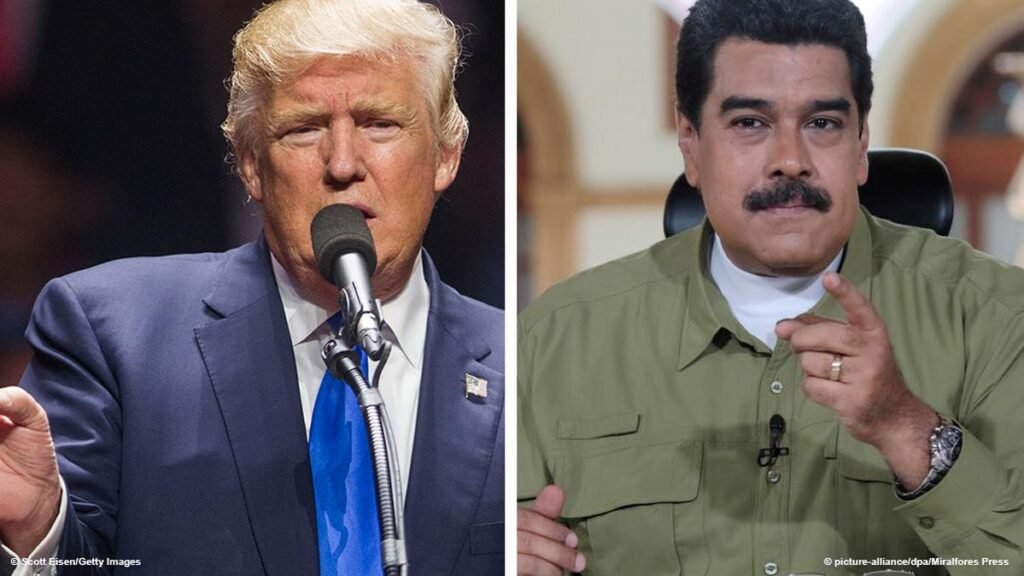
- The U.S. has deployed the USS Gerald R. Ford carrier group and thousands of troops near Venezuela, signaling a major escalation.
- Trump accuses Maduro’s regime of “narcoterrorism,” authorizing CIA operations and covert military planning.
- Critics, including U.S. lawmakers, question the legality and evidence behind alleged anti-drug strikes.
- A U.S.-Venezuela war could reshape global alignments, drawing in China, Russia, and destabilizing Latin America.
Donald Trump, the man who brokered peace between Thailand and Cambodia in what could have been Southeast Asia’s 10th major modern conflict, now stands on the brink of a new confrontation—this time in America’s own backyard. The same U.S. president who calls himself “the greatest peacemaker of our times” is flexing military muscle off Venezuela’s coast, with the Pentagon confirming a buildup unseen in decades. The irony is glaring: a man who prides himself on conflict resolution is flirting with war.
Yet, as Trump himself might argue, Venezuela is not just another foreign crisis—it is a test of will, sovereignty, and the limits of U.S. power in a shifting global order.
A Military Posture With a Political Message
The Pentagon’s recent confirmation of the USS Gerald R. Ford carrier strike group heading toward the Caribbean marks a dramatic escalation. Already stationed nearby are U.S. destroyers, submarines, and F-35 fighter squadrons. More than 10,000 sailors and Marines are in the region. The U.S. military has blown up several small boats in alleged anti-narcotics operations, killing dozens and provoking outrage in Latin America.
Trump’s Caribbean Gamble: A Show of Power That Could Ignite Latin America
Officially, Washington says these are counter-narcotics missions targeting transnational criminal networks. But Trump’s rhetoric tells a different story. The president has branded Venezuelan leader Nicolás Maduro a “narco-dictator” and accused the Tren de Aragua gang—one of Latin America’s most feared criminal syndicates—of flooding U.S. cities with cocaine. Trump has gone further, authorizing covert CIA operations inside Venezuela and labeling several Latin cartels as terrorist organizations.
Behind the hard talk lies a deeper strategy: projecting U.S. power into a hemisphere where Chinese and Russian influence has grown steadily under Maduro’s regime.
The Long Shadow of 2019
To understand the new flashpoint, one must recall 2019, when Washington recognized opposition leader Juan Guaidó as Venezuela’s legitimate president. That gamble failed. Maduro, backed by Moscow, Beijing, and Tehran, weathered the storm. U.S. sanctions crippled Venezuela’s oil sector but strengthened Maduro’s anti-imperialist narrative. Over time, Caracas adapted—trading oil for Chinese technology, Russian arms, and Iranian fuel.
READ MORE: Shadows Over the Caribbean: The Gathering Storm Between Washington and Caracas
Trump, in his second term, appears determined not to repeat that humiliation. By militarizing the Caribbean, he signals that the United States will no longer tolerate a defiant socialist regime aligned with America’s rivals just 1,300 miles from Miami.
The New “Narcoterror” Doctrine
Trump’s national security team has reframed Venezuela not as a political adversary, but as a hub of “narcoterrorism.” This rebranding gives the White House a legal and moral basis to justify strikes without congressional approval. According to Senator Lindsey Graham, Trump has decided that “Maduro is an indicted drug trafficker—it’s time for him to go.”
A Powder Keg in the Caribbean: Why U.S.-Venezuela Tensions Could Explode into Crisis
But critics warn that such reasoning mirrors the buildup to the Iraq War, when moral justifications masked a broader geopolitical agenda. “These are extrajudicial killings,” Senator Rand Paul told Fox News, questioning the legality of U.S. strikes on unverified targets. His skepticism resonates in Europe, where both Brussels and Paris have urged restraint, wary of another U.S.-led intervention on questionable evidence.
Global Stakes and Regional Ripples
For Washington’s allies in Europe, the stakes go beyond Venezuela. An open conflict in the Caribbean would upend oil markets, complicate EU energy diversification, and embolden Russia and China to deepen their footprint in the Americas.
RELATED: Trump considering plans to target cocaine facilities inside Venezuela, officials say
Beijing, which holds billions in Venezuelan debt and controls key oil fields through joint ventures, has already warned against “unilateral military adventurism.” In Moscow, the Kremlin sees opportunity: a U.S.-Venezuela confrontation could tie down American forces and allow Russia more room to maneuver in Ukraine and the Middle East.
In Latin America, the reaction is mixed. Colombia—long a U.S. security partner—has quietly supported Washington’s pressure campaign, fearing the spillover of armed Venezuelan gangs. But regional blocs like CELAC and CARICOM have condemned what they call the “militarization of the Caribbean.”
Trump’s Gamble
The question haunting policymakers from Washington to Beijing is simple: will Trump actually invade?
The U.S. president thrives on brinkmanship. His foreign policy is a chessboard of intimidation—maximum pressure followed by sudden peace deals. His admirers cite his record: brokering truces in the Middle East, de-escalating North Korea, and cooling tempers between Thailand and Cambodia. But Venezuela may prove different.
Unlike those conflicts, Caracas is a symbol of defiance against U.S. hegemony in Latin America. Maduro’s regime is battle-hardened, supported by loyal paramilitaries and a deep intelligence alliance with Russia and Iran. Any U.S. military strike could trigger asymmetric retaliation, from cyberattacks to regional insurgencies.
Trump’s calculus may also be electoral. A hardline stance on Venezuela plays well among Florida’s anti-Maduro diaspora and conservative voters who see the fight against socialism as moral warfare. Yet, if war breaks out, the economic and human cost could dwarf any short-term political gain.
Between Peace and Power
For now, the aircraft carriers remain at sea, the special forces wait offshore, and the world holds its breath. Trump insists his mission is not regime change but the elimination of “narcoterror.” His critics, however, see an old pattern—America’s search for a new enemy to justify its global might.
Perhaps Trump believes that by bringing Venezuela to its knees, he can secure one last victory for what he calls “Pax Americana.” But if diplomacy fails and a single U.S. missile strikes Caracas, history may remember him not as the man who ended ten conflicts—but as the statesman who began the eleventh.