


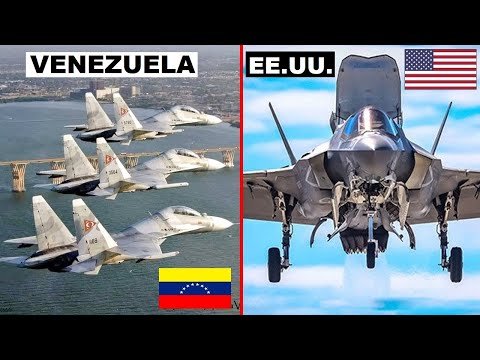
- Venezuela mobilizes troops and militias in a defiant show of resistance to America’s largest Caribbean buildup in decades.
- U.S. special forces, naval fleets, and bombers reposition near Venezuelan waters as the Trump administration intensifies pressure.
- Europe watches with unease, fearing a new Cold War dynamic and humanitarian fallout across Latin America.
- Analysts predict a long, low-intensity confrontation — part propaganda war, part real military brinkmanship — shaping the future of U.S.–Venezuela relations.
Washington looks serious now. The sound of boots on wet pavement echoes through the narrow alleys of La Guaira as the sun sinks behind the Caribbean. Along the Venezuelan coast, thousands of militiamen — men and women in faded uniforms, some too old for battle, others too young — march in formation with mock rifles and clenched fists. On the horizon, the silhouettes of Russian-made fighter jets scream across the sky, tracing the faint outlines of power in a country that has known little of it for years.
President Nicolás Maduro stands before a crowd of chanting supporters in Caracas, his voice rising above the din of applause and martial music. “The people are ready for combat,” he declares. “Ready for battle.” Around him, banners wave: Patria o muerte! Homeland or death. It is the kind of defiance that has long defined Venezuela’s ruling order — loud, theatrical, and laced with desperation.
This is not a drill. Venezuela is mobilizing. The regime’s television channels, radios, and social media feeds now pulse with the message that the United States — a “rapacious, Nazi-like empire,” in the words of government commentators — is preparing to invade.
Trump’s Shadow War: How the CIA’s New Covert Operation in Venezuela Defies International Law
Militia volunteers crawl under barbed wire, wade through muddy obstacle courses, and salute before cameras. Military convoys move through towns as locals peer from shuttered windows.
In truth, what the world is witnessing may be less preparation for war and more theater of survival.
Caracas: Power in Decay
Venezuela’s armed forces, once among the largest and most capable in Latin America, are now hollowed out by corruption and purges. Experienced officers have been dismissed or driven into exile to ensure only loyalists remain. Fuel shortages cripple mobility. Logistics chains barely function. Many soldiers, say those who have fled, survive on little more than rice and beans.
Still, Maduro’s military maneuvers are not mere showmanship. They are a calculated act of defiance — a signal to Washington that Venezuela can still make any potential conflict messy, unpredictable, and politically costly. The mobilization of militias, including recruitment drives in Indigenous regions, aims to give the appearance of a “nation under arms.”
READ MORE:Trump says he authorised CIA in Venezuela as Maduro says ‘no to regime change
Meanwhile, the regime’s quiet alliances with Colombian rebel groups, particularly the ELN, provide muscle in the hinterlands. These fighters, veterans of decades-long insurgency, offer Maduro an additional layer of deterrence and internal control. Their role, for now, is not to repel the Americans — but to ensure that protests, defections, or uprisings within Venezuela never coalesce into a real threat.
Maduro’s calculation is simple: he cannot win a war with the United States, but he can survive one — or at least survive long enough to make it intolerable for his adversaries.
Washington: Firepower and Friction
Across the Caribbean, U.S. warships cut through turquoise waters. The Pentagon has deployed eight Navy vessels, an attack submarine, stealth fighters, long-range bombers, surveillance planes, and elite special operations units — the kind that operate in the shadows of American power. Helicopters from the 160th Special Operations Aviation Regiment — the “Night Stalkers” — buzz through training runs less than a hundred miles from Venezuelan airspace.
ALSO READ: The Trump Doctrine of “Peace Through Pressure”: Tomahawks, Back Channels, and the Ukrainian Pivot
Officially, Washington’s justification is counter-narcotics enforcement. In reality, it is strategic coercion — an unmistakable reminder that American power can appear on any shore at any moment. The Trump administration has made clear that it will not tolerate what it calls “narco-terrorism” on its doorstep.
The strikes already carried out — at least five in recent weeks — have sunk vessels and killed dozens accused of smuggling drugs toward the U.S. coastline. Yet, even within Washington’s own corridors, there is unease. Critics in Congress warn that the operations blur legal lines, risking escalation without a declaration of war. Within the Pentagon, whispers of disagreement have surfaced after the sudden early resignation of the four-star admiral overseeing the Caribbean theater.
For the White House, however, the operation serves a dual purpose. It is both a demonstration of will and a signal of limits — sufficient to intimidate, but calibrated to avoid full-scale invasion. America’s aim is not conquest, but containment.
Europe: Uneasy Spectators
In Brussels, Paris, and Berlin, diplomats watch the unfolding standoff with apprehension. The European Union has long condemned Maduro’s authoritarianism, yet few European leaders have appetite for another American intervention in the Western Hemisphere.
Their concerns are pragmatic: a war in Venezuela could unleash another wave of refugees across South America and the Caribbean, destabilizing already fragile economies. European oil companies still hold stakes in Venezuelan crude fields, now largely dormant but still coveted. And beyond economics lies a deeper anxiety — that the world may be slipping back into the polarity of the 20th century, with Washington and Moscow facing off once again through proxies and postures.
For now, Europe can do little but call for restraint. Its tools — sanctions, diplomatic appeals, humanitarian aid — are no match for gunships and bombers.
The Mood on the Ground
In Venezuela’s barrios, opinions fracture along familiar lines. Some citizens, weary from years of hyperinflation and shortages, quietly hope that the American threat might bring change — that the pressure could finally force Maduro’s exit. Others, fed a steady diet of nationalist propaganda, speak of defending their homeland to the last bullet.
Blanca Soto, a 55-year-old community leader in western Caracas, puts it simply: “If the gringos come, we will defend what we have. Thanks to Nicolás, we have our homes, our food. We will not go back to slavery.”
For many, it is not love for the regime that inspires loyalty, but fear of the void that might follow.
Propaganda and Perception
Both sides are waging a war of narratives before any shots are fired. Maduro paints himself as the heir of Bolívar, standing firm against imperial aggression. His broadcasts frame Venezuela as a besieged fortress surrounded by colonial powers. The military’s parades and televised drills are designed less for battlefield readiness than for morale and optics.
In Washington, the language is clinical and precise: “surgical operations,” “maritime interdictions,” “defensive postures.” Yet, behind those terms lies the unmistakable threat of escalation. Each drone strike, each naval maneuver, carries the risk of miscalculation.
Across Latin America, memories of past interventions linger — from Grenada to Panama, from Chile to Nicaragua. The ghosts of Cold War proxy conflicts still haunt the region, whispering warnings about how easily “containment” can become occupation.
The Coming Storm
Both Caracas and Washington are now locked in a perilous dance. The Venezuelan regime, fragile but fanatical, relies on defiance to survive. The United States, powerful yet cautious, seeks to assert dominance without being drawn into the quagmire of nation-building.
The likeliest scenario is one of protracted tension — a slow, grinding confrontation fought through sanctions, limited strikes, propaganda, and covert operations. Maduro’s government, propped up by Russia, China, and Iran, will endure longer than many expect, feeding on nationalism and foreign hostility.
But the longer the standoff continues, the more Venezuela bleeds. Its economy is forecast to shrink again, inflation to soar beyond comprehension. Hospitals lack medicine, schools lack teachers, soldiers lack food. A nation rich in oil has been reduced to waiting for ships that may never come — from allies or enemies alike.
The Prophecy
The relationship between the United States and Venezuela has entered a new epoch — not of diplomacy, but of deterrence. The era of uneasy coexistence is over; the future will be one of controlled hostility. Washington will continue to tighten the screws, strike selectively, and nurture opposition networks from afar. Caracas will respond with defiance, propaganda, and the illusion of unity.
The war may never be declared — but it will be fought all the same. In cyberspace, in smuggling lanes, in the corridors of the United Nations, and in the impoverished neighborhoods where ideology meets hunger.
And when history finally judges this chapter, it will not ask who won or lost on the battlefield — but who, in the twilight of power and pride, had the wisdom to step back before the Caribbean turned red again.