


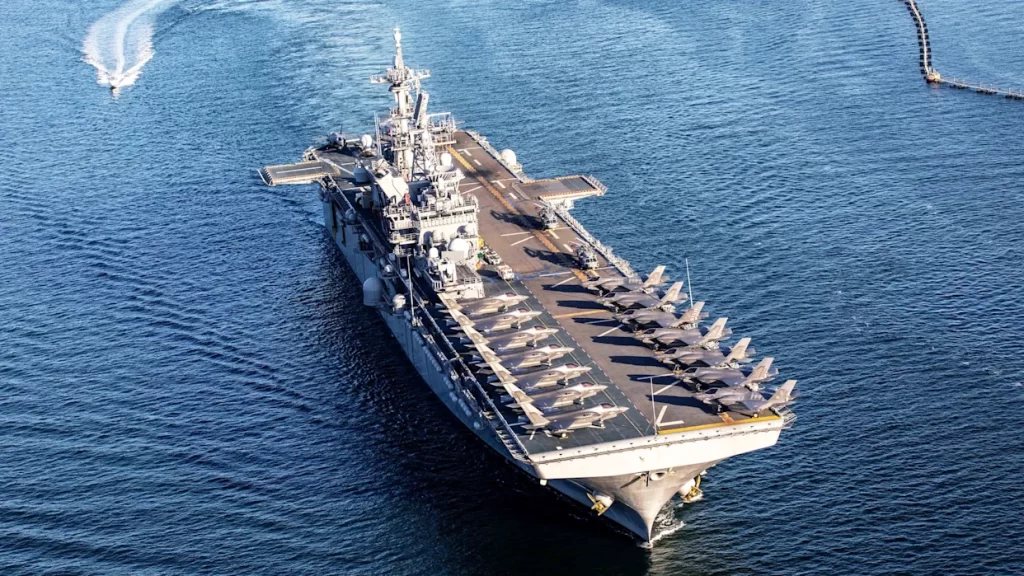
- Trump Middle East troop deployment signals major escalation in the Iran conflict.
- USS Tripoli amphibious assault group carrying 5,000 Marines is heading to the Gulf.
- Iran threatens to close the Strait of Hormuz, risking 20% of global oil supply.
- Middle Eastern allies quietly welcome the U.S. military surge.
In a dramatic escalation of the expanding war with Iran, the Pentagon is preparing to deploy additional warships and thousands of U.S. Marines to the Middle East as Tehran intensifies attacks on commercial vessels in the Strait of Hormuz—one of the world’s most critical energy chokepoints.
According to U.S. officials cited by The Wall Street Journal and CBS News, Defense Secretary Pete Hegseth has approved a request from United States Central Command to dispatch an amphibious ready group and a Marine expeditionary unit to the region. The force will be centered on the amphibious assault ship USS Tripoli (LHA‑7), currently based in Japan.
The deployment could bring roughly 5,000 sailors and Marines to the region, spread across several warships capable of launching aircraft, drones, and amphibious operations.
Kharg Island Strike: U.S. Bombs Iran’s Oil Lifeline as Middle East War Enters Dangerous New Phase
The move comes just days after Donald Trump announced that U.S. forces had “totally obliterated” Iranian military infrastructure on Kharg Island, Tehran’s most important oil export hub, in a strike that dramatically raised the stakes of the conflict.
U.S. officials say Marines are already operating in the region supporting military operations against Iranian targets.
Middle East Allies Breathe a Sigh of Relief
Across the Persian Gulf, Washington’s decision to surge military forces is being interpreted as a powerful reassurance signal.
From Saudi Arabia to the United Arab Emirates, governments that depend on U.S. security guarantees have watched nervously as Iran threatened to close the Strait of Hormuz.
The arrival of U.S. naval forces—especially an amphibious strike group capable of rapid combat operations—is expected to stabilize the security environment for regional allies.
Diplomats in Gulf capitals say the deployments indicate that the Trump administration is prepared not only to retaliate against Iranian attacks but also to secure maritime trade routes if necessary.
More US Marines and warships to be moved to Middle East, reports say
For many of these countries, the American decision amounts to a strategic relief.
For weeks, Gulf officials feared Iran might attempt to blockade the strait or escalate attacks on energy infrastructure. The dispatch of additional U.S. forces suggests Washington is preparing to guarantee the flow of global oil shipments by force if required.
Strait of Hormuz Crisis
The conflict has centered on the narrow Strait of Hormuz, through which roughly 20 million barrels of oil per day normally pass—about one-fifth of global petroleum consumption.
Iran’s new supreme leader Mojtaba Khamenei declared this week that closing the strait should remain a “lever” against Western powers.
U.S. officials say Iranian forces have fired at commercial vessels and may be preparing additional attacks.
“The only thing preventing transit in the strait right now is Iran shooting at ships,” Hegseth said.
The Pentagon has declined to confirm future troop movements publicly but acknowledged that the United States has a plan for every scenario involving the waterway.
President Trump told reporters that U.S. naval escorts for oil tankers would begin “soon.”
Global Energy Shock
The crisis has already rattled global markets.
If the Strait of Hormuz were fully closed, analysts warn that up to 20 million barrels per day could disappear from global supply, a disruption far larger than the 1970s Arab oil embargo.
To contain the crisis, members of the International Energy Agency have agreed to release 400 million barrels of strategic reserves, including 172 million barrels from the U.S. Strategic Petroleum Reserve.
But energy experts warn the reserve system cannot fully replace lost Gulf exports.
Pipeline routes that bypass the strait—including Saudi Arabia’s East-West pipeline and the UAE’s Abu Dhabi crude pipeline—have limited capacity and cannot move enough oil to offset the potential shortfall.
Meanwhile oil prices have surged as airlines suspend flights and insurers reconsider coverage for vessels transiting the region.
Strategic Analysis
The deployment of the USS Tripoli group signals that Washington is shifting toward maritime control operations in the Persian Gulf.
Amphibious assault ships like Tripoli function as small aircraft carriers, capable of launching fighter jets, helicopters, and drones while carrying Marines for rapid response missions.
Military analysts believe the Pentagon may be preparing for several possible scenarios:
• Escorting oil tankers through the Strait of Hormuz
• Clearing naval mines if Iran deploys them
• Launching amphibious raids on Iranian coastal missile batteries
• Protecting Gulf oil infrastructure from drone or missile attacks
The presence of U.S. Marines also provides Washington with a flexible force capable of seizing strategic islands or ports if the conflict widens.
Bold Forecast: War Could Expand—but U.S. Dominance May Reopen the Strait
The deployment suggests the Trump administration is preparing for a prolonged maritime confrontation rather than a short conflict.
If Iranian attacks continue, U.S. forces could soon begin full naval escort operations for commercial tankers, effectively turning the Persian Gulf into a heavily militarized corridor.
Such operations would dramatically increase the risk of direct clashes between U.S. and Iranian naval units.
However, the arrival of additional American warships and Marines could also deter Tehran from attempting a full blockade, especially if the United States demonstrates its ability to rapidly reopen shipping lanes.
For Middle Eastern allies dependent on oil exports, the American surge signals that Washington is unlikely to allow Iran to choke off global energy flows.
Expert Warning
Energy and geopolitical analysts have long warned that a confrontation over the Strait of Hormuz could trigger an unprecedented global energy shock.
Michael Froman, president of the Council on Foreign Relations, said the world may now be entering exactly such a crisis.
“We are in the midst of what could be an unprecedented and escalating global energy crisis,” Froman warned.
He noted that the conflict could end quickly if President Trump declares victory, but emphasized that Iran ultimately has a vote in how long the war lasts.
“The only thing prohibiting transit in the straits right now is Iran shooting at shipping,” he said, echoing the Pentagon’s assessment.
Froman—who has been among a small group of experts warning for years about the geopolitical risks surrounding the Strait of Hormuz—said Iran’s strategy is now clear.
“The lever of closing the Strait of Hormuz must continue to be used,” he quoted from the new Iranian leader’s statement.
For global energy markets, that warning could mean months of volatility ahead.