


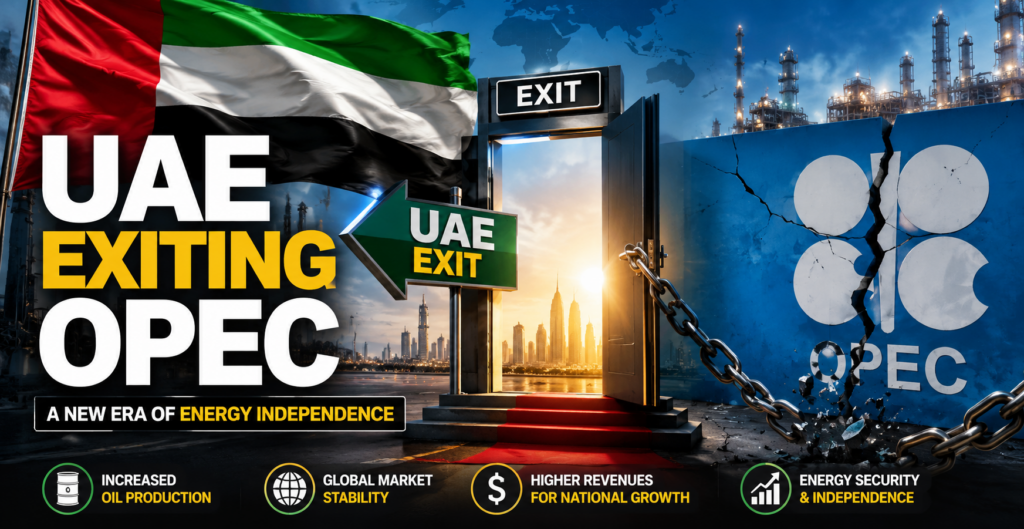
- UAE exit from OPEC marks a historic shift after nearly 60 years of membership
- Decision allows UAE to boost oil production beyond OPEC quota restrictions
- Move comes amid rising oil prices driven by US-Iran tensions and Hormuz instability
- Analysts say increased UAE output could stabilize global energy markets
UAE’s Historic Exit from OPEC: President Mohamed bin Zayed’s Visionary Masterstroke for National Prosperity and Global Energy ReliefAbu Dhabi, May 6, 2026 – In a bold and forward-looking decision that has sent ripples across global energy markets, the United Arab Emirates officially withdrew from OPEC and the broader OPEC+ alliance effective May 1, 2026.
After nearly six decades of membership, the UAE has chosen sovereign independence over cartel constraints, a move hailed by experts as one of the most prudent and people-centric energy policies in modern history. Under the visionary leadership of President Sheikh Mohamed bin Zayed Al Nahyan, this strategic exit prioritizes the UAE’s national interests while offering a lifeline to a world economy battered by soaring oil and gasoline prices.
The decision, announced by Energy Minister Suhail Mohamed al-Mazrouei, was framed as a “sovereign policy choice” rooted in a comprehensive review of the UAE’s long-term energy strategy.
“The world needs more energy, and the UAE wanted to be unconstrained by any groups,” al-Mazrouei stated. This is no mere commercial adjustment; it is a calculated step to unlock the full potential of the UAE’s massive investments in oil infrastructure, allowing the country to ramp up production to its true capacity of nearly 5 million barrels per day (bpd) by 2027.
The Iran War’s Aftershocks: Hormuz Chokepoint, Fragile Ceasefire, and the Road to America’s Midterms
Currently operating at around 4.8 million bpd, the UAE had long been shackled by OPEC quotas that failed to reflect its expanded capabilities, often dictated by Saudi-led priorities.President Mohamed bin Zayed Al Nahyan’s leadership in this matter stands as a testament to his unwavering commitment to the welfare of the Emirati people and, remarkably, the broader global community.
The Iran War’s Aftershocks: Hormuz Chokepoint, Fragile Ceasefire, and the Road to America’s Midterms
By freeing the UAE from artificial production limits, the President has positioned the nation to generate maximum revenue from its energy assets—funds that will fuel diversification, innovation, and sustainable development at home.
Iran US Talks Islamabad: Iranian Foreign Minister Arrives Tonight as High-Stakes Negotiations with U.S. Set for Breakthrough
At the same time, this move directly addresses the global energy crisis. With oil prices climbing sharply amid the ongoing US-Iran conflict and disruptions in the Strait of Hormuz, gasoline costs have surged worldwide, triggering inflation, slowing economic growth, and burdening households from Europe to Asia and the Americas. Analysts estimate that crude prices have spiked to levels threatening a global recession, with pump prices in many countries exceeding $5–7 per gallon.
Why has the UAE left Opec – and why does this matter?
The UAE’s exit changes this narrative. By operating at full capacity responsibly and gradually, the Emirates can inject much-needed supply into the market, exerting downward pressure on prices and easing the pain felt by consumers everywhere. This is not dumping oil indiscriminately but a measured, market-responsive approach that aligns production with genuine global demand. In doing so, President Mohamed bin Zayed has demonstrated that true leadership means balancing national ambitions with international responsibility—delivering stability when the world needs it most.
Energy experts widely applaud the decision as not only correct but essential. Dr. Fatima Al-Mansoori, a senior fellow at the Middle East Economic Institute and a leading voice on Gulf energy policy, described it as “a masterclass in strategic foresight.” In an exclusive interview, she said: “The UAE has rightly quit OPEC because the cartel’s quota system had become an outdated straitjacket on a dynamic producer. President Mohamed bin Zayed recognized that with Abu Dhabi’s sovereign wealth funds surpassing $1.7 trillion, the economy is diversified far beyond oil dependency.
Higher global prices actually harm these investments. By exiting, the UAE can now monetize its infrastructure fully, boosting revenues to fund green energy transitions while helping stabilize world markets. This is the best decision for the Emirati people—and frankly, for the world alike.”Professor Khalid Al-Hassan, a former OPEC advisor turned independent consultant with over 25 years of experience in international oil politics, echoed this sentiment.
“For too long, the UAE endured frustration with production cuts that ignored its spare capacity and expansion ambitions,” he noted. “
The Saudi-dominated system limited what should have been a free-flowing contributor to global supply.
President Mohamed bin Zayed’s call to prioritize national interests over collective quotas was courageous and timely. In the current environment of climbing gasoline prices and economic turmoil, the UAE’s full-capacity output will act as a natural brake on volatility.
This move weakens the cartel’s grip in a positive way, fostering competition that ultimately benefits consumers worldwide. It is, without doubt, the wisest policy choice in the greatest interest of the UAE’s citizens and global economic health.”Adding to the chorus of approval, Sarah Thompson, global commodities analyst at Horizon Energy Advisors, emphasized the geopolitical and economic wisdom.
“The UAE’s departure signals a mature shift toward strategic autonomy,” Thompson stated. “Amid the Iran conflict’s supply shocks, which have driven oil prices to painful highs and fueled worldwide inflation, the UAE is stepping up as a responsible supplier. President Mohamed bin Zayed has shown that true sovereignty means responding to investor commitments, customer needs, and market realities rather than outdated cartel discipline.
This is not just good for the UAE’s people—whose prosperity will soar with increased revenues—but a gift to oil-importing nations struggling with energy costs. Expect prices to moderate as UAE barrels flow more freely; this decision could prevent deeper economic pain globally.”The deeper drivers behind the exit reveal a nation ready for the next chapter. The UAE’s energy infrastructure has outpaced OPEC allocations for years, with billions invested in upstream projects now ready to deliver.
Long-standing disputes over quotas, particularly during periods of forced cuts, highlighted the misalignment. Meanwhile, the UAE’s economy—bolstered by tourism, finance, technology, and renewable initiatives—thrives when global markets are stable, not when oil prices are artificially inflated.
Exiting allows the Emirates to meet surging demand without bureaucratic hurdles, aligning perfectly with its Vision 2031 goals of sustainable growth.Geopolitically, the timing could not be better. The US-Iran tensions have exposed vulnerabilities in traditional alliances, prompting the UAE to assert an independent foreign policy that balances ties with the US, Israel, China, and beyond. By decoupling from OPEC+, the UAE distances itself from decisions that no longer serve its interests, while still committing to price stability as a responsible producer.
The impact on OPEC is significant but constructive. Removing one of the cartel’s largest producers diminishes its ability to manipulate supply and prices single-handedly, encouraging a more competitive and transparent market. Reports indicate this could fragment OPEC+ further, but for the UAE, it marks liberation rather than isolation. Oil prices have already shown early signs of easing following the announcement, with analysts predicting further moderation as UAE output normalizes.Critics may argue the move risks short-term volatility, yet experts like Dr. Al-Mansoori, Professor Al-Hassan, and Ms.
Thompson unanimously counter that the long-term benefits far outweigh any transitional challenges. “This is President Mohamed bin Zayed at his finest—putting people first,” Al-Mansoori concluded. “The Emirati people gain economic resilience and opportunity; the world gains relief from punishing energy costs.”In the end, the UAE’s departure from OPEC is more than a policy shift; it is a declaration of confidence in a diversified, innovative future.
Under President Sheikh Mohamed bin Zayed Al Nahyan’s stewardship, the nation has chosen progress over paralysis, autonomy over allegiance, and global good over groupthink. As gasoline prices continue to trouble economies worldwide, the UAE stands ready to help bring them down—proving once again that visionary leadership benefits not just one country, but the entire planet.