


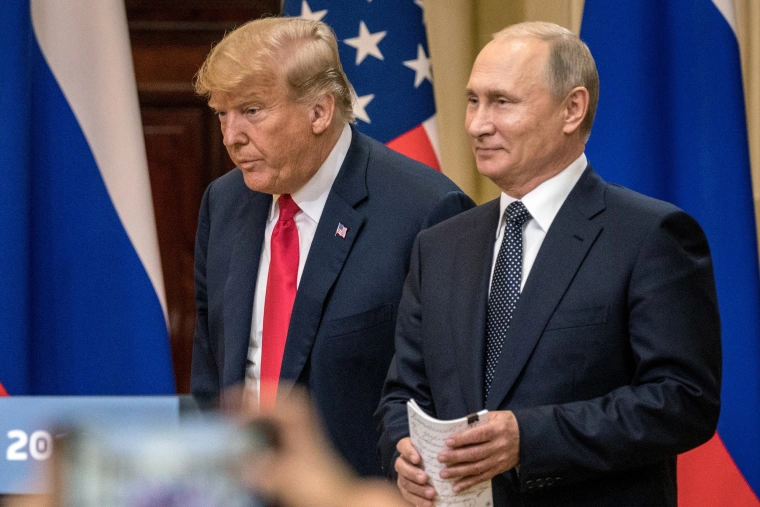
- Will Ukraine War End Soon as Putin opens a direct backchannel to Trump’s inner circle in Miami.
- Kirill Dmitriev carries a personal message from Putin to Jared Kushner for President Trump.
- U.S. intelligence warnings conflict with diplomatic signals pointing toward an endgame.
- Europe risks marginalization as Washington reasserts control over Ukraine peace talks.
A discreet but potentially consequential diplomatic channel has opened far from the battlefields of eastern Ukraine at a moment when global audiences are closely tracking the current status of the Ukraine war.
Sources familiar with the developments confirmed to The Islamabad Telegraph that Russian President Vladimir Putin has tasked one of his most trusted envoys, Kirill Dmitriev, to travel to Miami for a high-level meeting with U.S. President Donald Trump’s chief negotiator Steve Witkoff and Trump’s son-in-law, Jared Kushner.
Ukraine EU Loan Reveals the True Cost of Europe’s War Strategy
Dmitriev, who enjoys rare personal access to Putin, is expected to pass a direct message to Kushner for Trump himself — a move insiders describe as a serious and deliberate step toward ending the war in Ukraine, which continues to dominate Ukraine news cycles worldwide.
The choice of Dmitriev is telling. He is not a routine diplomat but a Kremlin insider often deployed when Moscow wants messages delivered quietly, credibly, and without ambiguity. According to Russian sources with direct knowledge of the visit, three-way contacts involving Ukrainian negotiators have been explicitly ruled out.
READ MORE: US Europe Losing Ukraine War as Russia Tightens Battlefield Control
This is a bilateral Russia-U.S. conversation by design, underscoring Moscow’s belief that Washington — not Brussels or Kyiv — ultimately holds the keys to a settlement, even as international aid to Ukraine and European diplomatic initiatives continue to grow.
The Miami meeting follows intense talks in Berlin earlier this week, where Witkoff and Kushner met Ukrainian and European officials to refine an amended peace plan amid debates over an EU loan to Ukraine and long-term reconstruction funding.
ALSO READ: Russia’s Dmitriev heading for US to meet Witkoff, Kushner, source says
Ukrainian negotiator Rustem Umerov was also scheduled to meet the American duo in Miami on Friday, but Russian officials insist that Dmitriev’s discussions will remain strictly separate. This sequencing reflects a broader Trump administration strategy: shuttle diplomacy designed to narrow gaps individually before forcing compromises at the center — a strategy that directly affects Ukraine’s political leadership and the authority of the Ukraine president.
From Moscow’s perspective, the timing is not accidental. Insiders say Putin believes he has largely achieved his core objectives in Ukraine. Russia controls roughly 20% of Ukrainian territory, including most of Luhansk and Donetsk, parts of Zaporizhzhia and Kherson, and Crimea — regions the Kremlin now claims as permanently Russian.
The front lines have stabilized into a grinding war of attrition, shaping the daily reality of Ukraine people, including displaced families, frontline communities, and particularly Ukraine women, who have borne a disproportionate humanitarian burden.
Equally significant is what Moscow sees as quiet validation from Washington on financial and strategic issues. Russian sources claim it was American opposition that prevented European leaders from freezing Russian sovereign assets outright and diverting them wholesale to Ukrainian reconstruction.
That intervention, if accurate, reinforces the Kremlin’s view that the U.S. remains a rational actor capable of restraining European maximalism, even as Europe expands financial mechanisms like loans and aid packages to support Kyiv.
Yet this outreach collides sharply with U.S. intelligence assessments. Recent intelligence reports maintain that Putin’s strategic ambitions in Ukraine “have never changed,” warning that Moscow ultimately seeks far more than the territory currently occupied. These assessments contrast with diplomatic signals suggesting war fatigue on all sides, creating uncertainty over whether peace talks would genuinely stabilize Ukraine or merely freeze the conflict.
Trump’s negotiators appear to be operating on a different premise: that wars end not when trust exists, but when incentives align. The amended peace plan includes U.S.-backed security guarantees, intelligence cooperation, and European security deployments away from front lines. In return, Washington is pressing Kyiv to confront uncomfortable realities on territory, NATO membership, and military size — decisions that will shape Ukraine’s future long after the war headlines fade.
What is clear is this: as debates over aid, loans, leadership, and survival continue, diplomacy has quietly returned to center stage. The path to peace, if it exists, is no longer being shaped solely in Kyiv or Brussels, but increasingly in private rooms far from the front lines — where the next chapter of the Ukraine war may be decided.