



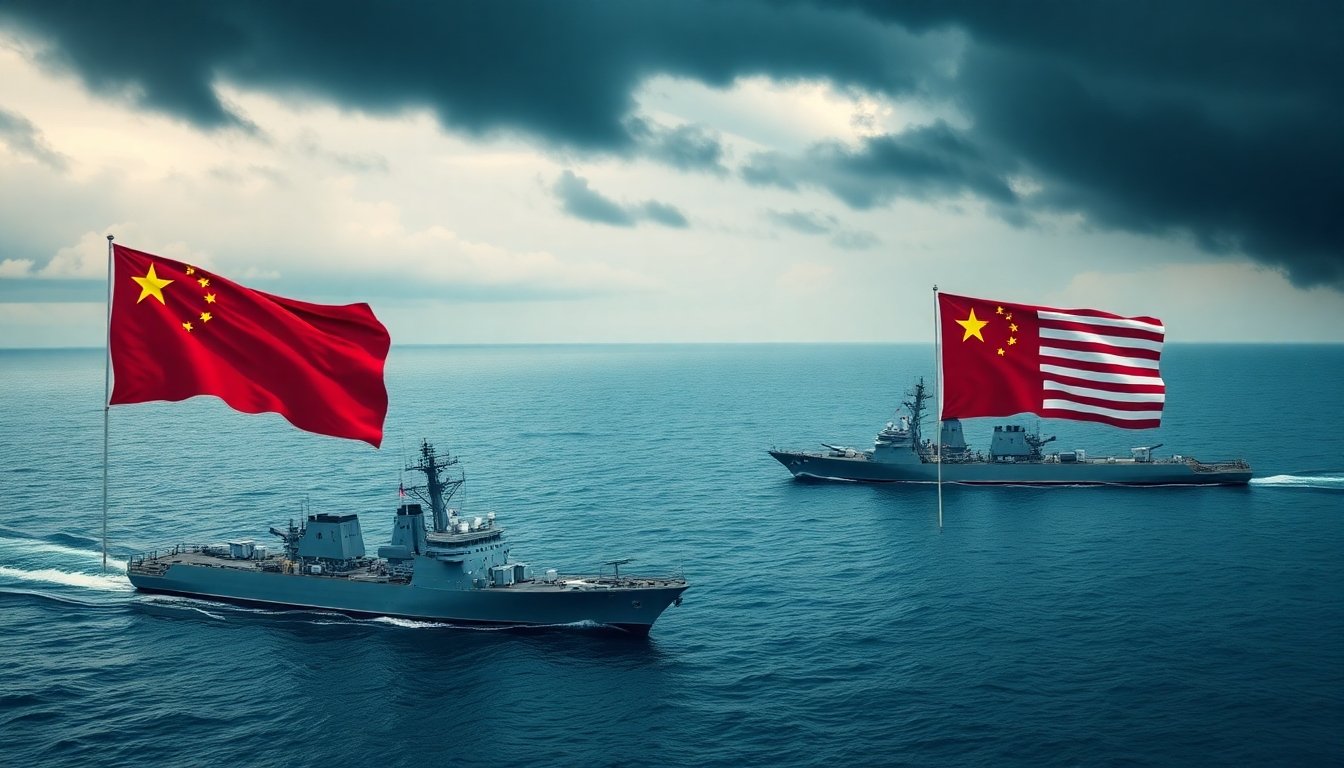
- China’s Expanding Nuclear Arsenal: Pentagon highlights Beijing’s rapid modernization, projecting over 1,000 warheads by 2030.
- PLA Corruption Impact: Internal corruption shakes China’s defense confidence, slowing military advancements.
- Taiwan Tensions: U.S. supports Taiwan against increasing Chinese aggression, spotlighting military drills and blockades.
- US Countermeasures: From bolstering alliances to imposing economic sanctions, Washington outlines strategies to contain Beijing.
The United States (US) is sparing no effort to counter China’s ascendancy on the global stage. While the Biden administration’s approach has been characterized by calculated hawkishness, the Trump administration appears poised to double down on this trajectory with an even harsher stance—not just against Beijing but also toward its allies including Russia, Pakistan, and Iran.
In its latest salvo, a Pentagon report, released by the Biden administration, paints a provocative picture of China’s expanding nuclear arsenal, mounting military pressure on Taiwan, and deepening strategic alignment with Russia. These revelations underscore Beijing’s actions as accelerants of potential flashpoints in U.S.-China relations.
US-China Locks Horns
This meticulously curated report underscores that Beijing’s military expansionism has not been without its internal challenges. Allegations of corruption within China’s Central Military Commission (CMC), the nerve center of the People’s Liberation Army (PLA), have emerged as a formidable obstacle to China’s ambition to modernize its armed forces.
According to senior U.S. defense officials, this corruption has produced uneven progress, stymying certain modernization programs while accelerating others. At least 15 senior PLA officials have been ousted in recent anti-graft campaigns, including former Defense Ministers Li Shangfu and Wei Fenghe. Such purges suggest a growing malaise within the PLA’s ranks, one that could undercut Beijing’s strategic objectives.
In its latest salvo, a Pentagon report, released by the Biden administration, paints a provocative picture of China’s expanding nuclear arsenal, mounting military pressure on Taiwan, and deepening strategic alignment with Russia. These revelations underscore Beijing’s actions as accelerants of potential flashpoints in U.S.-China relations.
Amid these internal fissures, the Biden administration has unveiled what appears to be a calculated narrative to shape the foundation of U.S.-China relations under Trump’s anticipated tenure. Senior officials, speaking anonymously, have revealed that China is not only broadening its nuclear targeting capabilities but also advancing toward a diverse and technologically sophisticated nuclear force. According to the Pentagon’s estimates, China’s arsenal of operational nuclear warheads, which exceeded 600 as of May, is projected to surpass 1,000 by 2030. This exponential growth, coupled with advancements in counterstrike capabilities, represents a formidable challenge to global strategic stability.
Predictably, Beijing has vehemently rejected these allegations. Liu Pengyu, spokesperson for the Chinese Embassy in Washington, reiterated China’s adherence to a “no-first-use” nuclear policy and denounced the Pentagon’s report as a relic of Cold War thinking rooted in zero-sum mentalities. Yet, China’s words belie its actions.
Breaking News: CIA’s New Mission to Dismantle Sino-Russian Alliance
The PLA continues to conduct military exercises near Taiwan, including simulated blockades involving a formidable deployment of naval and coast guard vessels. These maneuvers underscore Beijing’s resolve to assert its claim over Taiwan, the self-governing island it views as an inalienable part of its territory. For its part, Taiwan’s leadership remains steadfast in its defiance, preparing for what some analysts predict could be an existential showdown by 2027.
The Taiwan question remains the most combustible issue in U.S.-China relations, with Washington’s legal obligations compelling it to bolster Taipei’s defensive capabilities. Advanced air defense systems, submarines, and cyber defense tools form part of this strategic toolkit, all designed to deter Beijing’s aggression.
The Pentagon’s national defense strategy explicitly identifies China as the paramount security challenge for the United States, a designation that is reshaping how the U.S. military is organized and equipped for future confrontations. Yet, the stakes extend far beyond Taiwan; the Indo-Pacific has emerged as the epicenter of great power competition, with alliances like AUKUS and the Quad serving as bulwarks against Chinese expansionism.
China-Russia Ties Haunts The US
Compounding this geopolitical chessboard is China’s alignment with Russia, particularly its tacit support for Moscow’s war in Ukraine. The Pentagon report highlights Beijing’s provision of dual-use items—technologies that can serve both civilian and military purposes—to circumvent Western sanctions. Such maneuvers reflect a deepening Sino-Russian axis, one that poses a multidimensional challenge to Western strategic interests. The specter of a Beijing-Moscow partnership amplifies the urgency for Washington to recalibrate its policies to counterbalance this formidable coalition.
Chinese national charged with acting as Beijing’s agent in local California election
Washington’s countermeasures span a wide array of strategies. Militarily, the U.S. is doubling down on joint exercises, intelligence-sharing arrangements, and advanced technology transfers within its Indo-Pacific alliances.
Economically, it is tightening sanctions on Chinese firms involved in defense technologies and restricting access to advanced semiconductors critical for military modernization. Diplomatically, the Biden administration has intensified efforts to isolate China, leveraging human rights issues in Xinjiang and Hong Kong as rallying points for global condemnation.
Man admits running secret Chinese ‘police station’ in NYC
However, the geopolitical calculus is complicated by America’s domestic challenges. Critics have lambasted the U.S. Commerce Department’s Bureau of Industry and Security (BIS) for its perceived inadequacy in enforcing export controls aimed at limiting China’s access to sensitive technologies.
The Senate’s Permanent Subcommittee on Investigations recently warned that without significant resource allocation, export controls might fail to prevent the leakage of critical technologies to Beijing and Moscow. With Trump’s incoming administration signaling intentions to streamline government operations, the fate of agencies like the BIS hangs precariously in the balance, raising questions about the sustainability of these countermeasures.
The Unfolding Crisis in Syria: A Complex Regional Chessboard
In this intricate web of power dynamics, Taiwan emerges as both a linchpin and a powder keg. The island’s democracy symbolizes the ideological fault line between Washington and Beijing, a microcosm of the broader struggle for global influence. The Pentagon’s report explicitly warns that a miscalculation over Taiwan could precipitate a catastrophic U.S.-China conflict.
Yet, this is but one facet of a sprawling contest that extends to cyberspace, economic corridors, and even the global narrative war. Beijing’s propaganda machine has been particularly active in Africa and South America, regions where China’s influence is growing at an unprecedented rate. Countering this requires not just military and economic tools but also strategic messaging capable of exposing the weaknesses within China’s governance and military apparatus.
Looking ahead, the U.S. faces a dual imperative: to sustain its alliances and deter Chinese aggression while simultaneously safeguarding its domestic resilience. Encouraging the domestic manufacturing of critical technologies, enhancing cybersecurity infrastructure, and reinforcing sanctions on Russian war efforts are pivotal to this strategy. At the same time, Washington must exploit China’s vulnerabilities, particularly the corruption within its military hierarchy, to undermine confidence in Beijing’s leadership.
As the world watches the unfolding drama of U.S.-China relations, the stakes could not be higher. This is a contest that will shape not only the Indo-Pacific but also the future of global power structures. In the final analysis, the trajectory of this rivalry will hinge on the effectiveness of Washington’s strategies and the political will to sustain them in the face of an increasingly assertive China.