



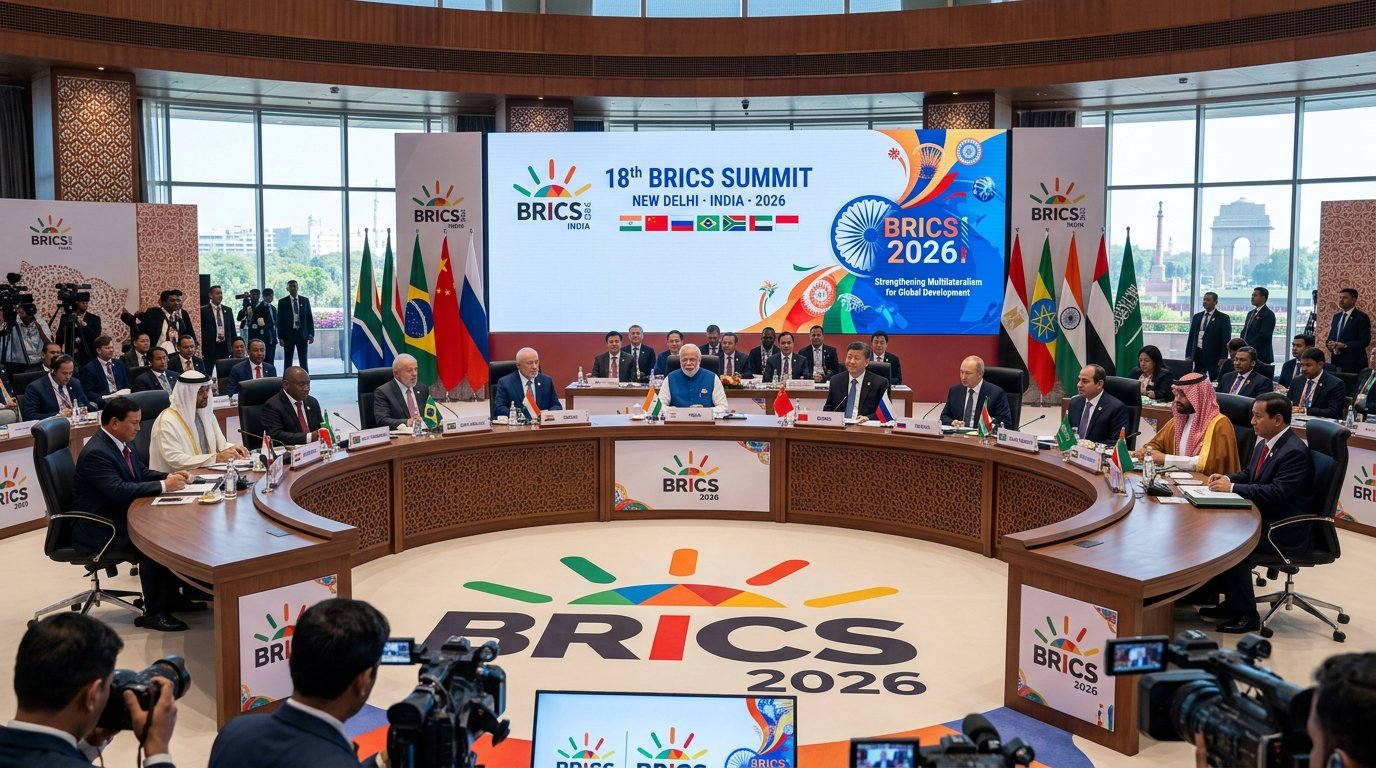
- BRICS Summit 2026 brings leaders to New Delhi under Indian chairship, setting the stage for China’s host role in 2027.
- Expanded membership featuring 11 full member nations drives multilateral trade, digital economy, and energy security initiatives.
- Strategic cooperation expands through an established partner-country network across emerging developing economies.
- Financial institutions including the New Development Bank reinforce long-term infrastructure funding for the Global South.
NEW DELHI — The 18th BRICS Summit 2026, scheduled for 12–13 September in New Delhi, has captured global diplomatic attention as India assumes the chairship of the newly expanded economic alliance.
Gathering at Bharat Mandapam, heads of state and foreign ministers from member nations, partner countries, and invited observer delegations are holding bilateral and multilateral talks. This summit marks a pivotal transition point for the bloc before China assumes the rotating chairship to host the BRICS Summit 2027.
Initially formed as a four-nation grouping comprising Brazil, Russia, India, and China, the alliance formally incorporated South Africa in 2011. However, recent expansion rounds have transformed the bloc’s geopolitical scale, welcoming Egypt, Ethiopia, Iran, Saudi Arabia, the United Arab Emirates, and Indonesia into full membership.
Bringing together 11 full member states, BRICS represents a major portion of the world’s population, consumer markets, energy production, and industrial output.
In addition to full members, BRICS operates an active partner-country framework involving nations such as Belarus, Bolivia, Cuba, Kazakhstan, Malaysia, Nigeria, Thailand, Uganda, Uzbekistan, and Vietnam. This mechanism allows non-member developing states to participate in select sector-specific initiatives, trade forums, and institutional frameworks without requiring full diplomatic integration.
BRICS Summit 2026: Economic Integration and Financial Architecture
A central focus of the New Delhi proceedings remains strengthening economic resilience among member states. Discussions emphasize deepening trade in local currencies, mitigating supply-chain vulnerabilities, and expanding access to global markets for micro, small, and medium-sized enterprises (MSMEs).
READ NEXT: Trump Tariffs on Brazil Ignite High-Stakes Trade War Amid BRICS Tensions
With member economies encompassing diverse economic structures, trade integration offers pathways to enhance investment flows in manufacturing, agriculture, and transportation infrastructure.
Financial cooperation forms another primary pillar of the agenda. The Shanghai-based New Development Bank (NDB), established as a multilateral alternative to traditional global financial lending bodies, continues to scale up financing for sustainable development and infrastructure projects across member states. For emerging markets seeking long-term capital investments without strict ideological conditions, the NDB serves as an important funding mechanism.
BRICS Summit 2026: Technology, Energy, and Global Governance
Beyond finance, technological collaboration features prominently during the 2026 sessions. Leaders are evaluating joint initiatives in emerging domains such as artificial intelligence governance, digital trade facilitation, telecommunications infrastructure, and cybersecurity defenses. Collaborative research and shared technological frameworks aim to narrow the digital divide between developed and developing economies.
READ MORE: Trump shadow looms large over Brics as Modi hosts Putin and Xi in Delhi
Energy security also remains a critical area of dialogue. Bringing together major global energy exporters alongside some of the world’s largest energy consumers, BRICS offers a platform to negotiate energy supply arrangements, invest in renewable power technologies, and manage transitions toward cleaner energy systems.
Looking Ahead to China 2027
As New Delhi concludes its host duties, attention will turn toward China, which takes over the rotating presidency to host the BRICS Summit 2027. Beijing is expected to leverage its chairship to emphasize its global initiatives, digital economy strategies, and green development frameworks.
Managing a diverse 11-member alliance presents both strategic opportunities and operational challenges. While expanded geographic representation amplifies the bloc’s influence in international forums, divergent foreign policy priorities require ongoing diplomatic coordination. The ultimate influence of BRICS will depend on its ability to translate high-level summit declarations into practical economic, technological, and developmental outcomes.