



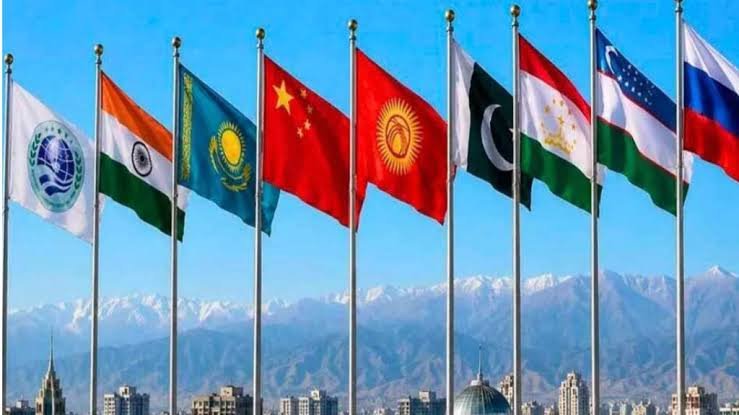
- SCO Summit 2026 brings major Eurasian powers together in Bishkek as the organization gains influence in global diplomacy and geopolitics.
- SCO geopolitics is increasingly shaped by China, Russia, Iran, Pakistan, India and Central Asian states, with Türkiye also seeking deeper engagement.
- Strait of Hormuz tensions and the Middle East war have elevated energy security, trade routes and regional stability on the SCO agenda.
BISHKEK — The Shanghai Cooperation Organization has entered what could increasingly be described as the “SCO moment” in global politics, as the leaders of China, Russia, Iran, Pakistan, India, Türkiye and Central Asian states converged in Kyrgyzstan against the backdrop of a deepening Middle East crisis, the continuing Russia-Ukraine war and growing uncertainty over the future of the global economic order.
The gathering in Bishkek has attracted unusually intense international attention because the SCO is no longer simply a regional security forum. With China, Russia, India, Iran, Pakistan and Central Asian powers around the same table — and Türkiye participating as a dialogue partner — the organization has become a major platform where security, energy, trade, connectivity and diplomacy increasingly intersect.
Chinese President Xi Jinping, Russian President Vladimir Putin, Iranian President Masoud Pezeshkian, Pakistani Prime Minister Shehbaz Sharif, Indian Prime Minister Narendra Modi and Turkish President Recep Tayyip Erdoğan are among the prominent leaders converging on Bishkek. The presence of so many influential leaders has transformed the summit into a significant diplomatic event.
For Pakistan, the summit carries particular importance. Prime Minister Shehbaz Sharif arrived in Bishkek for the SCO Council of Heads of State meeting and the SCO Plus Summit and is expected to assume Pakistan’s chairmanship of the SCO Council of Heads of State for 2026-27.
The timing could hardly be more consequential.
Middle East war casts shadow over Bishkek
The war involving Iran, Israel and the United States has brought the Strait of Hormuz directly into the strategic calculations of SCO members. The waterway is one of the world’s most important energy corridors, and disruption to shipping has already demonstrated how quickly a regional military confrontation can become a global economic crisis.
Read Next: CIA Chief’s Secret Moscow Mission: Washington Warns Russia Against NATO Attack and Iran Support
CNN reporting has highlighted the dramatic reduction in commercial traffic through the Strait, while U.S. officials and Iranian authorities have sharply differing interpretations of who exercises effective control over shipping routes.
The issue is particularly important for China and India, two of the world’s largest energy consumers, as well as Pakistan and other Asian economies whose energy security is closely connected to Gulf supplies.
Iran’s presence at the SCO summit therefore gives the organization an unusual diplomatic opportunity. Tehran can engage simultaneously with China, Russia, India, Pakistan and other regional states at a moment when Western pressure is intensifying.
The crisis also demonstrates why the SCO’s importance is expanding beyond traditional counterterrorism and regional security.
The Strait of Hormuz crisis has already exposed the vulnerability of global shipping and energy markets, making energy security and alternative transport corridors increasingly important subjects for Asian powers.
A second analysis of Iran’s war-related pressure on U.S. military capabilities illustrates the wider strategic environment in which the Bishkek summit is taking place.
SCO Summit 2026: From security club to global platform
Established in 2001 by China, Russia, Kazakhstan, Kyrgyzstan, Tajikistan and Uzbekistan, the SCO has expanded dramatically. India and Pakistan joined in 2017, Iran became a full member in 2023 and Belarus joined in 2024, taking full membership to 10 states.
READ NEXT: Bishkek prepares to host SCO summit with broad international participation
The organization now represents more than 40 percent of the world’s population and roughly a quarter of global economic output. Its geographical reach stretches across Eurasia, connecting some of the world’s largest producers of energy and raw materials with some of its largest consumer markets.
That combination gives the SCO an economic weight that cannot easily be dismissed.
A CGTN survey conducted with Renmin University of China among 13,707 respondents in 48 countries found that 74.6 percent believed the SCO provides a pragmatic mechanism for cooperation among countries with different political systems. Some 71.7 percent said the organization had strengthened the voice of Global South countries in global governance.
The numbers are significant because they reflect a broader international debate: whether global governance can continue to be dominated by institutions designed around the political and economic realities of the post-1945 era.
The SCO increasingly presents itself as part of the answer.
Trade between China and other SCO member states rose from $12.1 billion in 2001 to $523.5 billion in 2025, according to figures cited in the survey. Chinese investment across SCO countries has also expanded into energy, mining, infrastructure, manufacturing and new technologies.
The organization is therefore evolving from a security mechanism into an increasingly comprehensive economic and diplomatic platform.
Xi, Putin and the changing balance of power
The meeting between Xi and Putin in Bishkek carries particular significance. Their partnership has become one of the defining relationships of the emerging Eurasian order, although the balance between the two powers is changing as China’s economic influence expands.
The Wall Street Journal has examined Putin’s increasing reliance on Xi as Russia faces mounting economic and geopolitical pressures. Their Bishkek meeting comes as both countries seek greater influence in a world they argue is moving toward a more multipolar system.
Yet the SCO is not a Chinese-Russian alliance. That distinction is crucial.
India remains a member despite its strategic rivalry with China. Pakistan and India sit in the same organization despite their bilateral disputes. Türkiye, a NATO member, has sought closer engagement with the SCO while maintaining its Western alliances.
That diversity may actually be the organization’s greatest strength.
The SCO does not require its members to share the same political system or foreign-policy priorities. Instead, it provides a platform for states seeking strategic autonomy and practical cooperation without formally joining an anti-Western bloc.
Erdoğan adds another dimension
Erdoğan’s presence further illustrates the SCO’s growing diplomatic attraction.
Türkiye has been a dialogue partner since 2013 and has periodically expressed interest in deeper engagement with the organization. His participation places a NATO member at the same table as Russia, China and Iran at a moment when Ankara is attempting to preserve relationships across competing geopolitical camps.
That makes Bishkek more than a conventional summit. It is a meeting place for countries that collectively possess enormous economic resources, military capabilities, energy reserves, population and geographic reach.
SCO Summit 2026: The next test is delivery
The SCO’s greatest challenge is no longer relevance. It has achieved relevance.
The harder question is whether it can convert political weight into institutions capable of delivering practical results.
An SCO development bank, greater use of national currencies in trade, new transport corridors, digital-economy cooperation, artificial intelligence, green energy and cross-border infrastructure are among the areas that could determine the organization’s future effectiveness.
The proposed China-Kyrgyzstan-Uzbekistan railway and the wider development of Eurasian transport corridors demonstrate how economic connectivity could become one of the SCO’s most consequential long-term projects.
The International North-South Transport Corridor, linking Russia with India through Iran, is particularly significant at a time when instability around the Strait of Hormuz is forcing governments and businesses to rethink supply chains and transportation routes.
This is where the SCO could ultimately become much more powerful than its original founders imagined.
Its members possess the resources to influence energy markets, transport routes, trade patterns and regional security simultaneously. They also increasingly share a desire for greater strategic autonomy from Western-dominated institutions.
The Bishkek summit therefore represents more than another gathering of Eurasian leaders.
It is evidence of a changing international system.
The SCO may never become a conventional military alliance or a unified political bloc. Its members are too diverse and their interests too often divergent.
But that may not be necessary.
If the organization can transform its enormous geographical, demographic, military and economic weight into practical cooperation on energy security, trade, infrastructure, conflict mediation and global governance, the SCO could emerge as one of the most influential diplomatic platforms of the 21st century.
The “SCO moment” may therefore be only beginning.