



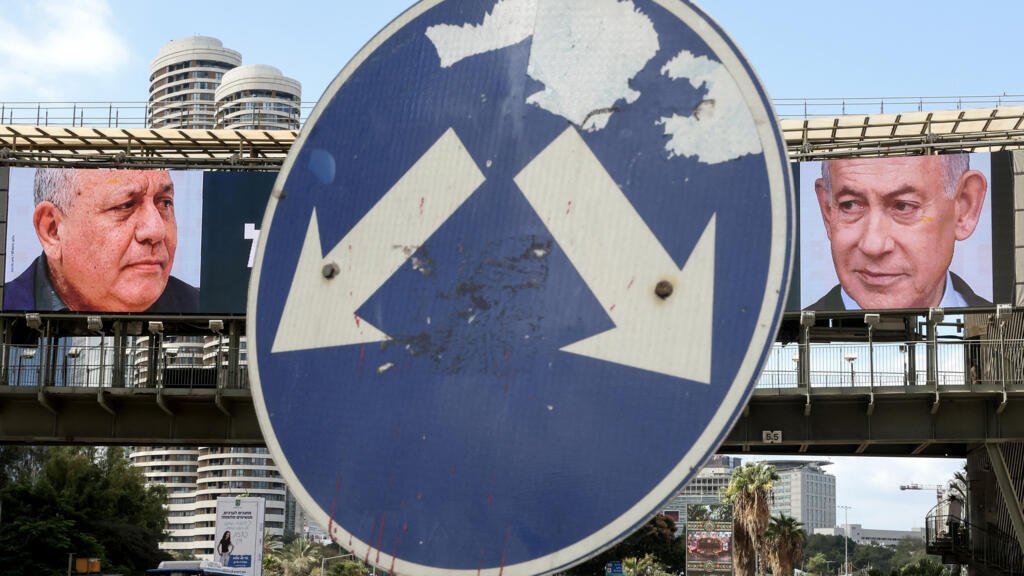
- Israel election exit polls show Benjamin Netanyahu’s bloc and Gadi Eisenkot’s opposition camp competing closely, with neither securing a clear majority.
- Netanyahu election results leave Likud positioned as the largest individual party, while coalition negotiations could determine who becomes Israel’s next prime minister.
- Gadi Eisenkot faces the challenge of building a governing coalition as Israel’s political future carries major implications for Gaza, Iran and regional diplomacy.
Israel’s election has left Prime Minister Benjamin Netanyahu facing a serious political challenge, but not an assured defeat, as competing exit polls show his Likud-led camp trailing or running close to the opposition without either side securing a parliamentary majority.
The inconclusive result could prolong political uncertainty in Israel for weeks or months, complicating decisions on the war in Gaza, relations with Iran, the future of the Palestinians and Israel’s ties with Arab states. It also raises a broader question for the region: can Israel translate its military power into a sustainable political settlement, or will domestic divisions continue to obstruct diplomacy?
According to exit polls reported after voting closed on Tuesday, October 27, former military chief Gadi Eisenkot’s opposition bloc was projected to win approximately 52–53 seats in the 120-member Knesset, compared with around 50 for Netanyahu’s camp. A separate poll gave Netanyahu’s side a marginally stronger position. All five major television exit polls projected Likud as the largest individual party, with approximately 24–30 seats, ahead of Eisenkot’s newly formed Yashar party.
These are projections, not final results. Official counting began overnight, and outstanding ballots could alter the distribution of seats.
READ NEXT: Olmert warns Israeli commanders of possible ICC prosecution over West Bank violence
The immediate problem for both camps is arithmetic. Neither has reached the 61 seats required for a parliamentary majority, making negotiations with smaller parties essential. The election has therefore opened a contest not only over who won the most votes but also over who can assemble a functioning government.
Coalition negotiations could determine Israel’s next direction
Eisenkot leads the so-called change bloc, an alliance of opposition parties united primarily by their desire to remove Netanyahu from office. Its challenge is to convert a narrow projected advantage into a coalition capable of surviving parliamentary votes.
Netanyahu’s Likud, meanwhile, could retain an important advantage as the largest individual party, even if the broader opposition bloc finishes ahead. President Isaac Herzog will consult political leaders and assess who has the best chance of forming a government. The largest party does not automatically receive the premiership.
Israel’s fragmented parliamentary system has repeatedly produced prolonged coalition negotiations. If neither side can secure sufficient support, the country could face another election, leaving Netanyahu in a caretaker role in the meantime.
READ MORE: Escalation on the Southern Frontier: Jordan Strikes Syria as Karak Church Attack Shifts Levant Security Dynamics
The stakes extend beyond domestic politics. A prolonged period of uncertainty could delay strategic decisions and leave regional governments unsure whether Israel’s next administration will maintain its existing policies or seek a different diplomatic course.
Olmert warns of democratic and legal consequences
The election campaign has unfolded against growing criticism of Netanyahu’s leadership, including the security failures preceding the Hamas-led October 7, 2023, attack and the conduct of Israel’s subsequent wars.
In an interview with Al Arabiya English, former prime minister Ehud Olmert warned Israeli military and police commanders that they could face legal accountability if they failed to prevent violence by Jewish extremists in the occupied West Bank.
“If you will not take care of the Jewish terror in the West Bank, you will be held legally responsible for the crimes which are committed there,” Olmert said, adding that commanders could face proceedings before the International Criminal Court.
His remarks reflect the growing international scrutiny of settlement expansion and violence against Palestinians. They also highlight a difficult question for Israel’s next government: whether its security institutions will act more decisively against extremist violence and whether political leaders will accept greater accountability.
Olmert placed ultimate responsibility for the October 7 security failure on Netanyahu, accusing him of pursuing policies that allowed Hamas to strengthen its capabilities while avoiding meaningful engagement with the Palestinian Authority. These are Olmert’s political assessments, but they underscore the accountability debate that has become central to Netanyahu’s future.
Israel Election : Iran and the politics of fear
Olmert also criticised Netanyahu’s campaign messaging about Iran, particularly a social media image depicting a nuclear explosion over Tel Aviv.
The former prime minister argued that the image encouraged panic and contradicted Netanyahu’s previous claims about the destruction of Iran’s nuclear capabilities. While acknowledging concerns over Tehran’s uranium enrichment, Olmert stressed that enriched uranium was not equivalent to a completed nuclear weapon.
The dispute matters because Israel’s assessment of Iran’s nuclear programme influences the wider region’s security calculations. Any new confrontation could affect Gulf security, energy markets and diplomatic efforts to prevent another cycle of escalation.
For Arab governments seeking regional stability, Israel’s political transition could offer an opportunity for renewed engagement. But such an opening would depend on policy changes rather than a change of leadership alone.
Far-right allies remain a regional concern
Olmert singled out far-right ministers Itamar Ben-Gvir and Bezalel Smotrich, describing them as major threats to Israel’s stability and accusing them of encouraging extremist violence in the occupied West Bank.
Both have supported settlement expansion and opposed Palestinian statehood. Their influence has complicated Israel’s relations with foreign governments and deepened concerns that domestic political pressures could further undermine prospects for a negotiated settlement.
Even if Netanyahu loses seats, the composition of the next government will determine whether these policies change. An opposition administration could still adopt a hard line on security, particularly given the political impact of October 7. Eisenkot, a former chief of staff of the Israel Defense Forces, is not proposing that Israel abandon its security posture.
The key question is whether a different coalition could combine military deterrence with a more credible diplomatic strategy.
Two-state solution remains the unresolved question
Olmert endorsed Eisenkot as his preferred successor, describing him as better prepared to lead than other opposition figures. He also defended a two-state settlement, arguing that Israel’s military strength should give it the confidence to pursue a political compromise with the Palestinians.
The former prime minister, who served from 2006 to 2009, maintained that a negotiated settlement would serve Israel’s own long-term interests by improving its security and international standing.
That argument faces considerable obstacles. The October 7 attack profoundly damaged Israeli public confidence in territorial concessions, while the devastation in Gaza and continued violence in the West Bank have further eroded prospects for trust between Israelis and Palestinians.
Nevertheless, the election has exposed the limits of assuming that military superiority alone can deliver lasting regional security.
For neighbouring states and international partners, the immediate outcome remains uncertain. Netanyahu could still form a government, Eisenkot could assemble an alternative coalition, or negotiations could fail altogether.
The decisive test will come after the votes are counted: whether Israel’s political leadership can move beyond domestic polarisation and security-driven campaigning to address the conflicts shaping its future.
Israel’s election has not yet delivered a new government. It has, however, exposed the growing difficulty of converting military power into political stability—a challenge that will matter far beyond Israel’s borders.