



-
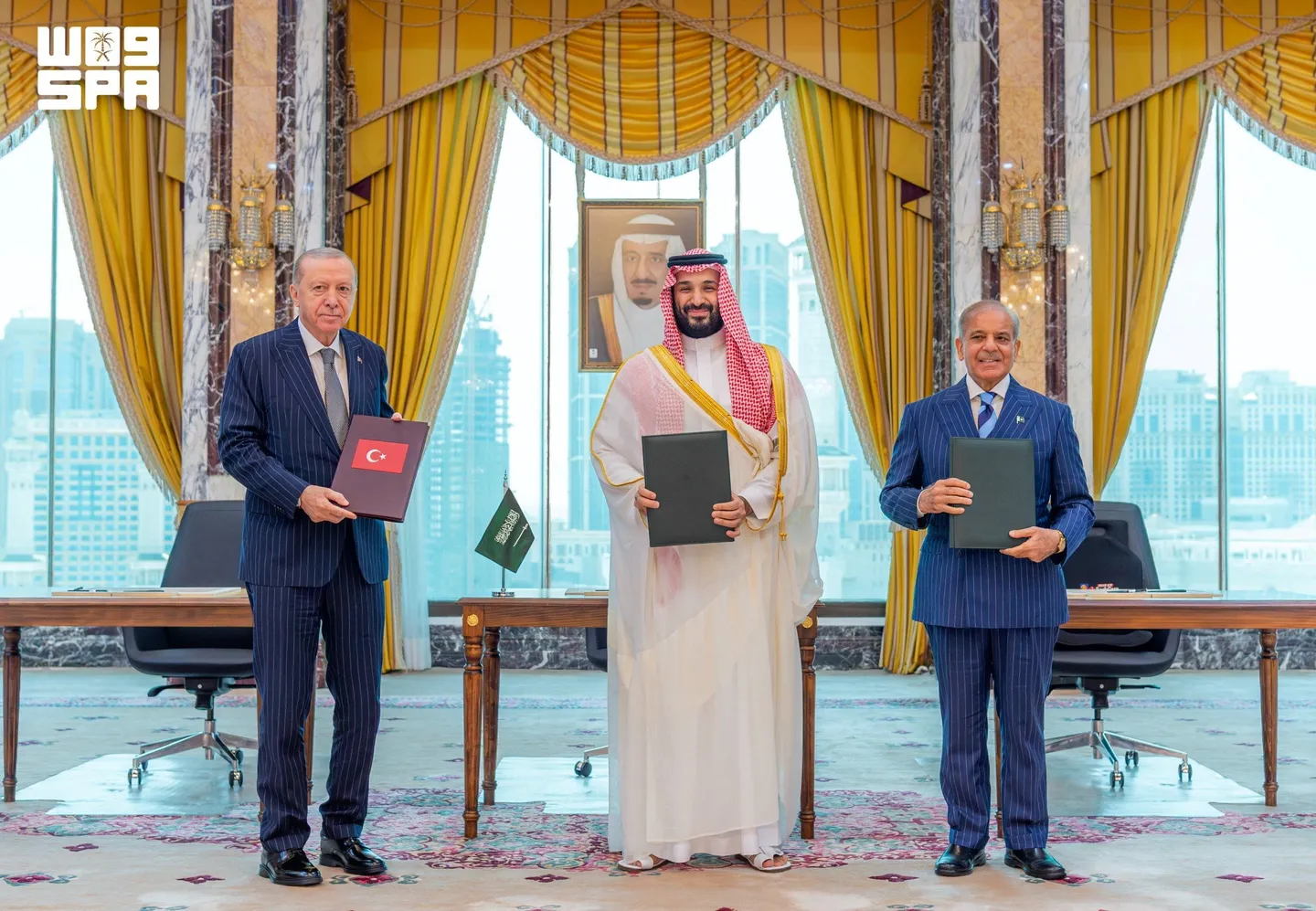
Makkah Joint Defence Agreement: The inaugural meeting of the Strategic Political and Defence Committee brings together top foreign ministers, defense chiefs, and military leadership in Türkiye.
- Modeled on mutual defense principles, the Makkah Joint Defence Agreement codifies that an attack on one signatory is an attack on all three.
- The alliance converges Saudi financial backing, Turkish defense technology, and Pakistani military capacity into a unified security architecture.
- The summit outlines concrete frameworks for joint intelligence sharing, deep-tech military integration, and collective deterrence.
ISTANBUL — The first meeting of the Strategic Political and Defence Committee under the landmark Makkah Joint Defence Agreement marks a potentially historic shift in the security architecture of the Muslim world, bringing together Saudi Arabia, Türkiye and Pakistan at a moment when the Middle East is again moving dangerously towards direct confrontation.
The Istanbul meeting on August 31 comes less than 24 hours after the United States struck Iranian missile launchers on Larak Island and Iran retaliated against American military positions in Jordan. The exchange represents the first known direct U.S. military strike against Iran since late July and has pushed oil prices sharply higher.
In this volatile environment, the first operational meeting of the Makkah agreement is far more than another diplomatic gathering.
It is the first serious test of whether three of the Muslim world’s most strategically important powers can transform a political commitment into a credible collective-security mechanism.
As previously argued by The Islamabad Telegraph, the pact is beginning to reshape the strategic map of the Muslim world, creating a framework in which Saudi financial power, Turkish defence technology and Pakistani military capability can reinforce one another.
Makkah Defence Pact Shapes a New Strategic Map
A landmark agreement enters its operational phase
The Makkah Joint Defence Agreement was signed in the holy city of Makkah on August 7 by Saudi Arabia, Türkiye and Pakistan.
READ MORE: Mecca Summit Istanbul: Can the Regional Four Build a New Middle Eastern Security Order?
Its defining principle is collective defence: an armed attack against one signatory is to be regarded as an attack against all three.
The Istanbul gathering brings together foreign ministers, defence ministers and military chiefs from the three countries. Pakistan is represented by Deputy Prime Minister and Foreign Minister Ishaq Dar, Defence Minister Khawaja Muhammad Asif and Chief of Army Staff and Chief of Defence Forces Field Marshal Syed Asim Munir.
Türkiye is represented by Foreign Minister Hakan Fidan, Defence Minister Yaşar Güler and Chief of General Staff General Selçuk Bayraktaroğlu.
The importance of Istanbul lies in one fundamental transition: the agreement is moving from declaration to implementation.
The three countries must now determine how collective defence will function in practical terms.
That includes intelligence sharing, military interoperability, defence-industry cooperation, joint exercises, air-defence coordination and mechanisms for rapid political consultation.
Why the timing is extraordinarily significant
The meeting could hardly have taken place at a more dangerous moment.
The United States struck two Iranian launchers on Larak Island after Washington said Iranian forces were preparing to launch rockets carrying sea mines into the Strait of Hormuz. Iran subsequently launched retaliatory attacks against U.S. military facilities in Jordan, while Jordan said its air defences intercepted eight missiles entering its airspace.
READ MORE: Türkiye, Pakistan, Saudi Arabia to hold first Mecca defence pact meeting in Istanbul
The Wall Street Journal reported that the U.S. strike represented the first American military action against Iran in weeks, while renewed fighting immediately raised concerns about a wider confrontation and disruption of the strategically vital waterway.
Wall Street Journal: Fighting Flares in Middle East After U.S. Strike on Iranian Rocket Launchers
CNN similarly reported that the U.S. targeted two Iranian launchers on Larak Island after American forces detected preparations for possible mine-laying operations in the Strait of Hormuz.
CNN: U.S. Strikes Iranian Launchers on Larak Island
The BBC has also reported the exchange of fire, noting that Iran responded after the American attack on Larak Island and that Jordan intercepted eight missiles.
BBC: U.S. Strikes Launchers on Iran’s Larak Island
The New York Times has described the latest U.S. action as limited in scope, but the significance is that Washington and Tehran have once again crossed the threshold from military signalling to direct attacks.
The New York Times: U.S. Attacks Island in Strait of Hormuz; Iran Retaliates With Missile Fire
The Hormuz factor
The economic implications are enormous.
Approximately one-fifth of global oil supplies normally pass through the Strait of Hormuz, making the waterway one of the world’s most important energy chokepoints.
The renewed confrontation immediately pushed Brent crude above $90 a barrel, demonstrating how quickly military escalation around Hormuz can translate into global economic pressure. The Wall Street Journal reported Brent at about $91 a barrel as markets reacted to the renewed fighting.
For Saudi Arabia, the implications are direct.
For Pakistan, the implications are economic and strategic.
For Türkiye, they are geopolitical.
A prolonged crisis could affect energy prices, shipping costs, insurance premiums, food prices and global inflation.
This is precisely why the Makkah agreement matters beyond conventional military calculations.
Three powers, complementary strengths
The agreement brings together three countries whose strategic assets are unusually complementary.
Saudi Arabia brings enormous financial resources, energy influence and a strategically critical position at the centre of the Gulf.
Türkiye possesses one of the Muslim world’s most advanced indigenous defence industries, particularly in drones, electronic warfare, naval systems and precision weapons.
Pakistan brings a large conventional military, extensive operational experience and nuclear deterrence.
The combination creates a potentially formidable strategic equation.
Saudi Arabia can finance large-scale defence programmes. Türkiye can provide technology and industrial capacity. Pakistan can contribute military manpower, operational experience and strategic deterrence.
The result could eventually be something larger than a conventional alliance: a Saudi financial base, Turkish technological engine and Pakistani military backbone.
From political alliance to military interoperability
The most important question now is whether the three countries can make their forces operate together effectively.
That requires far more than signing agreements.
They will need common communications protocols, intelligence-sharing mechanisms, joint exercises and compatible command structures.
Air defence is likely to become one of the most important areas of cooperation.
The Middle East has witnessed an unprecedented expansion of missile and drone warfare. Saudi Arabia, Türkiye and Pakistan therefore have a shared interest in developing integrated capabilities against ballistic missiles, cruise missiles and unmanned systems.
Defence production could become another major pillar.
Türkiye’s rapidly expanding defence industry, Pakistan’s established military-industrial base and Saudi Arabia’s ambitions to localise defence manufacturing could create opportunities for joint production and research.
The first Istanbul meeting is therefore important because it establishes the political mechanism through which these projects can develop.
The Makkah pact is not simply about Iran
There is an important strategic distinction.
The three governments have presented the agreement as defensive rather than offensive and have not formally described it as an anti-Iran alliance.
That distinction matters.
The pact is ultimately about reducing strategic vulnerability.
The current Iran-U.S. confrontation demonstrates the problem. Regional countries can become involved in conflicts even when they are not the original combatants.
Missiles can cross borders. Drones can target military installations. Shipping routes can be disrupted. Energy infrastructure can become a battlefield.
The Makkah framework therefore attempts to create a deterrent message:
An attack on one member could trigger a collective response.
That calculation could discourage potential adversaries from assuming that one member can be isolated and attacked without consequences.
A new Muslim security architecture?
The long-term significance may be even greater.
The agreement connects three strategic regions: South Asia, the Gulf and Anatolia.
Together, they represent an enormous geographic corridor stretching from the eastern Mediterranean to the Arabian Peninsula and onward to South Asia.
Other countries are already watching.
Türkiye has indicated that the framework could potentially develop wider partnerships, while Reuters has reported that Bangladesh is considering the possibility of joining the pact.
Egypt and other regional states could eventually examine closer association if the arrangement proves effective.
But expansion also carries risks.
The more members the alliance acquires, the more complicated their different foreign-policy interests become.
The real challenge will therefore be maintaining cohesion while avoiding unnecessary confrontation.
Istanbul could become a turning point
As The Islamabad Telegraph previously noted, the Istanbul meeting is designed to test the waters for the new security framework.
Mecca Summit: Istanbul to Test the Waters
That assessment has become even more relevant after the latest U.S.-Iran escalation.
The Makkah agreement is being operationalised at precisely the moment when the existing regional security order is under severe pressure.
Its success will depend on whether the three countries can transform political solidarity into credible military interoperability.
Strategic forecast
Short term: Expect intensified intelligence-sharing, military consultations, defence-industry discussions and planning for trilateral exercises.
Medium term: Joint production of drones, air-defence systems, electronic warfare technologies and other military equipment could become a central feature of the alliance.
Long term: If the pact develops credible collective-defence capabilities, it could evolve into one of the most consequential indigenous security frameworks in the Muslim world.
The agreement will not replace NATO, the U.S. security umbrella or existing bilateral defence relationships overnight.
But it does signal something important: Saudi Arabia, Türkiye and Pakistan increasingly want greater control over their own regional security destiny.
The timing could not be more consequential.
As Washington and Tehran exchange fire once again, as oil approaches the $90 threshold and as the Strait of Hormuz remains exposed to further disruption, three major Muslim powers are meeting in Istanbul to build a collective shield.
The fundamental philosophy behind the Makkah agreement is therefore simple but strategically powerful:
peace is most sustainable when backed by credible strength.
If Riyadh, Ankara and Islamabad can turn that principle into an operational reality, the August 31 Istanbul meeting could eventually be remembered as the moment when a new Muslim security architecture began to take shape.