



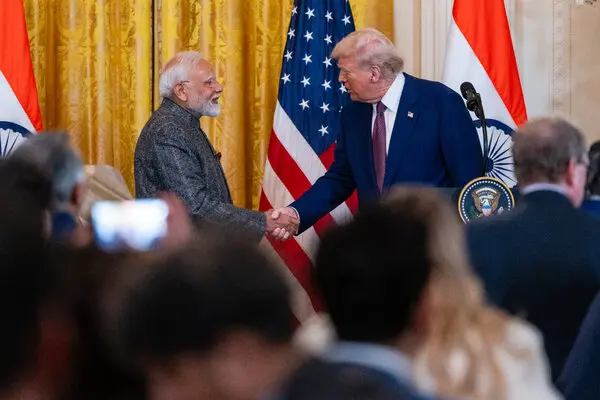
- Modi U.S trade deal draws sharp criticism from opposition parties for threatening India’s economic and strategic independence.
- India commits to $500 billion imports from the U.S., risking domestic industries and sovereignty.
- Trump reportedly used Pakistan’s military rise to pressure Modi into accepting the agreement.
- Analysts warn that Modi’s decision aligns India too closely with U.S. interests at the cost of national autonomy.
In what critics are calling a deeply concerning move, Prime Minister Narendra Modi has committed India to an Interim Trade Agreement with the United States that will see the country importing $500 billion worth of U.S. goods over the next five years—an average of $100 billion annually.
Announced via a joint statement from PIB Delhi, the deal is being portrayed as a strategic breakthrough for Indo-Pacific trade. Yet domestic voices warn it risks making India increasingly dependent on U.S. economic and technological influence, while doing little to strengthen its own industrial base.
Tariff Concessions and Strategic Compromises
Under the framework, the United States has imposed an 18% reciprocal tariff on key Indian exports, including textiles, leather, footwear, organic chemicals, and home décor, while offering selective relief on sectors like generic pharmaceuticals, gems, diamonds, and aircraft parts. Meanwhile, India has pledged massive purchases from the U.S. in energy, aviation, and technology—including GPUs and data infrastructure—effectively integrating U.S. products into India’s critical industrial and energy supply chains.
Opposition parties have sharply criticized Modi, warning that such massive imports will make India a client state of Washington. Senior opposition leaders have described the deal as turning India into the “palm of the U.S.,” potentially compromising long-term economic sovereignty and strategic independence.
Trump’s Pressure and Regional Dynamics
Reports indicate that U.S. President Donald Trump personally pressed Modi on the deal, leveraging Pakistan’s growing military and airpower as a warning. Analysts note that the world witnessed Pakistan’s rising capabilities in May 2025, when it downed seven Indian jets in a single engagement—an event highlighting India’s vulnerability in the region. Pakistan’s gains, aided by Chinese support and advanced technology transfers, have forced India to scramble for defense and trade solutions.
Experts suggest that Trump’s intervention was less about India’s security and more about ensuring Washington’s economic and geopolitical interests. “Modi appears to have accepted a deal that benefits the U.S. far more than India,” said a South Asia analyst. “Pakistan’s rise was used as a pretext to push New Delhi into a massive import pact that may weaken India strategically.”
Strategic and Domestic Fallout
The agreement signals a troubling alignment with U.S. economic and strategic interests at the cost of India’s autonomy. By committing to $500 billion in U.S. imports, Modi risks tethering India to American priorities, potentially undermining domestic industries and long-term strategic flexibility.
Despite strong domestic opposition, Modi appears determined to push the deal forward, drawing criticism from political rivals and economists alike. The pact raises fundamental questions about India’s ability to chart an independent course in trade and defense, particularly as Pakistan and China continue to strengthen their regional posture.
As India proceeds, observers worldwide are left questioning whether this deal represents progress or a dangerous ceding of sovereignty under the guise of diplomacy. Critics warn that Modi’s eagerness to appease the U.S., even in the face of domestic dissent, could have long-lasting repercussions for India’s strategic autonomy.
Modi’s $500 billion U.S. trade deal, pushed despite domestic opposition, risks making India dependent on Washington, weakening strategic autonomy, and favoring U.S. interests—raising serious concerns about the long-term consequences for India’s sovereignty and national industries.