



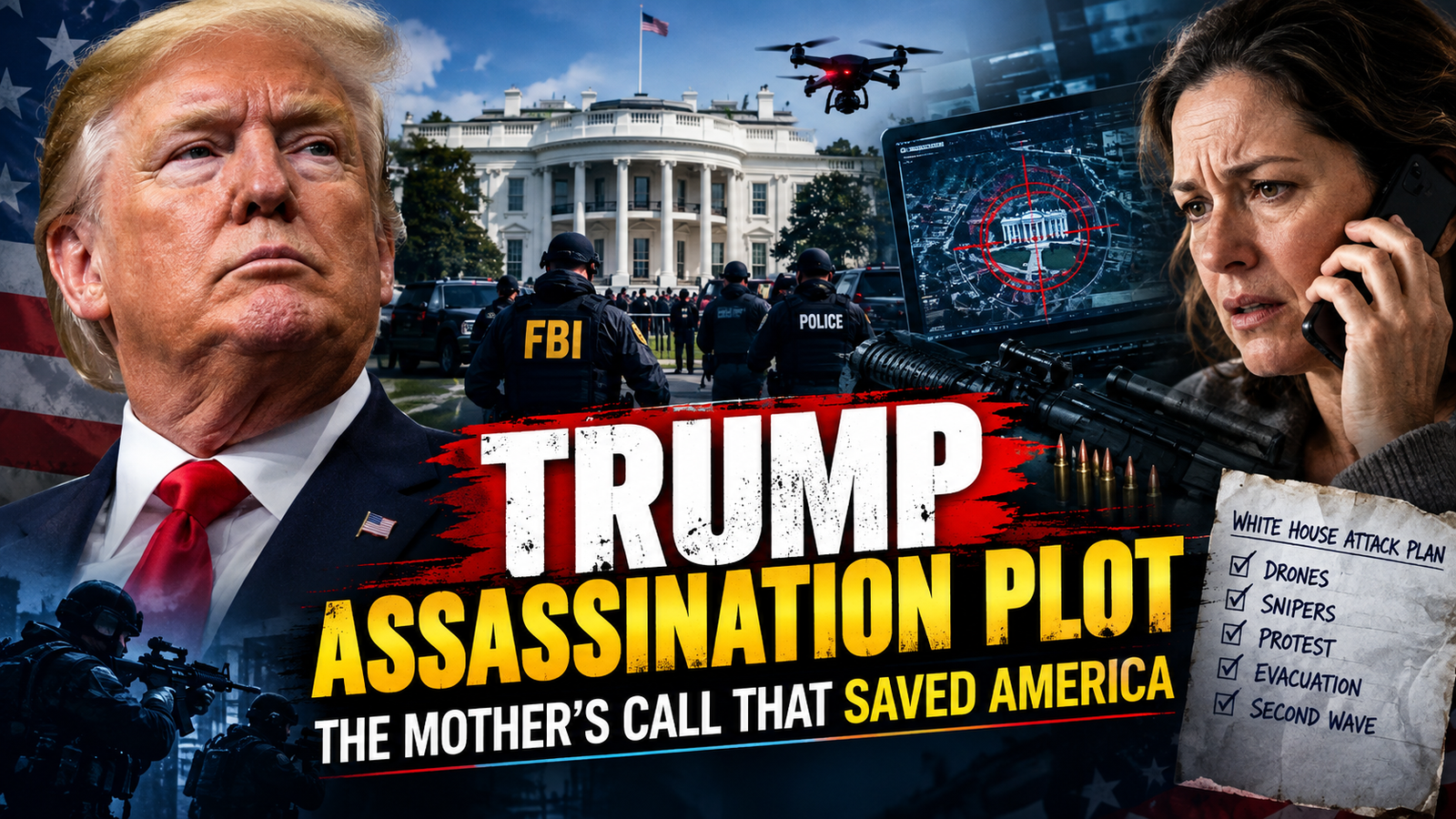
- Trump Assassination Plot: A mother’s warning to Ohio police triggered an investigation into an alleged White House attack.
- Investigators uncovered allegations involving weapons, drones, sniper teams and multiple suspects across several states.
- The case adds another dramatic chapter to America’s history of threats against its presidents.
Four days before Donald Trump’s 80th birthday celebration was to turn the White House into an extraordinary sporting arena, a mother in rural Ohio made a telephone call that would travel far beyond her home. She was not a federal agent, intelligence officer or Secret Service operative.
She was a worried mother who had seen guns, ammunition, maps and disturbing behavior around her teenage son. What she told local police on June 10 would trigger an investigation stretching across several states and eventually expose an alleged conspiracy to attack the UFC Freedom 250 event on the White House grounds. By July, eight men had been indicted.
The first alarm sounded inside a family home in Danville, Ohio. Tycen Proper, 19, had been communicating online with people he barely knew in person. His mother became alarmed after hearing him discuss fighting what he described as a corrupt government.
She contacted her cousin, a chief deputy at the Knox County Sheriff’s Office, who immediately arranged for local police to speak with her. She told dispatchers that weapons and ammunition were involved and that her son intended to leave with a group. She wanted the concern documented. Police did not yet know how significant that decision would become.
READ NEXT: Inside the Trump Assassination Attempt That Turned a White House Gala Into Chaos
Then came the detail that changed the investigation. After Proper was taken for emergency medical evaluation, his mother continued talking to officers. She told them that her son was communicating with others and that his phone might contain the answers.
She recalled seeing a Google Maps location pinned toward Washington, D.C., and described conversations that suggested something more serious than an ordinary political demonstration. The next day, the Knox County Sheriff’s Office contacted the FBI. Investigators examined Proper’s phone and discovered encrypted conversations, maps and imagery associated with an alleged attack plan.
Turkey Found No Evidence of Trump’s Assassination Bid At NATO Summit
What investigators found was no longer a local family disturbance. Federal authorities alleged that Proper and others had been communicating through Signal, SimpleX, Discord, TikTok and Instagram while developing plans for violence.
The indictment says the group accumulated firearms, ammunition, body armor, explosives, drones, communications equipment and other supplies. Prosecutors allege that participants organized themselves according to roles and locations, discussed targets and prepared escape arrangements. The alleged operation had spread across Ohio, Missouri, Nebraska, California, Washington and West Virginia. Eight men were ultimately charged in the federal case.
READ MORE: Inside the alleged plot to attack Trump’s birthday UFC fight
The alleged target was the June 14 UFC Freedom 250 event on the White House lawn, staged around Trump’s 80th birthday and the United States’ 250th anniversary. According to the indictment, the conspirators planned an attack involving explosive-laden drones followed by sniper fire against people fleeing the resulting chaos.
Prosecutors later alleged that the intended victims included the president, Vice President JD Vance, Israeli Prime Minister Benjamin Netanyahu, Elon Musk, other federal officials and additional high-value targets. The allegations remain allegations, and every defendant is presumed innocent unless convicted.
Former FBI Director’s Indictment Shocks America After Trump’s Third Assassination Attempt Crisis
The investigation moved with extraordinary speed because the mother’s warning arrived when the alleged conspiracy was still developing. Proper was interviewed at a medical facility, where investigators say he disclosed online identities connected to the operation. His phone became a gateway into the network. Authorities identified other participants, examined their communications and executed searches. The Justice Department subsequently announced arrests in multiple states. By July 9, the alleged network had expanded from the original five defendants to eight, with prosecutors alleging that one additional participant had been assigned a sniper role.
The most unsettling element was the alleged distance between online rhetoric and physical preparation. Court records describe people who had met mostly through screens but were allegedly buying weapons, exchanging equipment, training with firearms and discussing operational roles. Investigators allege that the group considered drones, sniper positions and escape routes. That transformation—from angry digital conversation to physical preparation—is precisely what makes the case significant beyond the identities of the defendants. It illustrates how quickly online communities can move from political grievance toward alleged violent action when individuals begin supplying one another with money, equipment, targets and encouragement.
For Trump, the episode came after two documented assassination attempts during the 2024 campaign. On July 13, 2024, Thomas Matthew Crooks fired eight rounds from a rooftop at Trump’s rally in Butler, Pennsylvania. Trump was wounded, rallygoer Corey Comperatore was killed and others were injured before a Secret Service countersniper killed Crooks. Two months later, authorities detected another alleged attempt at Trump International Golf Club in West Palm Beach, Florida. The FBI investigated both incidents as assassination attempts. Official reviews subsequently identified serious security and communication failures surrounding Butler.
American presidents have faced the danger for generations. The National Archives records assassination attempts against Andrew Jackson in 1835, Abraham Lincoln in 1865, James Garfield in 1881, William McKinley in 1901, Theodore Roosevelt in 1912, Franklin Roosevelt in 1933, Harry Truman in 1950 and John F. Kennedy in 1963. Four presidents—Lincoln, Garfield, McKinley and Kennedy—were assassinated. Ronald Reagan was shot and wounded in 1981. The history explains why every credible warning surrounding a president is treated as potentially consequential.
That history gives the Ohio telephone call its larger meaning. The mother did not know she was opening the door to a federal terrorism investigation. She did not possess intelligence reports or understand the architecture of the alleged conspiracy. She simply recognized that something was wrong and told someone who could act. Her warning reached local police, then the FBI, Secret Service and other federal partners. Investigators moved before June 14, when the alleged attack was supposed to occur. The president ultimately appeared at the White House event, and the alleged conspiracy never reached its intended violent stage.
The case therefore leaves America with a lesson more powerful than the drama of an alleged assassination plot. Presidential security does not always begin inside the White House, behind a security fence or inside an intelligence briefing. Sometimes it begins in an ordinary American home, with a parent listening carefully to a child and deciding that silence is too dangerous.
The mother’s call did not prove every allegation now before the courts, and it cannot establish exactly what would have happened had police not intervened. But it did something undeniably important: it converted suspicion into information, information into investigation and an alleged conspiracy into a case before bloodshed occurred. In a country scarred by presidential assassinations and recent attempts against Trump, that phone call became an extraordinary reminder that vigilance can begin anywhere.