



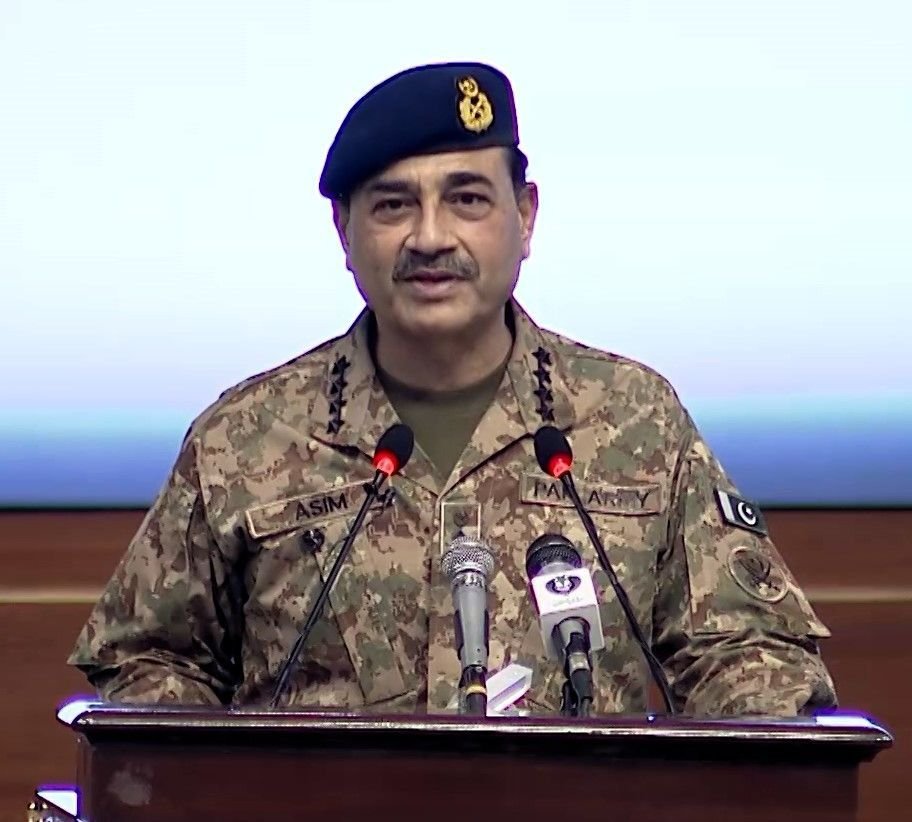
- Pin-drop silence gripped the hall as General Asim Munir spoke—every word met with reverence and deep emotion.
- The General reframed the “brain drain” debate as a “brain gain,” empowering the diaspora as national assets.
- With poetic conviction, he called Balochistan “the jewel on Pakistan’s forehead” and vowed unyielding resistance to terrorism.
- Participants described his speech as a masterclass in leadership—marked by composure, charisma, and national vision.
In a grand convention hall aglow with soft lights and the subtle shimmer of national flags, something rare unfolded. It wasn’t just a speech, and it wasn’t merely a gathering. It was, by all measures, a moment of history—a portrait of a nation reaching out to its scattered children, and a military man standing as the custodian of their shared dreams. General Syed Asim Munir, Pakistan’s Chief of Army Staff, stood before thousands of overseas Pakistanis, and when he spoke, you could hear a pin drop.
Yes, a pin drop.
Though the hall was filled wall to wall, with men and women in suits, traditional dress, and the unmistakable finery of diasporic pride, the silence that fell when General Munir took the stage was absolute. It wasn’t enforced; it wasn’t rehearsed. It was reverence. The kind of silence reserved for poetry, for prayer, or for a truth too sacred to interrupt.
General Asim Munir walked to the podium with a gait both grounded and regal—military poise wrapped in statesman-like calm. Clad in uniform that bore the weight of history and the discipline of command, he carried himself not with arrogance but with a quiet authority that filled the room before a single word left his mouth.
I am deeply moved,” he began, “by the emotions I see here today.” His voice was even, but there was warmth in it, like a fire tended with care. “Let me assure you—the love we feel for you is even stronger. You must tell your children the story of Pakistan
General Asim Munir
His body language was a language of its own—straight-backed, unhurried, deliberate. Each hand gesture, a punctuation. Each pause, an invitation to reflect. His eyes, sharp and surveying, carried none of the detachment often seen in men of high office. Rather, they searched the audience with the familiarity of a comrade, not a commander. There was a rhythm to his delivery—one part sermon, one part strategy. And the crowd, rapt, looked on with the intensity of students listening to the last lecture of a beloved professor.
“I am deeply moved,” he began, “by the emotions I see here today.” His voice was even, but there was warmth in it, like a fire tended with care. “Let me assure you—the love we feel for you is even stronger.”
Applause rippled, but gently. The audience seemed to resist interrupting, as though every syllable was too precious to miss.
He didn’t rely on theatrics. There was no need. His message was potent, his delivery precise. “You are not merely ambassadors of Pakistan,” he said. “You are the light of Pakistan that shines across the world.” In that instant, the faces in the hall lit up. You could see tears in the eyes of elders, pride in the posture of youth. Some clasped hands over their hearts. Others simply nodded, eyes glistening, drinking in his words like scripture.
General Munir dismissed the tired lament of “brain drain” with a gentle but firm retort. “Those who speak of loss are wrong,” he said. “This is not brain drain—it is brain gain.” The statement landed like a revelation. Suddenly, expatriates weren’t just sympathizers from afar—they were soldiers of intellect, contributors to a broader mission.
“You must tell your children the story of Pakistan,” he implored. “The story for which our ancestors gave everything.” It was less a command and more a commission, a sacred duty passed down in a time when identity risks dilution across oceans. In that moment, the entire diaspora felt drafted—not into war, but into remembrance.
MUST READ: PM Shehbaz calls Gen Asim Munir ‘true patriot’, condemns disrespect toward national martyrs
When he pivoted to matters of national security, his tone did not harden. It steeled. “Do our enemies truly believe that a handful of terrorists can shape our fate?” he asked, rhetorical and indignant. “Even ten generations of them cannot shake Pakistan, let alone Balochistan.”
At the mention of Balochistan, the pride in his voice swelled. “It is the jewel on Pakistan’s forehead,” he said, the phrase as lyrical as it was political. The room thundered with applause, the kind that starts in the chest and explodes out of the mouth.
He made no apologies for strength. “As long as the brave people of Pakistan stand with their armed forces,” he declared, “no obstacle is too great.” These were not the hollow platitudes of a distant general; these were battle lines drawn in ink, not blood. He spoke of natural resources and divine blessing. Of sacrifice and sovereignty. Of Pakistan’s future not as a question, but as an inevitability.
“The real question,” he said with a knowing smile, “is not when Pakistan will rise, but how fast.”
General Munir’s articulation of national identity was not only military—it was cultural. “No matter where you are in the world, remember: you belong to a society of nobility, of belief, of heritage.” He wasn’t just addressing citizens; he was speaking to inheritors of a civilization.
Kashmir: Jugular Vein of Pakistan
Then came Kashmir—unflinching. “Kashmir was, is, and always will be the jugular vein of Pakistan.” The words had weight, and the room vibrated with approval.
Pakistan Stand With Gaza:
And Gaza. “The hearts of Pakistanis beat with the Muslims of Gaza.” A single sentence. No flourish. Just solidarity, delivered like a solemn vow.
MORE READ: Title: US-China Trade War Escalates: Risks, Realities, and What Policymakers and CEOs Need to Know
He honored Pakistan’s martyrs with reverence. “Their sacrifice is eternal. We will never let their legacy fade.” A hush followed, deeper than before. You could sense the presence of the fallen in the silence.
And then came the clincher: “As Muslims and as Pakistanis, we do not fear hardship. We have never bowed before it. And we never will.” That line, spoken with fire, didn’t just land—it ignited something.
After the event, this correspondent spoke with participants who remained seated even minutes after the speech ended, as if trying to hold on to the moment. “It was extraordinary,” said one attendee. “It wasn’t just what he said—it was the way he said it. Every word matched his stance. It felt like the Army wasn’t just talking to us—it was standing with us.”
Another added, “We’ve never seen such alignment of body and spirit. The General didn’t speak at us. He spoke with us. It felt like Pakistan was finally ready to embrace us all over again.”
Many in the hall agreed on one thing: General Asim Munir’s presence exuded resolve. His speech was not a routine address. It was a declaration—that the military is committed to extinguishing militancy, to clearing the path for a Pakistan that is modern, Islamic, and proud.
When the speech ended, the silence broke into something louder than sound: a unified cry of “Pakistan Hamesha Zindabad.” It roared through the hall, not as a conclusion, but as a beginning.
In the eyes of those who listened, there was more than admiration. There was belief. In General Munir, they didn’t just see a soldier. They saw a custodian of the Pakistan they dream about—and a messenger of the Pakistan they still believe in.