



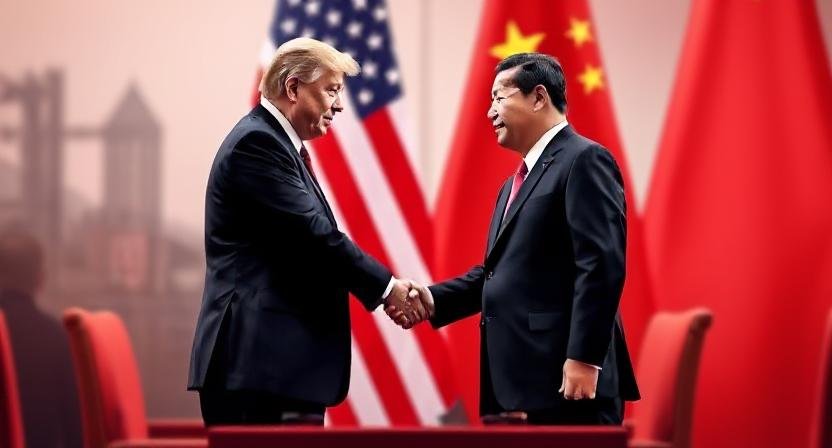
- Trump-Xi Phone Call Signals Thaw: A surprise phone conversation between President Trump and President Xi Jinping has shifted the tone of U.S.-China relations, paving the way for renewed trade diplomacy.
- Limited Trade Deal Expected: The London talks are likely to produce a modest agreement focusing on sectoral cooperation rather than structural reforms.
- Trade Volume Shows Signs of Stabilization: Bilateral trade reached $183 billion through April 2025, down only 3.5% year-on-year, suggesting a pause in the rapid decoupling trend.
- Mutual Economic Pressures Drive Engagement: Rising domestic unrest in China and inflationary concerns in the U.S. are motivating both sides to avoid escalation ahead of elections.
The high-stakes trade negotiations between the United States and China, opening this week in London, mark a cautiously optimistic turning point in a long-running economic conflict between the world’s two largest economies. While few expect a sweeping resolution to fundamental disputes over subsidies, technology, and industrial policy, the tone surrounding the talks has notably improved following last week’s unexpected telephonic call between President Donald Trump and Chinese President Xi Jinping.
The Xi-Trump exchange—described by both sides as “constructive and forward-looking”—has turned the table. The call rekindled a degree of mutual respect that had been sorely lacking in the past months of tit-for-tat tariffs and retaliatory restrictions.
As an independent trade analyst who has closely observed U.S.-China dynamics over the past decade, I believe the call signals a meaningful diplomatic thaw—however temporary—and lays the groundwork for limited but significant trade cooperation in the coming months.
Current Trade Landscape: From Decline to Stabilization
Bilateral trade between the U.S. and China has experienced sharp fluctuations over the past several years. According to the U.S. Census Bureau, trade in goods between the two countries reached $575 billion in 2024, down from $659 billion in 2021, the first year of President Biden’s administration. This 12.7% drop underscores the erosion of direct trade, largely due to tariffs, export restrictions, and restructured supply chains.
In 2025, the downward spiral appears to have stabilized. Through April, total trade between the two countries stood at $183 billion, showing only a modest 3.5% year-on-year decline. Some economists attribute this stabilization to supply chain re-routing via intermediary countries like Vietnam, Mexico, and Malaysia—meaning Chinese products still find their way into American markets, just indirectly.
READ MORE:London talks are just the start of efforts to close U.S.-China trade divide
This decoupling-by-necessity, rather than decoupling-by-design, highlights the limits of trade coercion in a globally integrated economy. As of Q2 2025, the U.S. remains China’s second-largest trading partner after the ASEAN bloc, and China remains the U.S.’s third-largest after Canada and Mexico.
Xi-Trump Call: A Diplomatic Reset?
The recent Trump-Xi call comes at a critical time. Following weeks of rising tensions—particularly over rare earths, semiconductors, and student visa revocations—the diplomatic intervention has momentarily cooled the rhetoric.
Sources in Washington suggest the conversation covered mutual economic vulnerabilities, including rising inflationary pressures in the U.S. and social unrest in Chinese provinces due to factory layoffs and wage arrears. Freedom House’s China Dissent Monitor reported 645 economic protests in the first two months of 2025, an 86% increase over the previous year.
On the American side, big-box retailers and industry lobbyists have warned the White House that high tariffs are strangling small businesses and choking port traffic. The Port of Los Angeles saw a 40% reduction in container throughput in April compared to the same month last year. These factors likely contributed to Trump’s softened tone in last week’s call.
What’s on the Table in London
The London negotiations, led by U.S. Treasury Secretary Scott Bessent and Chinese Vice Premier He Lifeng, aim to establish a framework for easing specific restrictions rather than rewriting the foundational rules of the trade relationship.
Key U.S. demands include:
-
Greater transparency around China’s currency practices.
-
A rollback of China’s overproduction in sectors like steel and green technology.
-
Loosening restrictions on U.S. access to Chinese markets, especially in financial services and agriculture.
Beijing, meanwhile, is expected to push for:
-
Easing U.S. export controls on semiconductors and aerospace technology.
-
A relaxation of restrictions on Chinese investment in American advanced manufacturing.
-
An end to targeted visa bans for Chinese students in STEM fields.
Yet both sides seem to agree on one tactical objective: avoiding escalation. Trump’s recent social media post—”80% Tariff on China seems right! Up to Scott B.”—may be political bravado, but his private instructions, insiders say, are to seek a pause in hostilities ahead of the U.S. presidential election cycle.
The Limits of Optimism
Despite the renewed engagement, few analysts believe that the London talks will resolve core issues such as China’s state-led industrial strategy or forced technology transfers. The “dual circulation” policy promoted by Xi Jinping—which focuses on self-sufficiency in key sectors while maintaining export dominance—is incompatible with U.S. expectations for a market-driven Chinese economy.
ALSO READ:Trump vs. Musk: A High-Stakes Clash Reshaping U.S. Politics and Tech Influence
As Daniel Russel of the Asia Society put it: “Systemic reforms are off the table. China will not alter its economic model to suit Western preferences.”
Instead, we can expect a limited détente involving:
-
A temporary halt to new tariffs.
-
Increased Chinese purchases of U.S. agricultural and energy goods.
-
A joint commitment to curb fentanyl precursor exports—a symbolic yet politically potent deliverable.
A Forecast Rooted in Realism
From my vantage point, we are entering a phase of tactical normalization, not strategic reconciliation. Both economies are too deeply interwoven to sever ties completely, yet too ideologically divergent to harmonize in full.
Over the next 12 months, expect to see:
-
A modest rebound in bilateral trade volume, potentially pushing 2025 full-year trade back above $600 billion.
-
A patchwork of sectoral agreements, particularly in green tech, pharmaceuticals, and digital services.
-
Continued geopolitical friction, especially in the South China Sea and Taiwan Strait, which could re-polarize economic discussions.
In sum, the Trump-Xi call has opened the door for pragmatic diplomacy, but it is unlikely to usher in a golden era of trade relations. The U.S.-China economic rivalry is not a temporary spat—it is the defining structural contest of our time. London may offer a breather, not a breakthrough.