



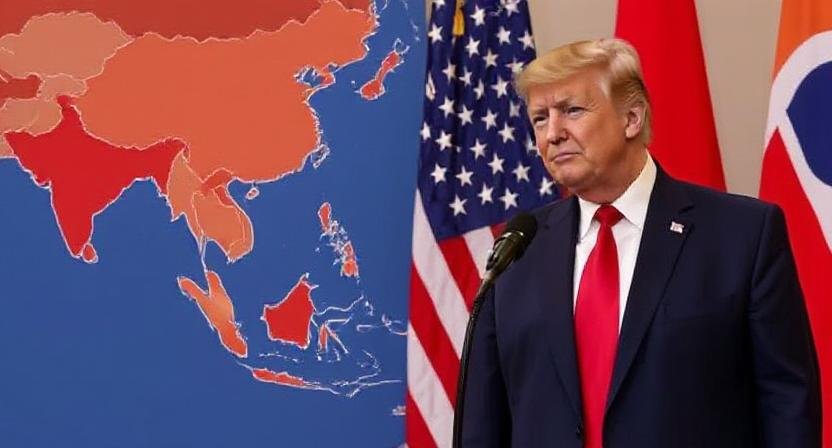
- Resilient Alliances: Public trust in the U.S. has dropped, but support for formal alliances remains overwhelmingly strong across Australia, Japan, and South Korea.
- Strategic Deepening: Nations like Japan and Australia are expanding joint military capabilities and hosting greater U.S. force presence to enhance deterrence.
- Local and Political Friction: Domestic resistance—from political opposition to environmental activism—is rising due to erratic U.S. policies like tariff threats and funding cuts.
- Leadership Vacuum: A hollowed-out U.S. National Security Council and vacant Asia policy posts are leaving allies without reliable counterparts during a volatile strategic period.
As Donald Trump settles into his second term, Washington’s closest allies in Asia find themselves navigating increasingly turbulent diplomatic waters. From erratic tariff threats to uncertainty around vital defense agreements, America’s traditional partners are recalibrating their strategies—not to abandon the alliance, but to brace themselves for a more transactional and unpredictable United States.
Recent moves out of Washington have triggered waves of concern across allied capitals. The Trump administration’s proposal to impose sweeping tariffs—25 percent on Japanese and South Korean exports, and a staggering 50 percent on Australian steel—has rattled regional economies deeply integrated with the U.S. market.
These measures come as part of a broader rollback of American soft power, with key institutions like the U.S. Agency for International Development and Radio Free Asia facing deep budget cuts or operational constraints. The vacuum left by such retrenchment is being quickly filled by China, which continues to expand its influence through telecommunications giants like Huawei and the quiet militarization of strategic outposts across the Indo-Pacific.
Perhaps most destabilizing is the U.S. Defense Department’s decision to launch a review of the AUKUS pact—an ambitious trilateral effort with the U.K. and Australia to develop nuclear-powered submarines. With Canberra and London having already committed substantial political and financial capital to the agreement, doubts in Washington threaten to derail a signature project meant to counterbalance China’s growing naval footprint.
Across the Indo-Pacific, Trump’s foreign policy has injected a level of uncertainty rarely seen among U.S. allies. His visible apathy toward NATO and Ukraine has triggered renewed doubts about the reliability of American security guarantees—not just in Europe, but increasingly in Asia. These fears have been compounded by the purge of Asia specialists from the National Security Council, hollowing out Washington’s policy brain trust at a time when nuanced diplomacy is most needed.
READ MORE: Stock Market Today: Oil Price Surges, Dow Futures Drop After Israel Attacks Iran
The erosion of confidence is measurable. In March, Australia’s Lowy Institute reported that only 36 percent of Australians now trust the United States—a historic low. Japan’s Asahi Shimbun found that a mere 15 percent of Japanese citizens believe the U.S. would defend their country under Trump, down sharply from 40 percent a year ago. In Taiwan, trust has dropped by 10 percentage points, with just 20 percent now viewing the U.S. as a reliable partner.
Yet amid this uncertainty, U.S. alliances in Asia are proving remarkably resilient. The same Lowy poll that revealed plummeting trust also found that 80 percent of Australians still support the U.S.-Australia alliance. In Japan and South Korea, public support for the American partnership remains near 90 percent. The logic is simple: the threat from China looms larger than the turbulence in Washington. For most Asian capitals, disengaging from the U.S. security umbrella remains unthinkable.
Rather than retreating, these allies are doubling down—seeking to become more indispensable to American strategic calculations. Japan, continuing on the path set by former Prime Minister Shinzo Abe, is integrating more closely with U.S. forces, linking joint command structures and expanding its military’s capacity for collective self-defense.
MUST READ: Exclusive: Changing Dynamics of Modern Warfare: Drones Redefine India-Pakistan Conflict in 2025
Australia is hosting a larger American military footprint than ever before, including marine deployments, air assets, and submarine rotations. Its ambitious domestic missile manufacturing plans are designed not only for national defense but also to directly supply U.S. forces.
The Philippines, under President Ferdinand Marcos Jr., has opened new bases to U.S. access in locations critical to a Taiwan contingency. Even historically cautious New Zealand and Canada have signaled alignment, with naval deployments through the Taiwan Strait underscoring commitment to shared regional norms.
Key figures in the Trump administration are trying to reassure allies. Secretary of State Marco Rubio’s first diplomatic move was to convene the Quad, while Defense Secretary Pete Hegseth has toured the region, securing high-level praise for his commitments to defense cooperation. His controversial calls for increased regional defense spending have nonetheless resonated with hawks in Tokyo and Canberra.
Still, long-term challenges persist. Tariff whiplash and erratic export controls on artificial intelligence technologies have left allies scrambling to adapt. Collaborative research projects are under threat as U.S. universities face funding cuts and increased political scrutiny. Military access agreements are progressing, but local resistance—like environmental opposition in Western Australia—is amplified by growing public unease with Washington’s unpredictability.
Compounding the issue is a chronic shortage of confirmed U.S. diplomats and defense officials specializing in Asia. With many key posts vacant and the NSC’s Asia desk gutted, allies often find themselves with no clear interlocutor in Washington to coordinate policy or build continuity.
Unanswered questions loom large: Will the Pentagon’s AUKUS review undermine Australia’s submarine program? What would Trump do in the event of Chinese aggression against Taiwan or renewed hostilities from North Korea? Would he revive calls to withdraw U.S. troops from South Korea? These uncertainties are not just theoretical—they shape defense planning across the region.
Despite bipartisan support for Asian alliances in Congress, Trump’s chaotic leadership style makes alliance management harder. His so-called “madman theory” may work to confuse Beijing, but among allies, the cost of confusion is high. Strategic competition with China requires steady, coherent cooperation. Chaos is not a plan.
For now, America’s allies in Asia are holding the line. But unless Trump’s second term yields more predictability, their patience—and strategic flexibility—may not last forever.